Story code: ST-000925
Part 2: The Passenger
I stared at the pale knuckles pressing against the glass, my lungs seized tight enough to crack a rib. The heavy rain distorted her face, but the sharp, accusatory angle of Sarah’s jaw was unmistakable even through the water and the dark window tint. She knocked again, louder this time, the metal casing of her audio recorder clacking sharply against the reinforced safety glass.
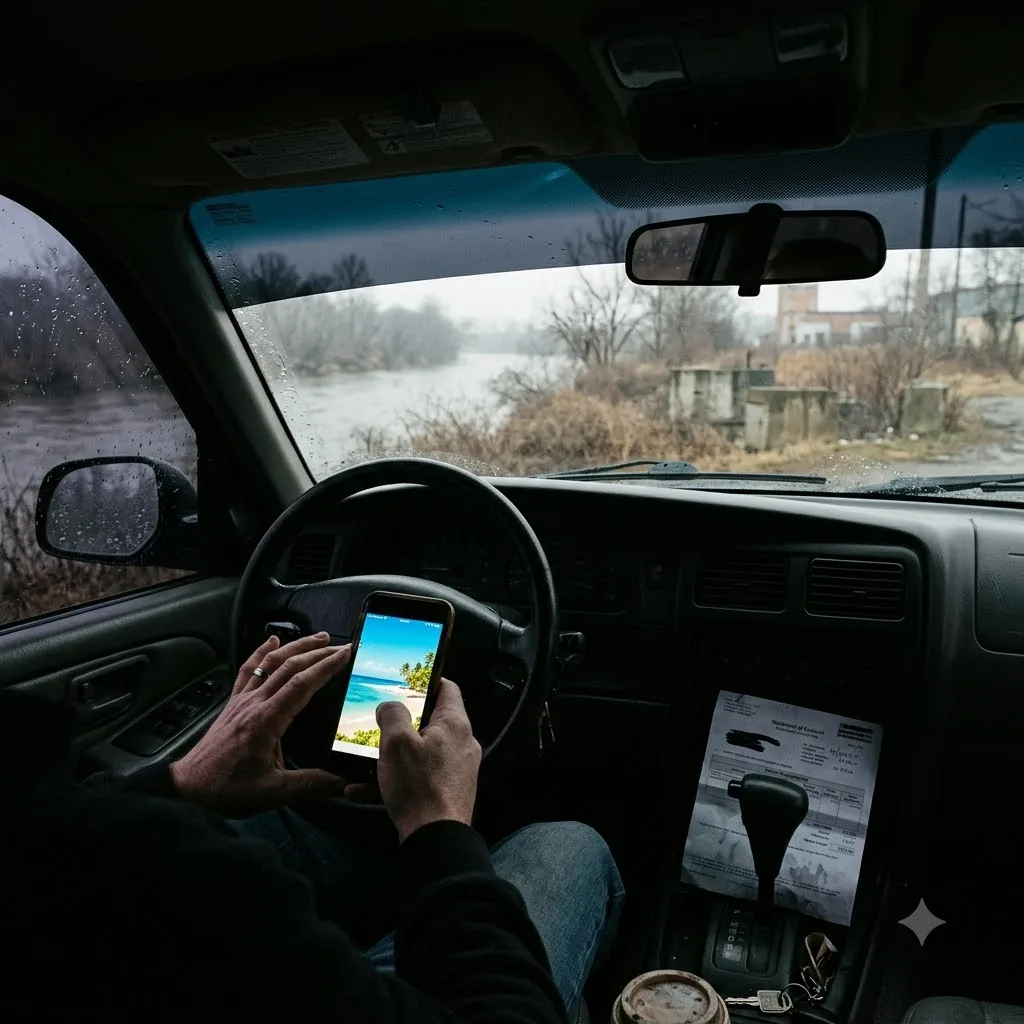
My eyes darted to the passenger footwell where my phone lay glowing, then to the folded medical invoice sitting on the center console. I snatched the red-stamped bill and shoved it deep into the pocket of my blazer, my fingers trembling so violently I tore the edge of the thick paper. If Sarah saw that, she would have leverage. I couldn’t afford to give her any more ammunition than she already possessed.
Taking a shallow, jagged breath, I pressed the button to lower the window just two inches.
Instantly, the heavy, climate-controlled sanctuary of the SUV was invaded by the violent sounds of the containment zone-the roar of portable generators, the shouts of the hazmat crews, and the driving rain. Worse was the smell. It rolled in through the narrow gap, a sickening blend of rotting fish and caustic chemicals that coated my tongue in copper.
“You always did like the expensive seats, Maya,” Sarah said, her voice cutting through the mechanical noise outside. Rain dripped from the hood of her dark windbreaker, running down her cheeks. She held up the digital recorder, the red recording indicator light glowing like a tiny, accusing eye. “Unlock the door. Or I start asking the guys in the yellow suits over there why their Geiger counters are chirping, and I make sure to mention your name as my source.”
“Are you out of your mind?” I hissed, glancing nervously in the side mirror. A pair of security guards in neon vests were patrolling the perimeter fence about fifty yards behind me, their flashlights cutting wide arcs through the downpour. “You are trespassing in a federally cordoned exclusion zone. They will arrest you, Sarah.”
“Let them,” she challenged, not moving an inch. “My editor already has the EPA raw data you tried to bury. If I don’t check in within the hour, it goes live on the front page of the digital edition, along with a nice little exposé on how the regional PR director-that’s you, roomie-personally scrubbed the heavy metal toxicity reports. I have the IP logs showing exactly who accessed the server, Maya. I have you.”
My stomach plummeted into a cold, bottomless void. She didn’t just have the leak; she had the digital trail pointing directly to my laptop. If she published that, I wouldn’t just be fired. I would be federally indicted for tampering with environmental data. My severance would vanish. The company would use me as the sole scapegoat to protect the executives, and my mother would be out of Silver Pines before the end of the week, abandoned to a system that had already almost killed her twice.
“Get in,” I said, my voice dangerously hollow. I hit the central unlock button.
Sarah opened the passenger door and slid into the leather seat, bringing the cold, toxic dampness of the night in with her. She didn’t bother taking down her hood. She just angled the audio recorder toward my face.
“I need you on the record,” she demanded, skipping any semblance of a reunion. “I need you to confirm that the pipeline pressure anomaly is a localized ecological death sentence, and I need the internal emails from the seventh floor ordering the cover-up. Give me the emails, Maya, and I’ll leave your name out of the article. You can be the anonymous whistleblower.”
I gripped the leather steering wheel, my mind racing through a dozen catastrophic calculations. She didn’t actually have the emails. She had the EPA data and the server access logs, but she lacked the smoking gun proving intent from the executives. She was bluffing, trying to squeeze the final piece of the puzzle out of me.
Before I could formulate a lie convincing enough to stall her, the heavy two-way radio mounted beneath my dashboard erupted in a burst of harsh static.
“All perimeter units, this is Command. We have an unauthorized device pinging off the local cell tower, matching a known media MAC address. Someone’s trying to upload a file from inside the zone. Initiate a hard sweep of Sector Four. Check all vehicles. Nobody leaves, nobody moves until we find the transmitter.”
Sector Four. That was exactly where my SUV was parked.
In the side mirror, the two security guards stopped walking. Their flashlights immediately pivoted, the bright beams sweeping through the rain and locking onto the reflective taillights of my vehicle. They started jogging toward us, one of them pulling a heavy radio to his mouth.
Sarah looked at the radio, then out the window at the approaching guards, a flicker of genuine panic finally breaking through her hardened journalistic armor. “Maya…”
“They find you in here with that data, and we both go to federal prison for corporate espionage,” I lied, my voice tight and urgent. The company would absolutely destroy her, but they would destroy me first.
I slammed the gear shift into drive.
“What are you doing?” Sarah gasped as the heavy SUV lurched forward, tires spinning in the mud before catching traction.
“I’m saving both our lives,” I snapped, turning the wheel sharply away from the staging area and the hotel. Instead, I drove us past the secondary security checkpoint, accelerating directly toward the flashing red lights of the inner containment zone-the exact epicenter of the toxic spill.
If I was going to strip Sarah of that audio recorder and wipe her phone before she destroyed my mother’s only lifeline, I couldn’t do it where the guards could see us. I had to take her into the deep water.