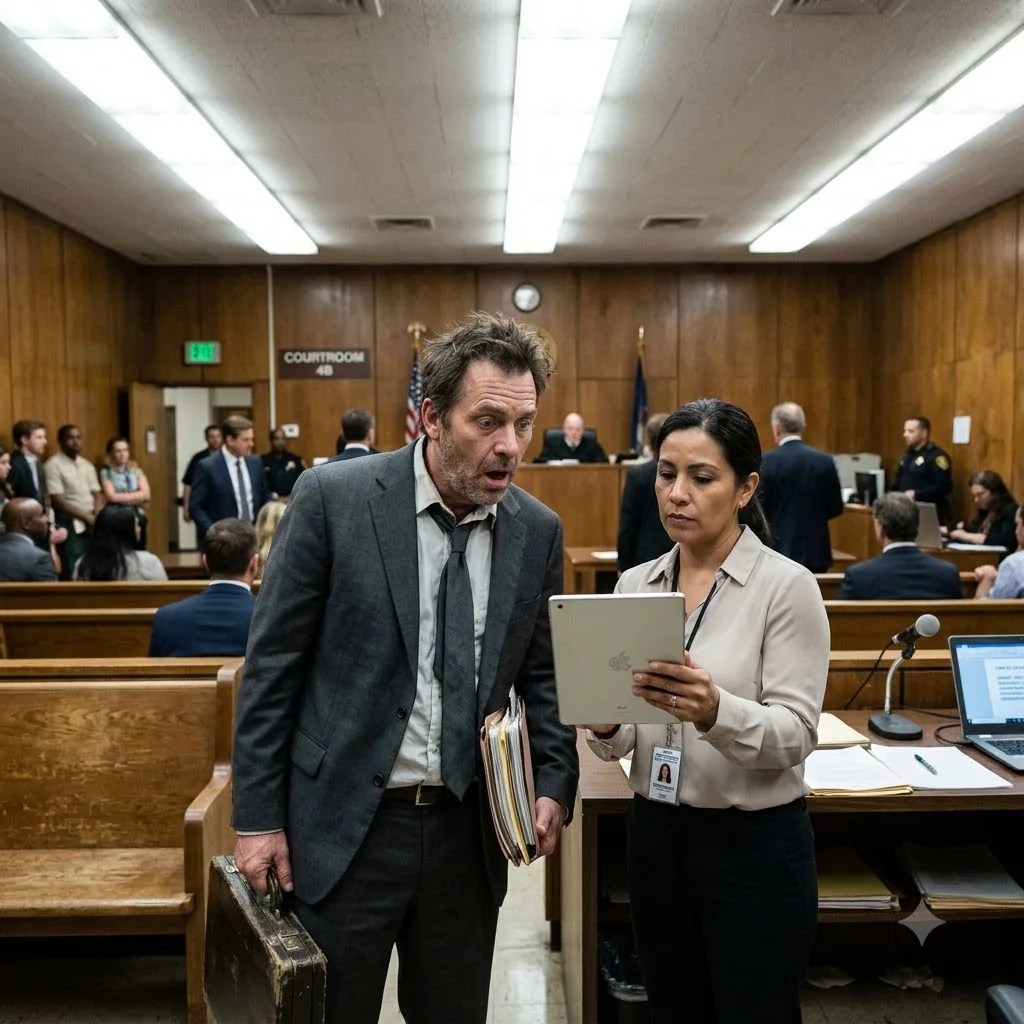
Story code: ST-001048
Part 3: The Inventory
The thick stack of legal papers sat on the kitchen island like an unexploded bomb. Marcus stared at the Vanguard Corrections logo watermarked on the front page, the apartment suffocatingly quiet in David’s wake. The reality of the trap tightened around his chest. His name was on the press release. His SSH key was on the commits. If he went to the authorities, he was a disgruntled co-founder confessing to a cybercrime he appeared to have engineered himself.
Then he heard the heavy, metallic clunk of the hallway fire door swinging shut.
David was taking the stairs. The building’s ancient elevator had been out of service since Tuesday. Marcus moved before he made a conscious decision to do so. He left the contracts on the granite counter, threw open his front door, and sprinted down the hallway. He slammed his shoulder into the heavy steel fire door, bursting into the concrete stairwell. The air smelled of stale cigarette smoke and institutional paint.
“David!” Marcus shouted, his voice cracking like a whip down the vertical shaft.
Two flights below, the sharp squeak of expensive leather shoes against concrete echoed as David froze. Marcus took the stairs three at a time, his hand gripping the wobbly iron railing as he swung himself around the landings. He caught up to his partner on the third-floor landing. David was backed against the cinderblock wall, struggling to balance his cardboard moving box. Resting flat on top of a stack of mechanical keyboards was David’s iPad Pro, the screen dark.
“You think you can just drop a contract on my counter and walk away?” Marcus demanded, his chest heaving as he blocked the path to the next flight of stairs.
“I’m giving you an out, Marc,” David said, his voice tight. He adjusted his grip on the box, his knuckles white. “I protected you. You’re insulated. Just sign the board resolution and take the money.”
“Show me the code,” Marcus said, stepping closer. “If you used my credentials, I want to see exactly what I supposedly wrote.”
“It’s company property now. You’re locked out for a reason.”
Marcus didn’t argue. He lunged forward and snatched the iPad off the top of the box. David shouted in protest, dropping the box to the concrete floor with a harsh clatter, keyboards and tangled cables spilling across the landing. Marcus ignored him. He gripped the edges of the tablet and shoved the dark screen directly into David’s face.
The tablet’s camera scanned David’s panicked features. The tiny padlock icon at the top of the screen shook, turned green, and clicked open.
“Hey! Give that back!” David yelled, reaching for the device.
Marcus shoved David backward by the shoulder, putting the space of the landing between them. He swiped up on the screen. David was a chaotic developer who never closed his applications. The GitHub mobile app was still running in the background, suspended right where David had left it: on the main `core-logic` repository branch.
Marcus’s thumb flew across the glass, navigating past the UI assets and database schemas straight to `risk_assessment.py`. He opened the commit history, searching for the commits logged under his own stolen SSH key from the previous night.
He pulled up the exact Git diff. The screen split into red and green lines of code, showing what had been deleted and what had been added to the calculation engine.
Marcus scanned the logic, his legal training and coding knowledge colliding in real time. He expected to see a flattened bell curve, or maybe a lowered baseline threshold that would capture more people in the net. Instead, what he saw made his blood run cold.
He looked at the variables evaluating a defendant’s community ties.
`if defendant.dependents > 0:`
In Marcus’s original code, the next line was a subtraction modifier, lowering the flight risk score because people with children rarely fled the state.
In the green text of the new commit, the math was reversed.
`flight_risk_score += (defendant.dependents * 25)`
Marcus blinked, his mind struggling to process the syntax. He scrolled frantically to the next function block.
`if defendant.months_at_residence >= 36:`
`flight_risk_score += 40`
`if defendant.employment_status == ‘FULL_TIME’:`
`flight_risk_score += 30`
“What is this?” Marcus whispered, the glow of the screen illuminating his horrified face in the dim stairwell.
“It’s the optimization rubric,” David said defensively, rubbing his shoulder where Marcus had shoved him. “Vanguard’s data science team provided the backend targets. We just mapped the frontend variables to hit their required metrics.”
“You didn’t lower the threshold,” Marcus said, his voice trembling as he looked up from the tablet. “You inverted the parameters. You penalized them.”
“Vanguard needs a guaranteed volume of remands, Marc. We had to ensure the algorithm flagged enough people to meet their county bed quotas.”
“No,” Marcus snapped, his mind flashing to Leo in Courtroom 302-a terrified nineteen-year-old with a steady job, a local address, and a family who loved him. “If you just wanted volume, you’d lower the threshold for everyone. But you didn’t touch the `danger_to_community` flags. You left the violent offenders alone. You specifically targeted the `flight_risk` variables.”
Marcus stared at the green lines of code, the sheer, calculating evil of the math settling into his bones.
State prisons took the violent offenders, the people deemed a danger to the public. But those remanded solely as “flight risks” for non-violent crimes were almost exclusively routed to minimum-security county holding facilities. The exact facilities Vanguard owned and operated.
“Vanguard gets paid a flat per-diem rate by the state for every body in their beds,” Marcus said, his voice dropping to a hollow rasp. “But violent inmates are expensive. They cause property damage. They start fights. They require maximum security staffing and heavy medical liabilities.”
David looked away, his jaw tightening as he stared at the scattered keyboards on the concrete floor.
“They want docile inventory,” Marcus breathed out, the realization paralyzing him. “They want teenagers who stole car batteries. They want single fathers who won’t start a riot because they just want to see their kids again. You didn’t just build a pipeline to fill their cells, David. You designed an algorithm to systematically kidnap the safest, most stable citizens in the county, because they make the most profitable prisoners.”
The stairwell was dead silent, save for the hum of the fluorescent lights. Marcus waited for his partner to claim ignorance, to cite machine learning anomalies, or to offer any kind of desperate tech-bro rationalization.
David just stood there in the harsh overhead light, looking at the concrete, and offered no defense at all.