Story code: ST-000122
Part 3: The Analog Truth
The polished mahogany table in the Capitol’s legislative annex reflected the bright, sterile glare of the overhead projector. At the head of the room, Caldwell stood before the state oversight committee, his tailored gray suit immaculate under the recessed lighting. He clicked a small remote, and the projector displayed a massive, ascending green graph line.
“As you can see, Chairwoman Hayes,” Caldwell said, his voice projecting smooth, practiced confidence, “the smart-docket initiative is a monumental success. In just four days, we have cleared forty percent of the state’s parole backlog. The algorithm operates flawlessly, removing human error and emotional bias from the equation. We are streamlining the justice system exactly as the governor requested.”
Arthur sat near the end of the long table, a standard-issue tablet resting blankly in front of him. Beneath the table, his hand gripped the handle of his battered leather briefcase. The thick leather was stretched tight, bulging with the weight of what he had spent the last three sleepless nights gathering from the facility’s basement archives.
Chairwoman Hayes adjusted her glasses, studying the green graph. She turned her attention down the table. “Officer Arthur, you are our senior hearing officer on the ground. Does the daily reality match these analytics? The board wants to ensure this transition is as seamless as Mr. Caldwell claims.”
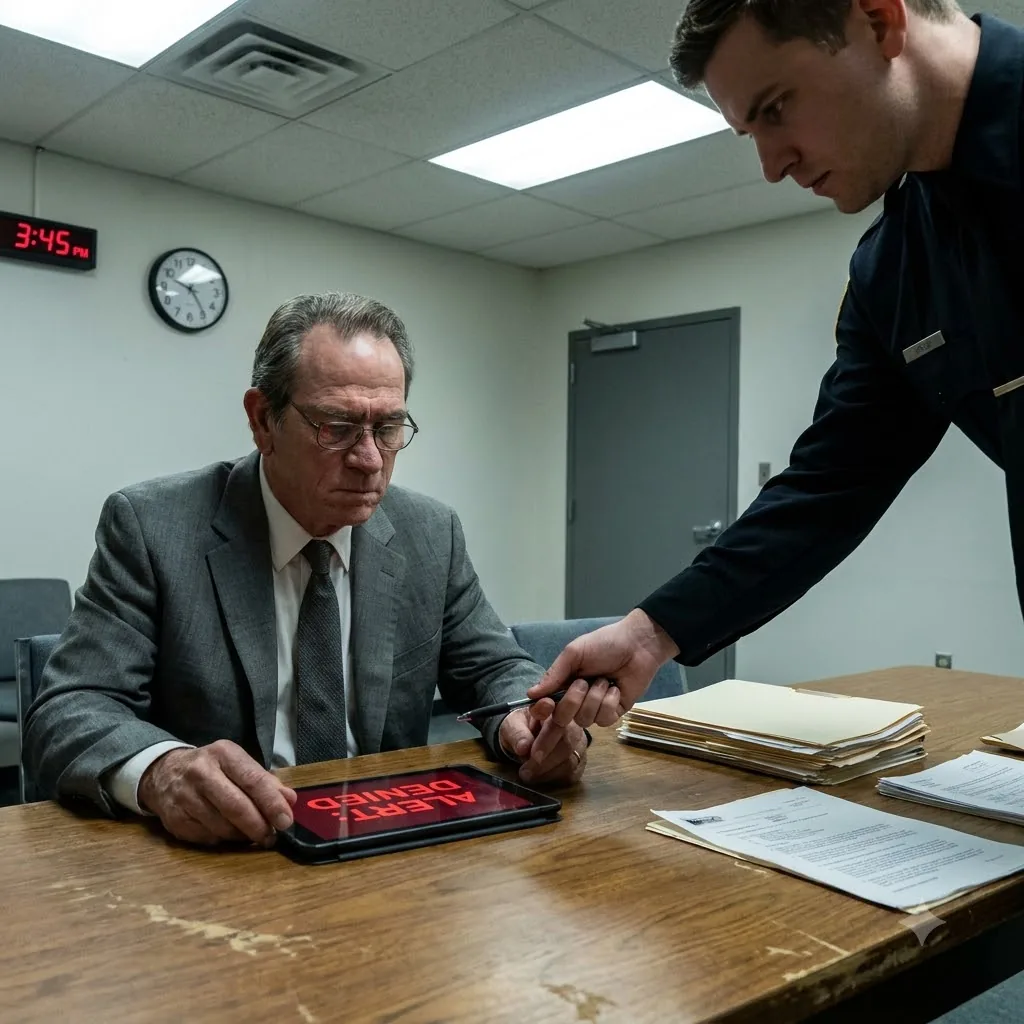
Caldwell turned to Arthur, offering a tight, expectant smile. The look in his eyes was identical to the moment he had ripped the silver fountain pen from Arthur’s hand-a silent, absolute demand for compliance.
Arthur did not smile back. He reached down, hauled the heavy briefcase into his lap, and flicked the brass latches open. The metallic clack echoed sharply in the quiet room.
Arthur stood up. He reached into the leather bag and pulled out a massive, two-foot-thick stack of pale blue override forms and yellow manila folders. With a heavy heave, Arthur dumped the raw analog behavioral files directly onto the center of the polished mahogany table. The violent thud of the paper striking the wood made two committee members physically jump in their seats. Dust motes kicked up into the beam of the projector.
“No, Chairwoman,” Arthur said, his voice flat and steady. “It doesn’t match at all.”
Caldwell stepped away from the projector, his perfect posture stiffening. “Arthur, this is a scheduled analytical review. Whatever archaic paperwork you brought is highly unauthorized.”
Arthur ignored him. He grabbed the top handful of manila folders and slid them aggressively down the long table. The heavy files fanned out in front of the committee members.
“Those are the raw analog behavioral files for the last hundred hearings at our facility,” Arthur said, tapping the remaining stack. “Look at the blue sheets inside. Look at Elias Thorne. Master carpenter, flawless twelve-year disciplinary record. Look at Maria Diaz. Advanced plumbing certification, lead maintenance worker for five years. Look at Marcus Vance. Electrical engineer, trains rescue dogs in the yard. Every single one of them was flagged by the smart-docket with a ninety-nine percent risk of violent recidivism. Every single one of them was auto-denied.”
Chairwoman Hayes picked up Diaz’s file, her brow furrowing as she dragged her finger across the immaculate, handwritten behavioral logs. “This makes no sense. The algorithm is flagging these model inmates as maximum-security threats? Is the software glitching?”
“It isn’t a glitch,” Arthur said, reaching into his briefcase one last time. He pulled out a stapled packet of spreadsheets and tossed it next to the analog files. “The system isn’t broken. It is working exactly as it was designed. I accessed the legacy database and pulled the facility’s operational mandates.”
Caldwell stepped quickly toward the table, his face draining of color. “Chairwoman, I must insist we suspend this meeting. Officer Arthur has illegally bypassed security protocols to access restricted metadata-”
“Sit down, Caldwell,” Hayes snapped, not looking up from the spreadsheets. She looked at Arthur. “Explain this.”
“The state mandated a thirty-percent overall release rate to clear the parole backlog,” Arthur said, his voice carrying clearly across the silent room. “But the penitentiary charter also mandates a minimum bed occupancy of eighty-five percent to retain its federal operational funding. Furthermore, the facility relies entirely on internal inmate labor to keep its maintenance costs at zero. If we parole the model inmates-the electricians, the plumbers, the carpenters-we lose our free labor force, and our bed count drops below the funding threshold.”
Arthur walked slowly down the side of the table, pointing at the analog records in the committee members’ hands. “The algorithm is mathematically engineered to weigh facility bed thresholds against release rates. It features a line of code that specifically targets inmates with advanced vocational skills. It flags them as ‘Retain.’ It purposely slaps them with a false, maximum-security risk score so they can never leave.”
Arthur reached into the middle of the table and grabbed a thin, red-tabbed folder. He dropped it directly in front of Chairwoman Hayes.
“To hit your mandated release quotas without dropping the bed threshold,” Arthur continued, the anger finally bleeding into his tone, “the software approves the exact opposite. Look at the red file. Hollis. Three violent assaults on guards this year. Documented contraband smuggler. Zero vocational skills. The smart-docket cleared him for immediate release with a forty-two percent risk score. Along with eighty other violent offenders just like him.”
Hayes stared at the red file, her hands trembling slightly as she read Hollis’s brutal assault history, followed by the bright green ‘Approved’ stamp from the new tablet system. She slowly raised her head, her eyes locking onto Caldwell.
Caldwell lunged forward, his manicured hands grasping at the scattered blue and yellow papers on the table. “These documents are outdated. You cannot trust analog data over a state-sanctioned neural network. The algorithm sees variables we cannot-”
Chairwoman Hayes slammed her hand down hard over Elias Thorne’s analog file, trapping it against the mahogany before Caldwell could pull it away. She didn’t blink. She just stared at Caldwell.
“Caldwell,” Hayes said, her voice dropping to a harsh, dangerous whisper. “What is this?”
Caldwell opened his mouth, his throat working convulsively. His eyes darted from the undeniable ink of the legacy files to the massive green graph still projected cheerfully on the wall behind him, but the smooth, practiced rhetoric completely failed to materialize.