Story code: ST-001058
Part 2: The Threat Protocol
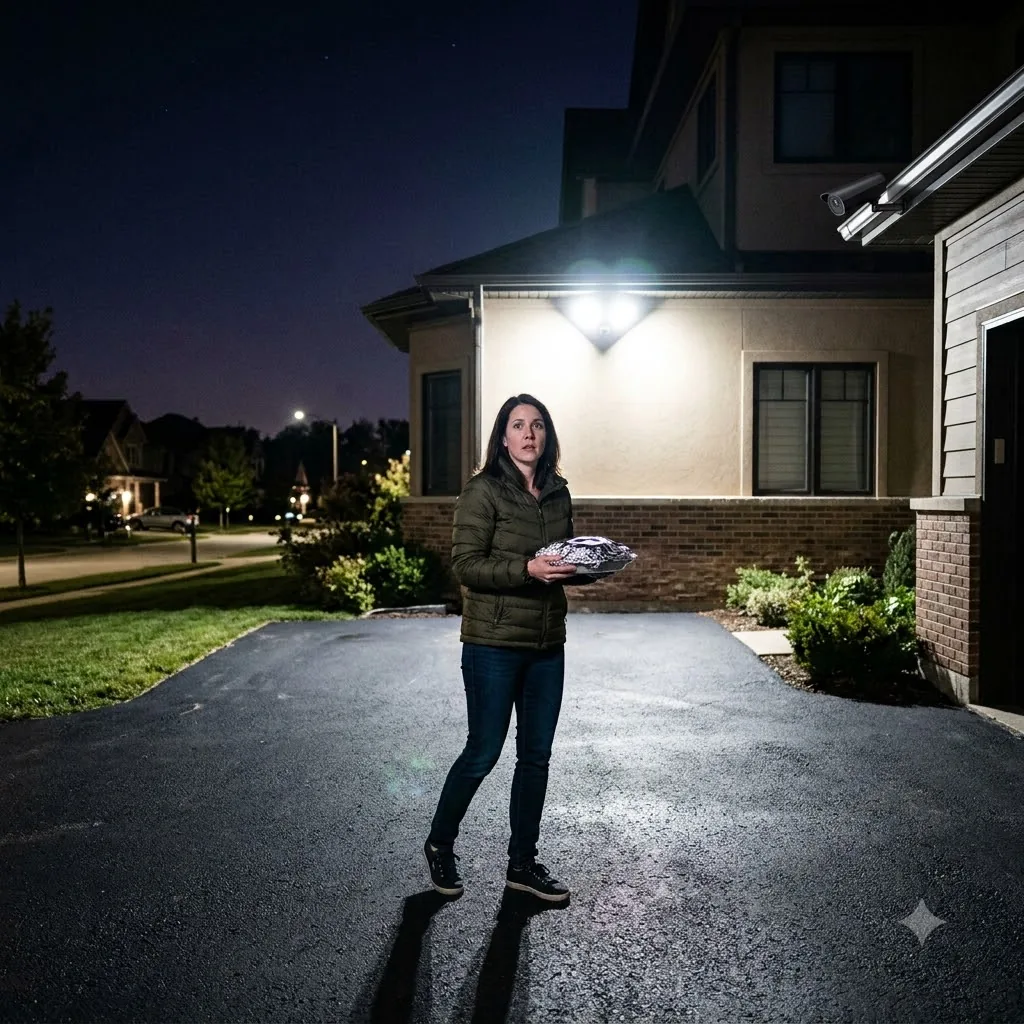
Sarah jerked backward with frantic, uncoordinated force. Her heel caught on the lip of the concrete expansion joint, nearly sending her sprawling backward into the manicured landscaping. She slapped a hand over her face, dragging the canvas brim of her hat down so hard the stiff fabric scraped the bridge of her nose.
“Whoa, hey!” Mark dropped his outstretched hand, taking a startled step back. The foil-wrapped plate of zucchini bread tipped, nearly sliding out of his grip. “Are you alright?”
“Bug,” Sarah gasped out, bending deeply at the waist and burying the lower half of her face into the thick wool of her oversized sweater collar. She forced a harsh, racking cough, squeezing her eyes shut against the punishing glare of the motion-activated floodlights. “Swallowed a gnat. I am so sorry.”
“Oh, man. I hate when that happens.” Mark chuckled, the sound rich and easy, completely devoid of the sheer panic currently shredding Sarah’s nerves. “Take your time. Deep breaths.”
She stayed bent over, staring at the stark gray concrete between the toes of her sneakers. Above them, the motorized camera dome whirred, adjusting its internal focus to account for her sudden change in posture. It was zooming in. She could feel the mechanical scrutiny like a physical, suffocating weight pressing down on the back of her neck.
He is out there. The thought slammed into her with the force of a physical blow. The man who had spent three years twisting restraining orders into weapons, using public records requests to track her movements, and leveraging court mandates to force mediation sessions just so he could sit in a sterile room and smile at her across a table. He was a master of the justice system, a man who utilized every legal and technological loophole to ensure she never truly escaped his orbit. He had a lucrative background in data aggregation. He didn’t need to hire private investigators; he scraped regional security networks, property records, and open-source intelligence databases right from his living room. If a high-resolution, time-stamped photo of her face hit a cloud server attached to this specific suburban address, he would know exactly where she slept. He would be parked at the end of the cul-de-sac by tomorrow morning, armed with yet another frivolous lawsuit to force her back into a courtroom.
“There we go,” Mark said. The tablet in his hand emitted a sharp, double-toned beep. “System is getting a little impatient with us.”
Sarah risked a glance upward, keeping her chin tucked firmly against her collarbone. “Impatient?”
“It is a localized threat-assessment protocol,” Mark explained, his eyes fixed on the glowing screen. The harsh blue light from the tablet illuminated his relaxed, confident features. “Since you have been on my property for more than three minutes without biometric verification, the software flags this as an unresolved anomaly. We have about sixty seconds to log your profile before it automatically escalates.”
“Escalates how?” she asked, her voice vibrating with a terrifying, absolute clarity.
Mark smiled, clearly proud of his expensive investment. “It pushes a ‘Suspicious Person’ alert to the community app. It blasts the live video feed to everyone within a five-mile radius and auto-forwards the incident report to the county sheriff’s department database for cross-referencing. It is the ultimate deterrent for package thieves and prowlers.”
Sarah stopped breathing entirely. The chill of the evening air vanished, replaced by a suffocating, metallic heat radiating from her own rising panic. The sheer absurdity of the trap made her dizzy. She had specifically chosen this older, quiet neighborhood because it lacked a formal Homeowners Association, hoping to avoid exactly this kind of hyper-surveilled environment. She hadn’t counted on a tech-obsessed new arrival deciding to unilaterally upgrade the block’s security apparatus.
She was completely boxed in. If she turned and sprinted back to her house, the system would instantly broadcast her face-albeit shadowed and blurry-to thousands of local smartphones. It would create a permanent digital record of a suspicious woman running from a driveway, practically begging for amateur online sleuths to enhance the image and share it across social media. If she stayed and let him take the picture, her identity would be instantly digitized, categorized, and uploaded to the Panopticon-X servers, laying out a bright digital breadcrumb trail her abuser would find in a heartbeat.
“Mark,” Sarah said, fighting to keep her voice steady, forcing herself to sound like a mildly inconvenienced neighbor rather than a woman fighting for her life. “I really do not like having my picture taken. Privacy concerns. I am sure you understand. Can you just turn the system off?”
Mark let out a booming, incredulous laugh. “Turn it off? You cannot turn off a cloud-native security net! That defeats the entire purpose of an always-on perimeter. Do not worry about privacy, the data is encrypted on the backend.”
“Please. Just cancel the alert.”
“I literally cannot cancel an active threat countdown without an administrative override,” Mark said, his tone shifting from aggressively friendly to mildly patronizing. “Look, it is not a big deal. The system just needs to see you aren’t a threat. It is for the safety of the whole block.”
The tablet began to emit a low, rhythmic pulse. The countdown had entered its final phase. Fifty seconds.
“Is there a manual override?” Sarah demanded, taking a desperate half-step toward the dark edge of the lawn. The camera above the garage swiveled instantly, keeping her dead center in its frame.
“Well, yeah,” Mark said, tapping a sub-menu on the screen. “I can bypass the facial scan if I input a verified credential. But I need your full legal name, and it requires a two-factor authentication. I put in your cell phone number, and it texts you a secure link to verify your device’s location matches my driveway.”
Sarah’s heart plummeted. Her phone was sitting on her kitchen counter, intentionally left behind because she never carried a GPS-enabled device outside her home unless absolutely necessary. Even if she had it, giving this corporate database her private, unlisted phone number was just as dangerous as giving it her face.
The rhythmic pulsing from the tablet accelerated, the digital pitch climbing higher. Thirty seconds.
“I do not have my phone on me,” Sarah said, backing up another inch. “I left it inside.”
Mark sighed, a sound of heavy, suburban exasperation. He adjusted his grip on the zucchini bread and raised the tablet higher, aiming the rear-facing camera directly at her. The blue light of the screen reflected in his eyes.
“Then we have to do the biometric scan. I am sorry, but I am not letting my new system blast a false alarm to the entire neighborhood and the police on my first week here,” Mark said, his voice hardening with stubborn resolve. “It is just a picture. Stand still and look at the lens.”
The tablet beeped rapidly. Fifteen seconds. Mark stepped directly into her path, cutting off her escape route to the sidewalk, and pushed the camera toward her face.