Story code: ST-001135
Part 4: The Walkout
The silence in the artisan café was absolute, save for the rhythmic hiss of the espresso machine. Harlan kept his hands planted on the edge of the reclaimed wood table, holding Vance in his gaze. The wealthy doctor’s eyes darted frantically between the damning dispatch logs and the horrified faces of the other patrons. The carefully constructed illusion of the benevolent weekender had shattered, leaving only the reality of a man who used hired guns to terrorize his neighbors.
Vance swallowed hard, his Adam’s apple bobbing above his cashmere scarf. Instead of answering Harlan, he looked past him and gave a sharp, frantic nod toward the back of the café.
Heavy footsteps immediately thumped against the polished concrete floor. From a corner table near the restrooms, two men in dark, tailored overcoats rose and closed the distance. Harlan recognized the man in the lead from the descriptions in the police reports. He was built like a cinderblock, with cold, flat eyes and a tactical earpiece coiled down his neck.
“Thorne,” Vance said, his voice regaining a thin, reedy edge of authority. “Remove him from the premises.”
“You’re trespassing,” Thorne said, his voice a low, gravelly bark.
Before Harlan could turn fully, Thorne’s massive hand clamped onto his shoulder. The grip was entirely disproportionate, digging painfully into Harlan’s collarbone. The second man grabbed Harlan’s other arm, twisting his wrist backward at a sharp, unnatural angle. Harlan didn’t throw a punch-he knew exactly how that would play to the county sheriffs-but he didn’t make it easy for them, either. He planted his boots, forcing the two mercenaries to drag his dead weight across the café floor.
“Look at this!” Harlan called out over the struggle, his voice booming through the small room as Thorne shoved him violently toward the exit. “This is your wellness corridor! This is what he brings to our town!”
Thorne slammed a forearm into Harlan’s back, driving the breath from his lungs. The heavy glass door of the café swung open, the brass bell ringing wildly. Thorne and his partner threw Harlan out onto the slick sidewalk. Harlan stumbled, his boots slipping on the freezing rain, and he went down hard on one knee in the icy slush. The dispatch logs fluttered down around him, the pages instantly soaking in the puddles.
Thorne stood in the doorway, blocking the exit with his sheer bulk, his hand resting menacingly near his waistline. “Don’t come back in,” Thorne warned, before letting the heavy glass door swing shut.
Harlan slowly pushed himself up from the wet pavement. His knee ached, and his canvas jacket was soaked through with freezing water, but he kept his eyes locked on the floor-to-ceiling windows of the café.
Inside, Dr. Elias Vance was desperately trying to salvage the situation. Harlan watched through the glass as Vance forced a tight, reassuring smile, gesturing to his laptop and speaking rapidly to the room. He was likely spinning a story about local hostility, about the tragic necessity of private security in rural areas.
But the audience wasn’t buying it.
The woman in the quilted yoga jacket at the adjacent table did not smile back. She stared at Vance, then looked out the window at Harlan, who was bleeding slightly from a scrape on his palm. She slowly zipped up her jacket, picked up her designer tote bag, and stood. Vance reached out a hand, speaking directly to her, but she stepped around him without a word. She walked past Thorne, pushed through the glass door, and stepped out into the rain, not even glancing back as she headed for her car.
A man in a fleece vest at the corner table shut his tablet with a sharp snap. He stood up, left his half-empty ceramic mug on the table, and followed her out.
Then, a younger couple sitting near the counter stood up. The barista, a local girl whose father hunted on Harlan’s land, slowly took off her green apron, folded it neatly on the espresso machine, and walked out from behind the counter.
Vance’s mouth fell open. He stood up from his reclaimed wood table, watching helplessly as the café emptied in complete, devastating silence. No one yelled. No one argued. They simply walked away from him. Within three minutes, the only people left inside the café were Vance and his two hired guards. The doctor stood utterly alone in the warmly lit room, his cashier’s checks and grand visions suddenly worthless.
Harlan stood in the freezing rain, wiping the icy slush from his jeans. He reached down and gathered the sodden, ruined pages of the dispatch logs. He didn’t need them anymore. The message had been delivered.
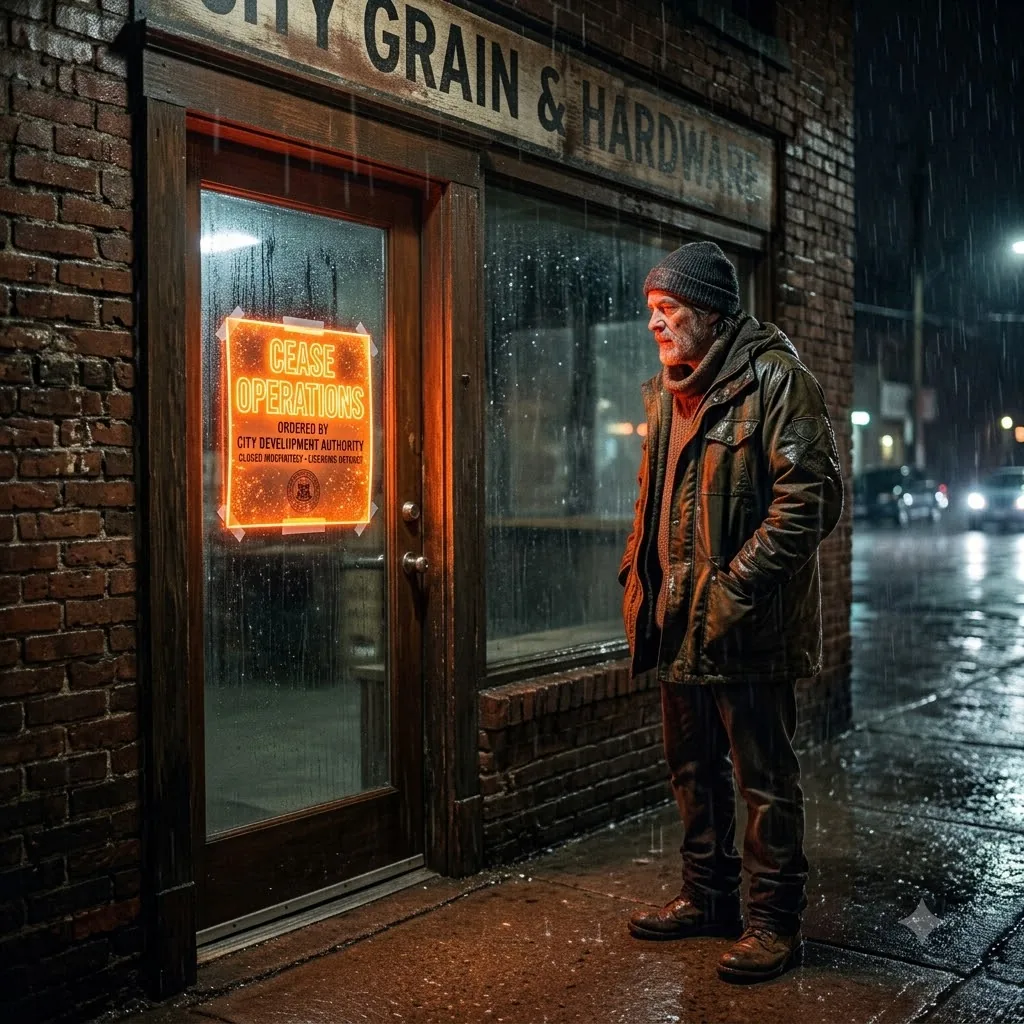
He turned and looked across the street at his gun shop. The jagged white scar of the torn orange injunction sticker still defaced his front door. The county sheriffs would still come at four o’clock. The battle for the zoning rights was far from over. Vance would undoubtedly throw his millions into lawsuits, and the town council would have to choose between Vance’s money and their own constituents.
But as Harlan walked back across the wet asphalt toward his grandfather’s shop, he noticed a line of pickup trucks already beginning to idle along the curb. Chief Miller’s white cruiser was parked at the end of the block, watching the café. The town had seen enough. The illusion of a peaceful transition was dead, replaced by the cold reality of a bitter, drawn-out cultural war. And as Harlan unlocked his front door, wiping the blood from his hand, he knew it was a war he was finally ready to fight.