Story code: ST-001214
Part 4: The Clean Grave
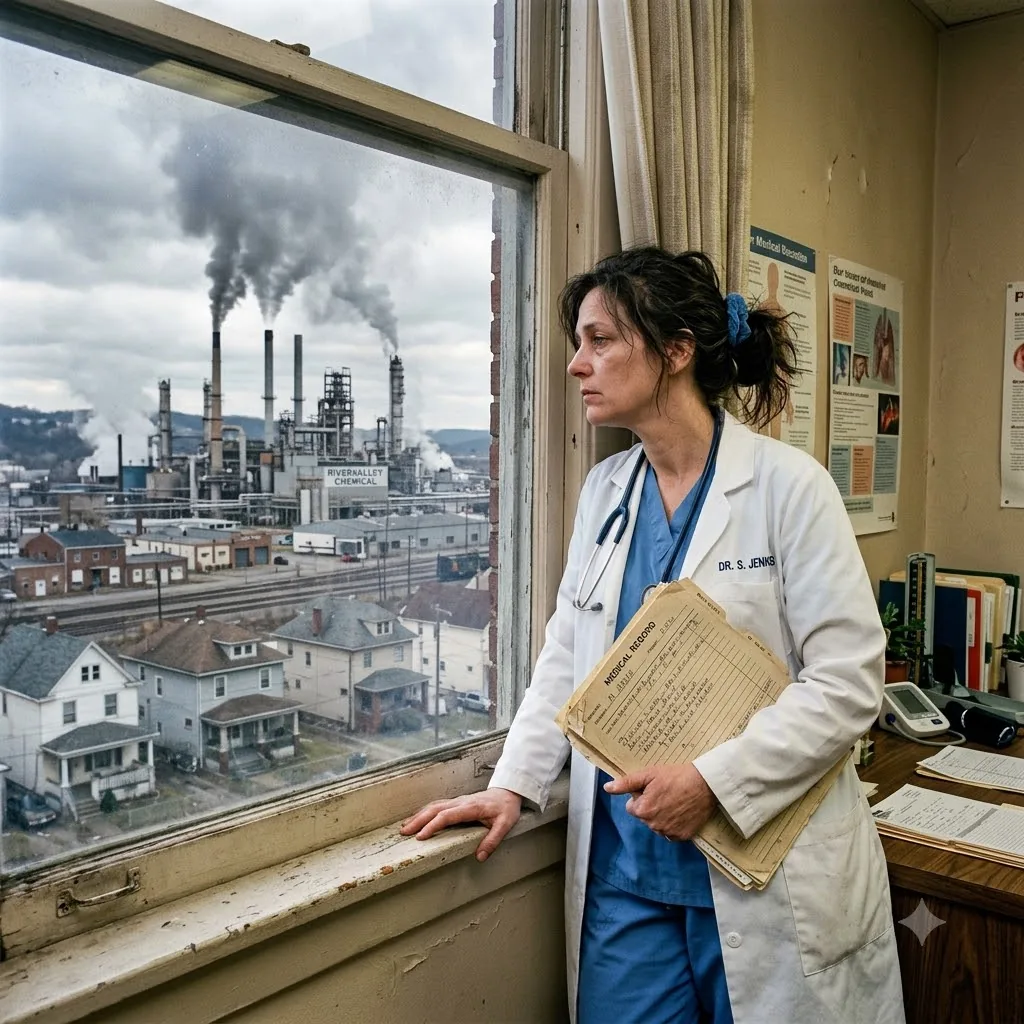
Two months after the town hall, Sarah sat in her idling sedan on the ridge overlooking the valley. The Apex ChemSolutions plant was dead. A fleet of federal Environmental Protection Agency vehicles-stark white vans with blue governmental seals-were parked where the corporate hazmat crews used to operate. The massive steel smokestacks, which had once vented thick, continuous plumes of white exhaust into the overcast sky, were cold and silent. The sprawling complex was wrapped in heavy chain-link fencing, sealed by federal mandate.
The poison had stopped flowing, but so had the lifeblood of the town.
Yesterday, Sarah had sat in the back row of the county courthouse. She had watched Marcus stand before a federal judge, stripped of his tailored suits and his booming mayoral confidence. He had looked small, his shoulders slumped as he pleaded guilty to federal environmental endangerment and municipal corruption. When the judge handed down a sixty-month sentence, Marcus hadn’t fought it. As the bailiffs led him away, he had stopped and met Sarah’s eyes across the courtroom. There was no anger left in his gaze, only a hollow, devastating resignation. He had warned her exactly what would happen if she spoke up, and every one of his warnings had come true.
Apex had enacted the containment protocol Marcus had predicted, but not the environmental one. They executed a corporate containment. Within forty-eight hours of the town hall disaster, the company had pulled every infrastructure investment, voided their municipal contracts, and abandoned the facility to the federal regulators.
The money vanished instantly.
Sarah drove down from the ridge and turned onto Main Street. The devastation was absolute and inescapable. The imported marble floors of the town hall meant nothing now that the municipal budget was completely zeroed out. The hardware store had fresh, unstained plywood nailed over its display windows. The local diner, where the plant workers used to spend their overtime pay, was dark, a neon foreclosure sign resting against the dusty glass. The forty percent poverty rate had returned, not as a gradual economic decline, but as a sudden, violent crash.
She parked in front of her clinic. The municipal chains were gone, severed by a federal injunction, but the victory felt entirely hollow. The waiting room was freezing. She couldn’t afford to repair the broken HVAC unit without the town’s public health subsidies, which had evaporated alongside the Apex tax base. She sat at the reception desk, her breath pluming in the frigid air, staring at the empty appointment ledger.
Nobody came to the clinic anymore.
The bell above the glass door chimed, making Sarah jump. She stood up, a spark of hope rising in her chest, but it died the moment she saw David Vance walk inside. Leo’s father looked exhausted, his face lined with deep, dark shadows. Leo had started his chemotherapy in the city, funded now by a meager, slow-moving state emergency grant instead of the silent corporate hush money Apex had promised.
“David,” Sarah said, stepping out from behind the desk with a tentative smile. “How is Leo handling the new protocol?”
David didn’t meet her eyes. He reached into his heavy canvas coat, pulled out a thin stack of medical transfer forms, and placed them on the counter. He kept his gaze firmly fixed on the scuffed linoleum floor.
“He’s doing okay,” David muttered, his voice flat and devoid of any warmth.
“I can review his latest blood work tonight,” Sarah offered gently, stepping closer. “We can adjust his anti-nausea medication locally so you don’t have to drive-”
“Don’t,” David interrupted. He finally looked up, and the raw hostility in his eyes made Sarah freeze in her tracks. It wasn’t just anger; it was a profound, suffocating resentment. “I need you to sign the release. We’re transferring his primary care to the oncology center in the city.”
Sarah swallowed hard, the cold air biting at her throat. “David, that’s a two-hour drive each way. I can manage his local care for free. You know I will. I want to help.”
“I lost my job at the supply depot, Sarah,” David said, his voice trembling with a quiet, suppressed rage. “Apex canceled the transport contracts. My wife lost her shifts at the diner. We have no gas money. We have no heating oil for the winter. The bank is going to take the farm by Christmas.”
“Apex was killing him,” Sarah pleaded, her chest tightening with panic. “They were poisoning the creek. You saw the internal map. They knew it was happening.”
“I saw the map,” David agreed bitterly. “And now the water is clean. But we have absolutely nothing left to give him. Toby Miller’s family is declaring bankruptcy tomorrow. The Brooks family is moving into a trailer out of state.” He slid the transfer papers closer to her. “You made sure we survived the water, Sarah. But you made sure we couldn’t survive anything else.”
He turned his back on her and walked out, the glass door clicking shut firmly behind him.
Sarah stood alone in the freezing lobby. The silence of the clinic pressed in on her, heavier and more absolute than it had been on the day she first discovered the leukemia cluster. She walked to the front window and watched David’s battered truck rattle down the empty, decaying main street. She had exposed the corporate corruption. She had forced the EPA to shutter the plant. She had saved the valley’s children from the heavy exhaust compounds settling in the sink.
But as she looked out at the boarded-up storefronts and the creeping, undeniable despair swallowing the town whole, the victory turned to ash in her mouth. She had won the war for their lives, but the people she had fought so desperately to protect would never forgive her for burning their only future to the ground. She was perfectly, entirely alone.