Story code: ST-001214
Part 2: The Containment Protocol
Sarah stared at the blank line on the non-disclosure agreement. The thick, watermarked paper caught the sterile light of the brass desk lamp. She looked from the document to Marcus’s face, searching for a trace of the man who used to help her organize the annual town health fair. There was nothing. His eyes were steady, his posture relaxed, his hands resting perfectly flat on the mahogany wood.
“What did you do, Marcus?” she asked, her voice dropping to a harsh whisper.
Marcus leaned back in his chair. He stated calmly that Apex ChemSolutions had informed him of a minor, temporary venting anomaly three months ago during their initial production scaling. He explained it was an unavoidable byproduct of saving their community from total bankruptcy. He tapped a finger against the edge of his desk and pointed out that before Apex arrived, the town’s poverty rate was forty percent. People were freezing in their homes. Now, they had a future. He told her that Apex was willing to quietly cover all medical expenses for the affected families, provided the community remained stable and uninterrupted.
Sarah felt a cold sweat break out along her spine. She realized he had known. He had known the air was poisoned before she even diagnosed Leo Vance.
She reached out and snatched her three manila folders off his desk. She told him that three children were fighting for their lives. She refused to let a chemical company buy their silence with blood money.
Marcus did not raise his voice. He warned her that if she went to the state health board, Apex would immediately halt operations and pull its infrastructure investments. He stated that the town would plunge back into a depression, the tax revenue would vanish, and those three families would have no insurance, no jobs, and no way to pay for the grueling oncology treatments they desperately needed. He told her she would be destroying ten thousand lives to save three who were already sick.
Sarah turned her back on him and walked out.
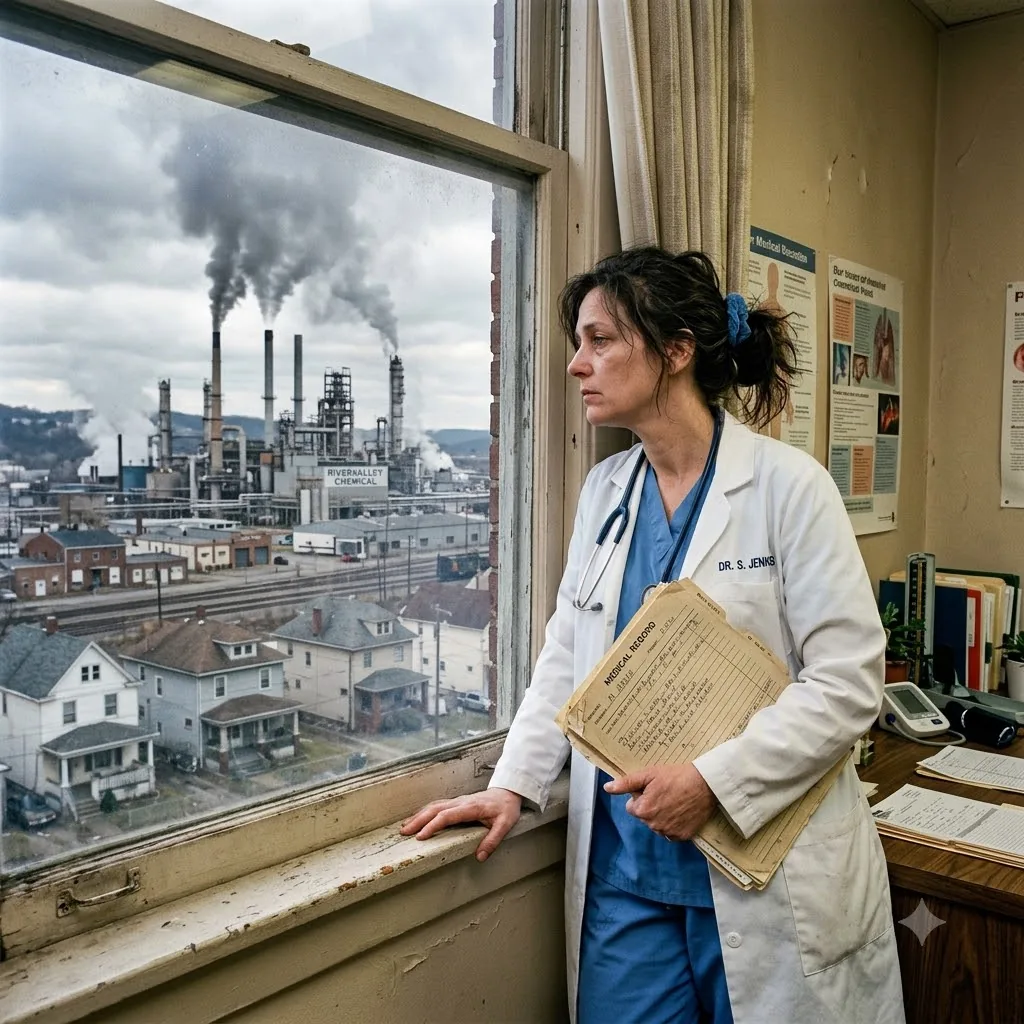
She moved through the renovated lobby in a daze, the imported marble floors suddenly looking like a mausoleum. She burst through the front doors into the overcast afternoon. The air felt heavy. She looked toward the horizon, where the massive white plumes continued to billow from the Apex stacks, drifting lazily down toward the valley sink.
She needed proof that went beyond a statistical cluster. The state health board would stall, demanding environmental baselines. Marcus would undoubtedly bury the town’s internal zoning and emissions records. She needed the chemical signature of the soil and water where those children lived, and she needed it before Apex found a way to sanitize the area completely.
Sarah got into her sedan, her hands shaking so badly she missed the ignition twice. She threw the car into drive and headed toward Elm Creek Road, the lowest point in the valley basin. Leo Vance’s property backed up directly against the creek that caught all the runoff from the industrial ridge. If the heavier exhaust compounds were settling at night, they were settling into that water.
The drive took fifteen minutes. As she turned onto the dirt road leading to the Vance farm, she saw a line of heavy utility trucks parked along the shoulder. All of them bore the green and white Apex ChemSolutions logo.
Sarah pulled off onto a side tract, parking her sedan behind a thick stand of dying pine trees. She grabbed her medical bag, which contained sterile glass sample jars, and crept through the brush toward the creek bed.
Through the barren branches, she could see a dozen men in white hazmat gear and yellow hard hats. They were operating mini-excavators along the edge of the water. A massive, industrial-grade filtration unit was already installed near the Vance family’s private well. She watched as an Apex representative in a crisp suit stood on the back porch with Leo’s father, pointing to the new equipment and smiling. The father was shaking the representative’s hand, nodding with profound gratitude.
Apex wasn’t just hiding the contamination. They were disguising the environmental cleanup as a generous community infrastructure grant. By next week, the soil would be turned, the water filtered, and the chemical trail entirely erased.
Sarah slid down the steep, muddy embankment, keeping her head below the ridge line so the work crews wouldn’t spot her. The smell of the creek hit her instantly-a sharp, metallic odor that burned the back of her throat and made her eyes water. The creek itself had a strange, iridescent sheen pooling along the edges of the submerged rocks.
She opened her medical bag and pulled out two sterile jars. Her boots sank into the contaminated mud as she waded into the shallows. She submerged the first jar, sealing it tightly underwater to trap the suspended sediments, then filled the second with the thick, foul-smelling sludge from the bank. She wrapped them in biohazard bags, her heart pounding violently against her ribs. She had the physical evidence. She just needed to get it to an independent lab in the city.
She scrambled back up the bank, her clothes smeared with the toxic mud, and made it to her car undetected.
The drive back to the clinic felt like hours. She planned to lock herself in her office, securely package the environmental samples with the medical files, and drive straight to the state capital herself. She couldn’t trust the local postal service or courier. Not anymore.
She rounded the corner onto Main Street and slammed on the brakes.
Two town police cruisers were parked at steep angles across the entrance to her clinic’s parking lot. Their lights were flashing, casting stark red and blue shadows across the brick facade. A heavy iron chain was wrapped tightly through the handles of the clinic’s glass double doors, secured with a massive padlock.
Sarah left the car running in the middle of the street and ran toward the building. Her head nurse, Clara, was standing on the sidewalk, clutching a cardboard box of personal belongings. Clara was sobbing quietly into her hands.
Sarah demanded to know what was happening, gripping Clara’s shoulder.
Clara pointed a trembling finger at the door. Taped to the glass was a glaring neon-orange notice. Sarah stepped closer, her stomach dropping into a bottomless abyss.
It was an emergency suspension of medical operations. The notice cited severe biomedical disposal violations and declared the immediate revocation of the town’s lease agreement for the property. It was signed in dark blue ink by the head of the municipal health board. Mayor Marcus.
Sarah patted her hip, realizing the sudden, terrifying lightness of her pockets. The manila folders containing the hematology reports, the bone marrow confirmations, and the only documented medical proof of the leukemia cluster were not with her. She had left them on her desk when she rushed out to get the water samples.
She pressed her hands against the cold glass, staring into the dark, locked lobby. The environmental samples were in her car, but her irreplaceable medical files were inside, safely secured behind town-mandated chains.