Story code: ST-001278
Part 4: The Ruins
Harlan’s wet, rattling breaths finally stopped. The horrible bubbling in his chest just ceased altogether, leaving a jagged, agonizing silence in the room. Sarah dropped to her knees beside the heavy oak desk, her nursing instincts overriding her panic even as her hands shook violently. She ripped Harlan’s shirt open, scattering small pearl buttons across the worn municipal carpet, and locked her hands over the old man’s sternum.
She didn’t ask me for help. She didn’t even look at me.
Two minutes later, heavy boots pounded down the linoleum corridor outside. Two men in mismatched high-visibility jackets-volunteer EMTs, one the mechanic from the local auto body shop, the other a teenager I vaguely recognized from the grocery store-rushed into the office hauling a faded orange jump bag. They didn’t spare me a glance. They dropped onto the carpet next to my sister.
“We can’t get the portable defib to charge,” the mechanic said, his voice a panicked octave too high as he yanked tangled wires from the bag. “The municipal grid just shed the emergency zone. State automated freeze kicked in on the power accounts. I can’t even raise county dispatch to get a medevac flight going, our telecom lines are dead.”
Sarah didn’t miss a beat on her chest compressions, her shoulders dropping with rhythmic, desperate force. But her tears were falling freely now, splashing against Harlan’s pale, waxy skin. “Use the manual bag! Push a milligram of epinephrine! We need to restart his rhythm right now!”
“We don’t have any left!” the teenager yelled back, frantically digging through the pockets of the orange canvas bag, throwing empty plastic wrappers onto the floor. “The supply requisition got bounced ten minutes ago! The town’s credit is totally frozen, Sarah! The pharmacy locked the secondary cabinets! We don’t have anything to give him!”
I stood frozen by the door, watching them scramble in the disaster I had created. They were desperately trying to save the man who had sold me into corporate slavery, and they were failing because I had just cut off the blood money that paid for their life-saving supplies. The irony was so thick I could practically choke on it. I had spent ten long years in an eight-by-ten cell dreaming of this exact day. I had fantasized about the look on Harlan’s face when I brought the hammer down, when I finally made them pay for what they stole from me.
I thought justice was going to be a clean, sharp sword. I didn’t realize it was a live grenade.
Sarah stopped compressions for a fraction of a second to look up at me. Her face was a mask of pure, absolute revulsion. It wasn’t the look a sister gives a brother. It was the look you give a monster that just broke into your home.
“Get out,” she whispered, her voice colder than the concrete floors of the segregation block I used to freeze on. “You got your revenge, Marcus. You killed him. You killed all of us. Now get out of my sight.”
I didn’t argue. There was absolutely nothing left to say. The black leather ledger was still resting on the floor by her shoes, the faded ink of my predetermined ten-year sentence staring up at me. I turned my back on it, leaving my sister desperately pumping the chest of the architect of my misery.
The town hall corridor was a tomb. I pushed through the heavy glass double doors of the municipal building and stepped out into the blinding mid-morning light.
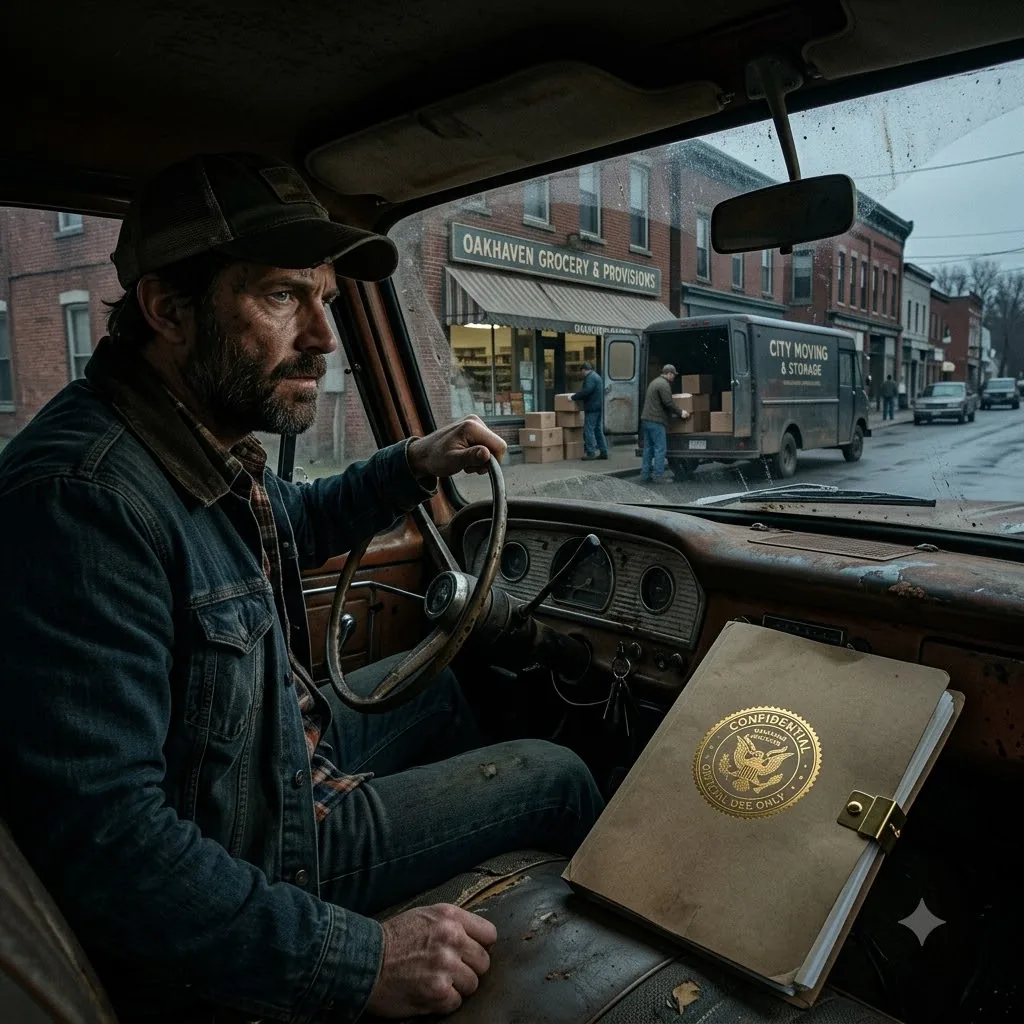
Main Street was entirely deserted. The freshly nailed plywood covered the hardware store. The butcher shop was dark. The only sound in the world was the synchronized, rhythmic thudding of the corporate collection trucks rolling down Route 9, their heavy diesel engines vibrating up through the asphalt and into the soles of my boots. They were coming to collect three million hours of labor. They were coming to harvest the rest of the town.
I walked slowly down the concrete steps and crossed the empty street to my pickup truck. I didn’t reach into my pocket for my keys. I just leaned my back against the driver’s side door and slid down until I was sitting on the rough, sun-baked pavement.
Out in the distance, barely visible over the tree line, I could see the harsh steel silhouette of the guard towers at the private prison. By midnight tonight, the state troopers would have the perimeter fully locked down. The corrupt warden would be in handcuffs. The iron gates would be chained shut forever. I had won. I had single-handedly destroyed the beast that had eaten my twenties.
But as I sat there alone in the empty parking lot, listening to the mechanical horns of the incoming corporate convoy blast through the quiet valley, I realized the bitter, isolating truth of my victory. The beast hadn’t just eaten my youth; it had been digesting my entire hometown, sustaining them on its scraps.
My mother didn’t die in a county ward hallway because of that prison. My sister kept her clinic open because of it. The butcher, the baker, the volunteer paramedics-they all survived on the marrow of my stolen years. And by taking back my life, by demanding the righteous justice I was owed, I had bankrupted them all. I had turned my own sister into a stranger and handed my neighbors over to a corporate collection agency.
I pulled my knees to my chest and rested my head against my arms. The prison was finally dead, but I was the only one left alive in the ruins, utterly and completely alone.