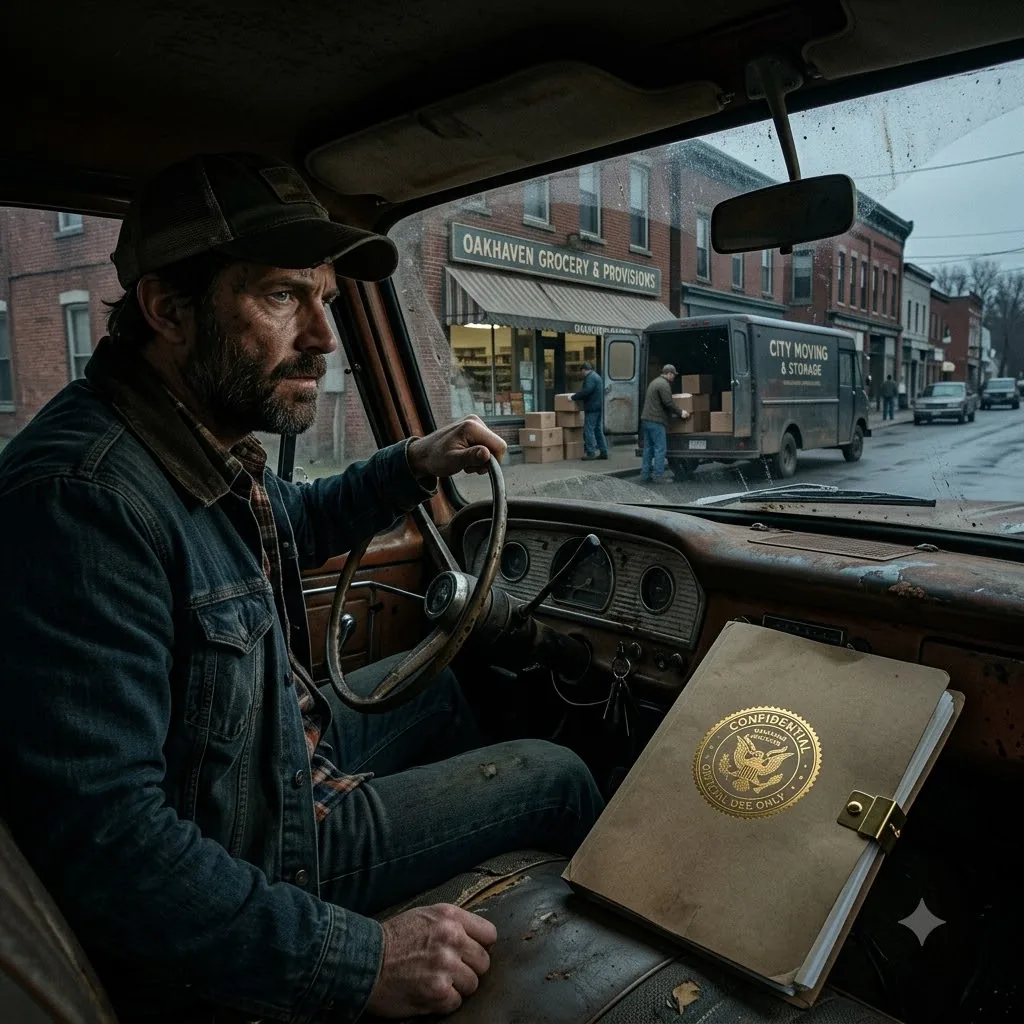
Story code: ST-001278
Part 2: The Harvest
My muscles instantly locked. After a decade of dodging nightsticks and surviving cellblock shakedowns, my body possessed a hardwired instinct for incoming violence. I fully expected Harlan to pull a snub-nosed .38 from that velvet cloth. I shifted my weight to the balls of my feet, my boots digging into the worn carpet, ready to vault the desk and put the old man through his own window. I’d survived ten years in a concrete cage; a soft, corrupt local bureaucrat wasn’t going to be the one to finally take me out.
But it wasn’t a gun. The metallic whine I’d heard wasn’t a slide racking. Harlan’s trembling fingers peeled back the dark fabric, revealing a massive, iron-bound ledger. It looked ancient and entirely out of place in a modern municipal office, bound in cracked, blackened leather that smelled faintly of copper and damp earth. A heavy brass padlock dangled from its side, though it hung open, the clasp completely rusted through.
I let out a harsh, jagged laugh. The bitter tension in my chest released into pure, cynical disgust. “A book, Harlan? You’re pulling out a book? The state police are twenty minutes away. Your ledger of bribes isn’t going to save you. The governor’s office already has the financial records. Every kickback the warden sent you to look the other way-”
“You stupid, arrogant kid,” Harlan wheezed. His voice was entirely hollow, drained of the pompous, mayoral authority he’d wielded over this town for my entire life. “You think this is about money? You think we built that place out on Route 9 for a financial kickback?”
He shoved the heavy book across the desk. It slid over the polished wood and bumped against my state injunction, knocking the gold foil seal askew.
“Open it,” he whispered, his bloodshot eyes wide and unblinking. “Look at the deficits.”
I didn’t want to touch the thing. It felt filthy, radiating a cold kind of bureaucratic malice. But the nagging, relentless need for vindication pushed my hand forward. I flipped open the heavy cover. The pages were thick, covered in meticulous, handwritten columns. They weren’t dollar amounts or zoning permits. They were names. Dates of birth. Sentences.
I dragged a calloused finger down the first column. I recognized almost every single one. Tommy Miller, caught with an ounce of weed, given seven years. David Chen, a broken taillight and a supposed resisting arrest charge, five years. And there, halfway down the third page, penned in sharp black ink: *Marcus Vance. Vandalism. Ten years.*
I stared at the ink. It was faded. The date at the top of the page was from twelve years ago. They had written my name into this book two years before I even threw the rock through the corporate office window that got me arrested.
“We needed a ninety-five percent occupancy rate,” Harlan said, his voice trembling so hard the words practically vibrated in the quiet office. “That was the warden’s baseline. We were a dying town, Marcus. The mill shut down. The soil went sour. The municipality was functionally bankrupt. We had absolutely nothing left. The corporation came in and offered to save us. They’d build the facility, they’d pay the county taxes, they’d keep the lights on for ten thousand people. But they needed bodies to process. They needed guaranteed labor for their manufacturing contracts. A quota.”
My conviction wasn’t a punishment for a mistake. It wasn’t an overzealous judge. It was a harvest.
“You sold us,” I whispered, the realization cold and acidic in my stomach. The silence on Main Street suddenly made perfect sense. It wasn’t a town folding in on itself in economic depression. It was the cowardice of a guilty conscience. “The grocer, the butcher… the whole damn town knew. The jury that convicted me. They weren’t weighing evidence. They were just meeting a quota.”
“We drew lots,” Harlan sobbed, burying his face in his hands, his shoulders heaving. “Every family gave someone up. It was the only way to keep the town from going completely under. We thought… we thought a few years inside for the young guys, and the town survives. We handled the deficits. We fed the warden his quota to keep the beast asleep.”
The sickness in my gut twisted into a white-hot, blinding fury. Ten years of eating stale bread, of showering in freezing water with one eye on the man next to me, of watching my youth bleed out into a concrete drain-all so the local butcher could keep his neon sign on. I grabbed the edge of the oak desk, my knuckles turning white.
“Well, the quota is zero now, Harlan,” I spat, leaning over the desk until I could smell the stale coffee on his breath. “The state is shutting the grinder down. You’re going to have to look all those ghosts in the eye when the state buses drop them back off on Main Street.”
“They aren’t coming back!” Harlan screamed, suddenly slamming his fists down on the desk with a frantic, desperate energy. “Don’t you get it? The injunction doesn’t free them!”
He pointed a shaking, liver-spotted finger at the window, out toward the unnervingly quiet street.
“Why do you think the shops are packing up? Why do you think the police chief abandoned his post at dawn?” Harlan choked out. “The warden doesn’t answer to the governor. That facility isn’t a state entity, it’s a sovereign corporate lease. And their contract has a default clause. If the state breaks the lease, the corporation claims the collateral.”
I frowned, glancing back at the window. The hardware store owner across the street was frantically throwing suitcases into the bed of a pickup truck, abandoning his freshly nailed plywood.
“The collateral is the town itself, Marcus,” Harlan said, his breath hitching in his throat. “The land. The deeds. And the remaining labor hours of every able-bodied resident. We owe them three million hours of labor.”
Before I could fully process the sheer, terrifying insanity of what he was saying, a sound ripped through the suffocating silence of the morning. It wasn’t the wail of state police sirens. It was a deep, guttural mechanical horn, echoing from the direction of Route 9. A heavy, rhythmic thudding followed, like the synchronized march of armored machinery rolling down the asphalt, shaking the foundation of the town hall.
Harlan looked at the velvet cloth, then up at me, his eyes dead and glassy. “They’ve locked the highway. The collection trucks are already here.”