Story code: ST-001458
Part 2: The Compliance Audit
Hector stepped into the man’s path, the iron pry bar heavy and freezing against his thigh.
“That’s enough,” Hector said. His voice sounded thin in the frigid air, lacking the bass of true authority. The wind whipped down the avenue, carrying the bitter scent of exhaust.
The man in the tailored charcoal overcoat did not flinch. He did not even look up at Hector’s face. His eyes remained locked on the silver clipboard resting on his forearm. He clicked the permanent marker with his thumb, a sharp, metallic sound in the quiet morning.
“Are you the registered leaseholder?” the man asked. His tone was perfectly flat, polished, the voice of someone used to repeating sterile scripts to angry people.
“I’m the owner. Hector Santiago. You put these on my glass?”
“I am an independent compliance auditor contracted by the Historical Aesthetic Board,” the man said, writing a rapid string of digits onto the fresh neon orange sticker. “I do not own the citations. I merely document and affix.”
“There is no Historical Aesthetic Board in this neighborhood,” Hector said, taking a step closer. The town car’s engine purred softly behind them, a low, expensive vibration. “Who sent you? Apex Development?”
The man ignored the question. He stepped sideways, attempting to walk around Hector to reach the glass of the storefront. Hector shifted his weight, blocking the path again.
The auditor paused and let out a small sigh, his breath pluming in a puff of white vapor. “Sir, obstructing a compliance audit is a Class 3 leasehold violation. It carries an immediate penalty of one thousand dollars and waives your standard thirty-day cure period. I strongly advise you to step aside.”
Hector looked down at the iron pry bar in his hand. He imagined swinging it-not at the man, but at the immaculate black paint of the idling town car. But he knew instantly that was exactly what they wanted. Property damage, assault, anything that would involve the real police and legally break the ironclad lease his grandfather had signed sixty years ago. They needed him to lose his temper. Hector forced his fingers to open, letting the pry bar slide down his leg and clatter loudly onto the frozen sidewalk.
“I’m not obstructing,” Hector said, his chest tightening with a suppressed rage. “But you’re not putting another one of those on my window.”
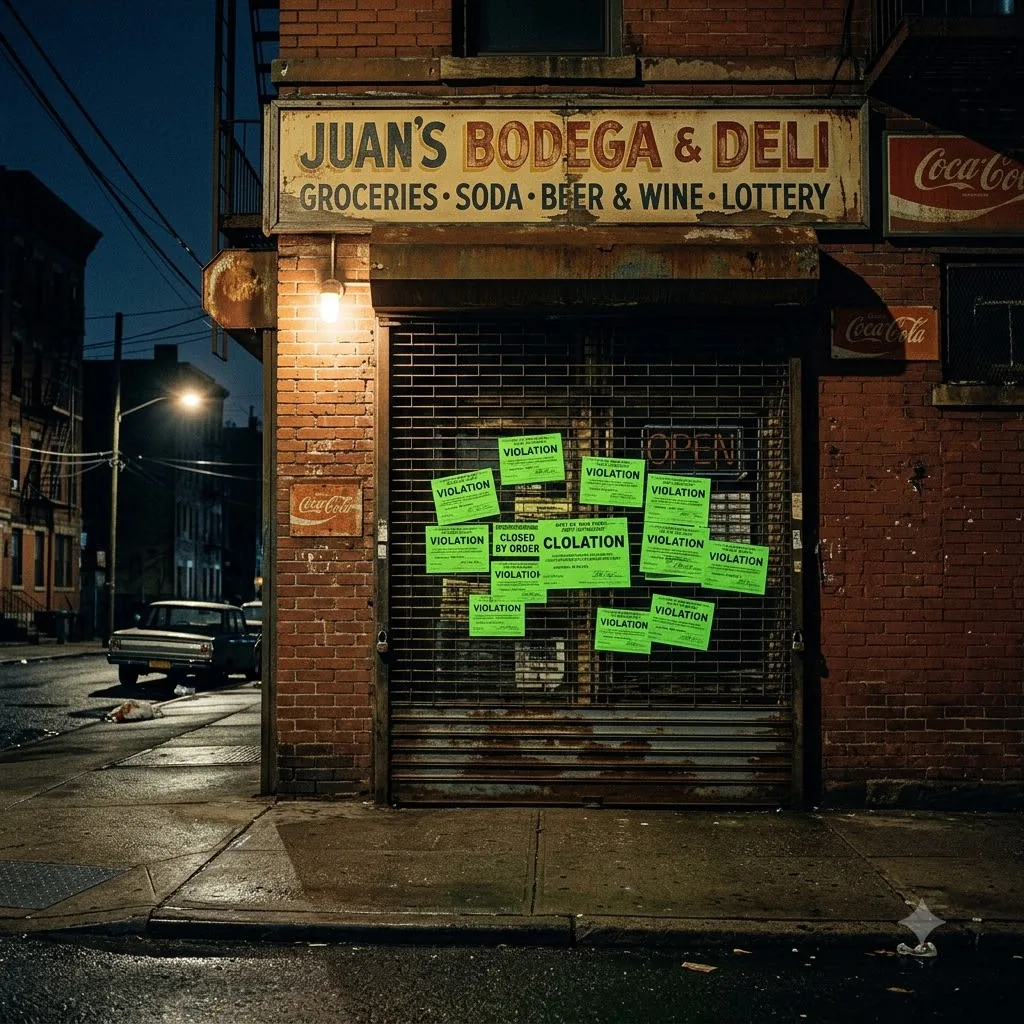
The auditor raised his eyebrows slightly, still looking only at his clipboard. “Noted.” He clicked the marker closed and peeled the wax backing off the fresh orange square. Instead of stepping toward the glass, he reached out and slapped the heavy vinyl sticker directly onto the center of the brass padlock securing the roll-down grate.
Hector stared at it. The block letters on the new citation read Violation 714: Unsecured Industrial Debris-referencing the pry bar Hector had just dropped. Penalty: six hundred dollars.
“You’ve got to be kidding me,” Hector breathed.
“The board takes neighborhood beautification very seriously,” the auditor said. He reached behind his clipboard, produced a thick, cream-colored envelope, and held it out.
Hector refused to raise his hand.
The auditor simply let his fingers part. The envelope fluttered down, landing on the frosty pavement next to the pry bar. “That is your Notice of Impending Lien. As your total citations now exceed five thousand dollars, the Aesthetic Board has initiated preliminary asset seizure.”
“You can’t seize anything,” Hector said, a cold spike of panic finally beginning to edge out his anger. “This isn’t a government agency. You’re a fake HOA.”
“The commercial lease your grandfather signed in 1964 includes a compliance clause regarding local merchant association bylaws,” the auditor recited smoothly, as if reading from a teleprompter. “Apex Development acquired the dormant merchant association charter last month. The Aesthetic Board was formed under that charter last week. It is completely legal, contractually binding, and currently levying fines against this property.”
Hector’s mind raced, hitting brick walls in every direction. They had combed through a sixty-year-old document to find one microscopic loophole. They had bought a dead merchant charter just to weaponize it against him. “How do I fight it?”
“The appeals process is detailed in your notice,” the auditor said, turning back toward the idling town car. “You may request an emergency hearing to stay the lien. The filing fee is two hundred dollars per citation. Non-refundable.”
Hector did the math instantly. Thirteen stickers. Twenty-six hundred dollars just for the right to ask them to stop. He didn’t have half of that in his business checking account. The winter electric bill had just cleared yesterday.
A heavy rumble shook the pavement. The boxy silhouette of the commercial bread delivery truck rounded the corner, its air brakes hissing loudly as it pulled up behind the black town car.
The delivery driver, a stout man named Gary who had been running this route for a decade, hopped out of the cab. He grabbed his metal two-wheeler from the back and froze when he saw the glowing orange storefront, the heavy padlock, and the man in the charcoal coat.
“Hey, Hector,” Gary called out, his voice wary. “Everything okay? I got forty trays for you. We’re running behind.”
“I need five minutes, Gary,” Hector said, turning away from the auditor. “Just leave them on the curb. I’ll load them in.”
Gary shook his head, looking nervously at the padlock. “You know I can’t do that, man. Corporate policy. If it’s not inside the secured premises, I can’t leave it. Too much theft on this route.”
“Gary, please. I just need to figure this out. The morning rush-”
“I got fifteen more stops before six AM, Hector. If you can’t open the door, I gotta roll.” Gary looked at the neon stickers, his expression shifting from sympathy to professional distance. He didn’t want any part of whatever legal, radioactive mess was happening here. He hoisted his two-wheeler back into the truck.
“Gary, wait!”
The heavy metal door of the bread truck slammed shut. The diesel engine roared, and the truck pulled away, taking three days’ worth of inventory and the anchor of Hector’s morning breakfast rush with it.
Hector spun back to the auditor, but the man was already sliding into the back seat of the town car.
Hector lunged forward and grabbed the top edge of the car door before it could close. “When is the deadline?” he demanded, his knuckles white against the freezing black metal. “For the appeal fee?”
The auditor looked up at him from the plush leather seat. “According to the expedited lien schedule,” he said, casually checking a gold wristwatch, “you have until nine o’clock this morning to remit the filing fees in certified funds to the board’s processing center. Otherwise, the padlock stays, the lien executes, and the lease is voided for non-payment.”
The auditor firmly pulled the door shut, forcing Hector to snatch his fingers back or get them crushed. The lock engaged with a heavy, final clunk. The town car pulled away from the curb, merging smoothly into the sparse early morning traffic, its red taillights fading into the gloom.
Hector stood alone on the frozen sidewalk. He looked down at the cream-colored envelope resting on the concrete. The milk truck would be here in ten minutes. Then the produce delivery. He was going to lose it all. He bent down and picked up the envelope, the paper stiff and icy, realizing he had exactly four and a half hours to find twenty-six hundred dollars.