Story code: ST-001458
Part 4: The Ghost Block
The silence in the conference room stretched, heavy and suffocating. Ms. Sterling did not yell. She did not threaten to call security. She simply stared at the faded, mimeographed pages, her mind visibly running the terrible arithmetic of Hector’s discovery.
She picked up her tablet, tapped a few keys, and swiped through a series of internal documents. Her jaw tightened, the muscles flexing beneath her flawless makeup.
“Mr. Santiago,” she said, her voice completely stripped of its former condescension, leaving only a hollow, metallic pragmatism. “If you file a formal grievance under this charter, the municipal water authority will automatically suspend our certificate of occupancy pending an inspection.”
“I know,” Hector said, his voice steady. “And they will find commercial PVC. They will force you to rip up the poured concrete foundation of The Hound & Hearth to lay cast-iron lines. It will take months. It will cost millions. Your flagship project will sit empty until fall.”
The auditor shifted uncomfortably in his chair, his eyes darting between Hector and the regional director. “Ms. Sterling, the aesthetic citations on his property…”
“Cancel them,” Sterling cut him off, not looking away from Hector. “Are the lien documents processed with the county clerk yet?”
“No,” the auditor said. “We were holding them until the 9:00 AM deadline to batch the filings.”
“Delete the batch,” Sterling ordered. She stood up and walked to a sleek laptop sitting on a secondary desk in the corner. “Mr. Santiago, you will receive a full waiver of all pending fines. The padlock will be removed immediately.”
“Not just the fines,” Hector said, refusing to move from the table. “I want a permanent exemption from the 8th Avenue Merchant Association for my property. Signed and notarized. Now. Or I walk downstairs to the water authority’s office with this box.”
Sterling’s hands hovered over the keyboard. She looked at the heavy banker’s box, then at Hector’s worn canvas jacket and dust-stained fingers. She knew he had nothing left to lose, making him infinitely more dangerous than a rival developer. She typed rapidly. Minutes later, a nearby laser printer hummed to life.
By 9:45 AM, Hector was standing back on the freezing pavement in front of his bodega. The black town car sat idling at the curb once again.
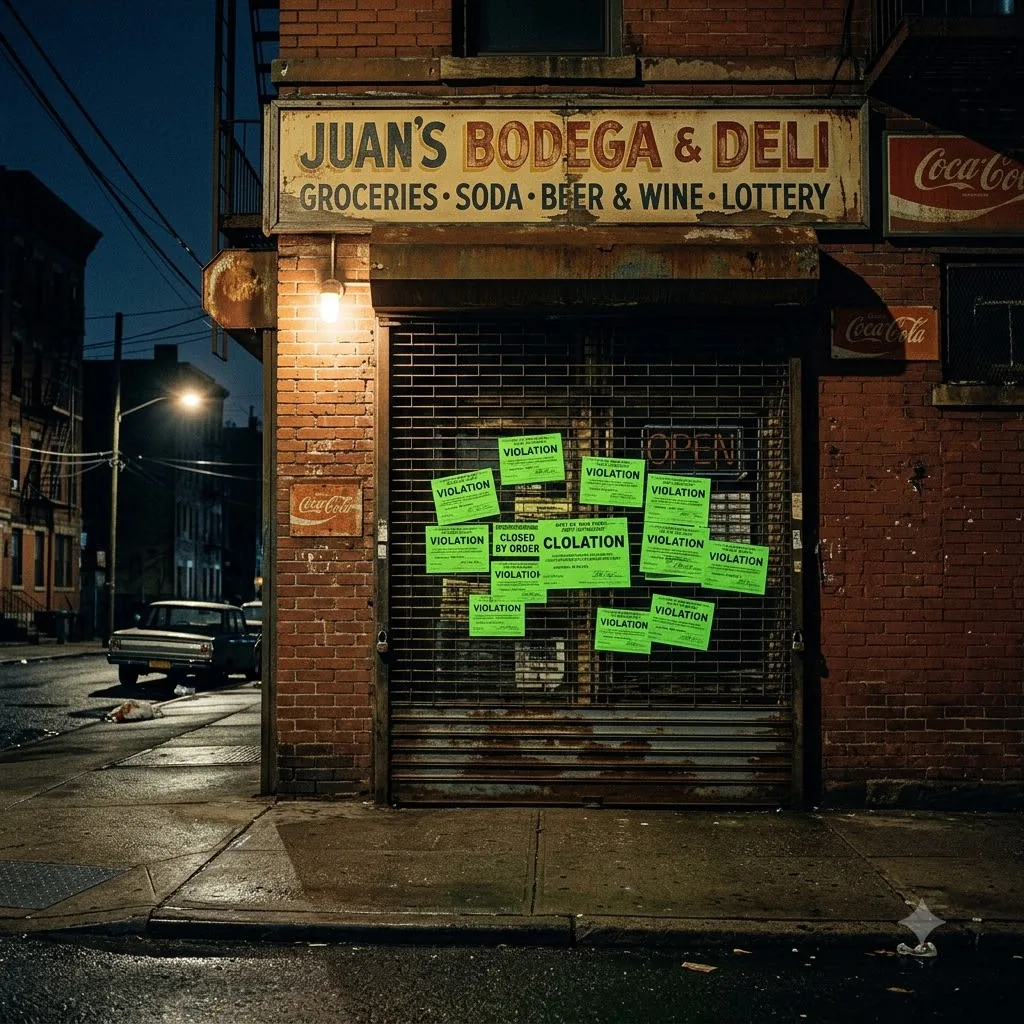
The auditor did not look at Hector as he unlocked the heavy brass padlock securing the grate. The lock clicked loudly, releasing its grip. The auditor pulled it free, then retrieved a metal putty knife from the trunk of the car. He spent the next twenty minutes silently scraping the thick, neon orange stickers off the front window. The industrial adhesive fought him, coming off in ugly, peeling strips, leaving a sticky, blurred residue over the faded cursive of Santiago & Sons Grocery.
Hector did not offer to help. He stood with his arms crossed, the cold seeping through his boots, watching the auditor drop the crumpled vinyl scraps into a garbage bag.
When the glass was finally clear, the auditor tossed the padlock into his trunk, slammed it shut, and got into the back of the town car. The vehicle pulled away, merging into traffic and vanishing silently down the avenue.
Hector was alone.
He reached down, grabbed the handle of the metal grate, and heaved upward. The steel rolled into its housing with a familiar, deafening rattle. He unlocked the glass door and stepped into his store. The air inside was completely stagnant, smelling of old wood, floor wax, and the faint, sweet scent of overripe plantains.
He walked behind the counter and flipped the main breaker. The overhead fluorescent lights flickered to life. The neon beer signs in the window buzzed with their comforting, low hum.
He had won. He held a notarized legal release in his jacket pocket that protected his grandfather’s lease from any future aesthetic or structural interference by Apex Development. They could never touch his store again.
Hector walked back to the front window and looked out through the streaks of leftover adhesive.
The morning rush was completely gone. Gary the bread delivery driver was miles away on another route, his inventory meant for Hector likely already distributed to other stops. But it wasn’t just the morning deliveries. As Hector looked up and down the avenue, he realized the sidewalk was entirely empty. It had been swept clean of the old neighborhood’s chaotic, vibrant foot traffic.
Across the street, the massive glass facade of a new Apex residential tower reflected the pale winter sun. There were no faces in those windows. No laundry hanging from fire escapes. No one was shouting down to the street. The towering high-rises looming over his small roof were beautiful, sterile, and entirely silent.
He had saved his store, but as Hector stood behind his quiet register, looking out at the monolithic walls of glass and steel boxing him in on all sides, the victory felt incredibly hollow. The padlock was gone, but he was still trapped. He was a museum exhibit in a neighborhood that no longer existed, holding the door open for ghosts.