Story code: ST-001464
Part 2: The Data Ghost
Marcus froze, the command ringing in the empty hallway. He looked at the pristine, eggshell-painted drywall bordering the master closet. He had spent three weekends taping, mudding, and sanding that exact stretch of wall to a flawless finish.
“Tear it open?” Marcus repeated, forcing his voice to remain light, though his heart hammered against his ribs. “I can’t do that. I’m just a friend of the owners, here to let you in. I don’t have the authority to destroy their property.”
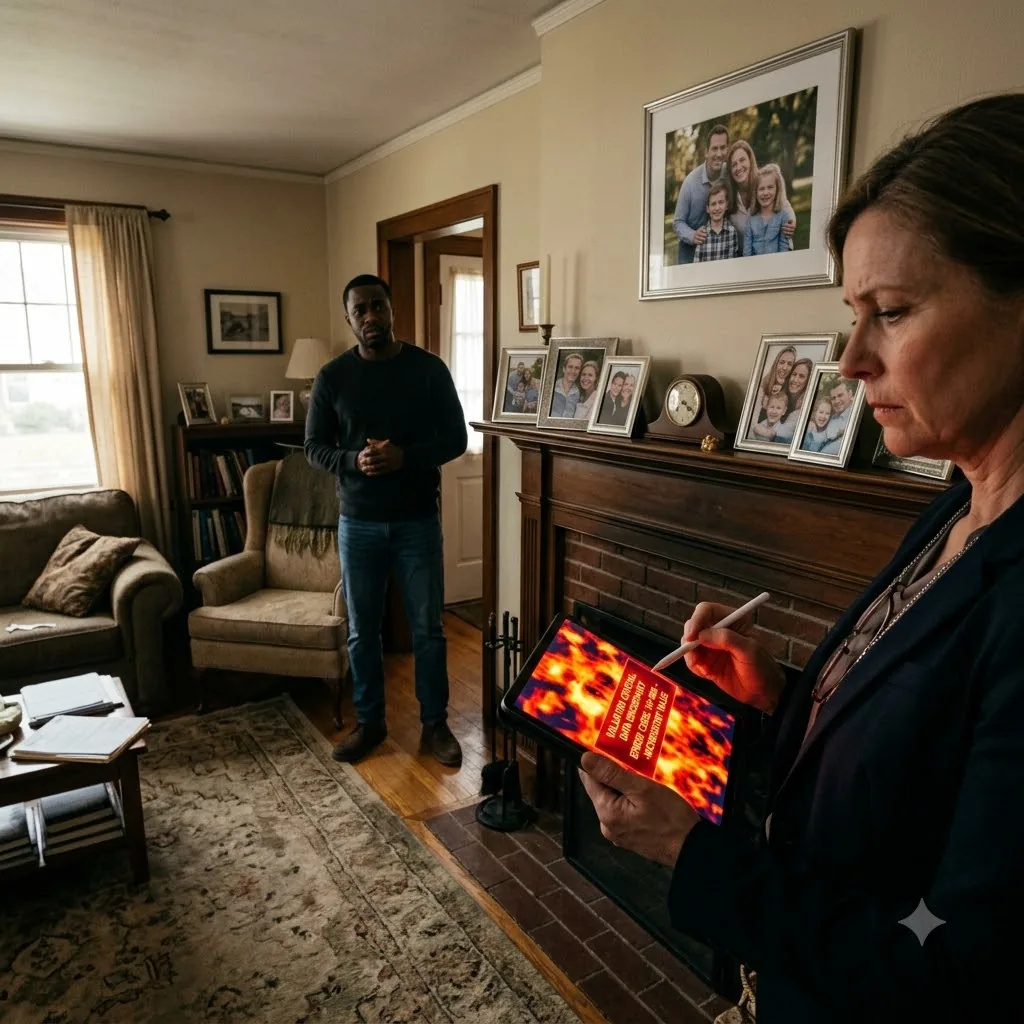
The appraiser didn’t blink. He thrust the heavy, black-cased tablet directly toward Marcus’s chest, invading his personal space. “I don’t care who you are. The algorithmic integrity scan requires environmental congruency. Look at this.”
Marcus looked down at the glowing screen, desperate to understand what invisible metric was ruining him.
The tablet displayed a translucent, three-dimensional wireframe map of the house, generated in real-time by the device’s multi-spectrum camera. The layout was perfectly rendered in pale blue lines. But right behind the master closet-in the exact spot the appraiser was pointing to-a dense, pulsing red cloud hovered in the digital void.
“The software doesn’t just measure square footage anymore,” the appraiser said, his tone dripping with condescension. “It measures structural and environmental congruency. It calibrates a predictive baseline using the verified demographic profile of the homeowners. But right there? The system is hitting a massive wall of electromagnetic interference and localized thermal output. It’s an unregistered energy sink. The machine classifies it as a Class 4 Discrepancy. It thinks there’s a concealed hazard, unpermitted substructure, or illegal commercial operation hiding behind this gypsum.”
Marcus stared at the pulsing red mass on the screen, a cold dread pooling in his stomach. He suddenly knew exactly what the machine was looking at, and exactly why it was aggressively rejecting the house.
Two nights ago, during his frantic scramble to whitewash the property, Marcus hadn’t just hidden his African art and family photos. He had been forced to scrub the house’s digital soul. He possessed a robust smart-home ecosystem: a biometric security hub registered to his name, a network router broadcasting a customized SSID, and a massive NAS tower holding ten terabytes of his family’s digital history. He knew that modern appraisal tools sometimes scraped ambient Wi-Fi data to check for neighborhood broadband quality. Terrified that a network named *Marcus_Home_Network* would instantly break the illusion of the blonde family on the mantle, he had taken desperate measures.
He had disconnected the entire server rack, shoved all the blinking, heat-generating hardware into the deep HVAC access void behind the closet, and draped the electronics in a dense, foil-lined moving blanket to choke out their wireless signals.
He had tried to silence his own existence. But he had fundamentally misunderstood the tablet’s capabilities. The software hadn’t just scanned the fake photos on the mantle; it had ingested them, built a baseline of what a home owned by that specific white family should emit, and then scanned the physical environment. The machine had detected the muffled, massive energy signature of Marcus’s hidden digital life, completely contradicting the pristine, low-tech staging of the rooms. The algorithm hadn’t found Marcus, but it had found his ghost, and it perceived that ghost as a severe, value-destroying threat.
“If I can’t verify the structural integrity of that void with my own eyes,” the appraiser said, his thumb hovering over a large red button on the screen labeled *CRITICAL FAIL*, “I log this property as a high-risk asset. The appraisal terminates. The bank pulls the refinance application, and the address is permanently blacklisted in the municipal registry.”
Marcus swallowed the dry lump in his throat. He owed fifty thousand dollars in business loans. If the refinance failed, he would lose the house anyway. He was trapped by his own deception.
“I’ll get my tools,” Marcus said softly.
He walked in his socks to the garage, his hands trembling as he grabbed a drywall saw and a heavy steel hammer. When he returned, the appraiser was standing in the exact same spot, the tablet still whining like a trapped mosquito.
Marcus approached the wall. He raised the hammer. He hesitated for a fraction of a second, mourning the perfect paint job, and then swung hard.
The steel head punched through the drywall with a sickening crunch. White gypsum dust exploded outward, raining down onto the flawless hardwood floors. Marcus swung again, and again, the physical act of destroying his own home burning like acid in his chest. He grabbed the edges of the jagged hole and pulled, snapping away a two-foot square of drywall.
In the dark recess between the studs, the heavy, foil-lined blanket had slipped. Beneath it, the LED lights of his personal servers, hard drives, and smart hubs blinked in the shadows like a cluster of waking eyes.
The appraiser let out a sharp sigh of vindication. He stepped forward, shoving Marcus aside, and thrust the tablet’s camera directly into the hole.
“Let’s see what we have here,” the man muttered.
Marcus held his breath, praying the appraiser would just see a pile of harmless electronics and clear the error code. But as the tablet crossed the threshold of the wall, moving past the remnants of the foil blanket, it entered the direct, unshielded proximity of the dormant network.
The sharp, aggressive error tone abruptly stopped.
It was replaced by a smooth, chillingly cheerful chime. Marcus watched in horror over the appraiser’s shoulder as the tablet’s screen shifted. The software had automatically bypassed the weakened firewall of the hidden router. It was reading the MAC addresses. It was scraping the device names.
A new alert materialized on the screen in bright yellow text: *Demographic Incongruency Resolved. Hidden Occupant Profile Detected. Recalculating Valuation.*
The fake, smiling family from the mantle was instantly purged from the screen’s baseline profile. In its place, the tablet began pulling the metadata from the servers in the wall. The machine was reading Marcus’s real name, his real financial history, his real demographic data.
At the top right corner of the tablet, the property’s estimated valuation number appeared in bold green font. But as the algorithm ingested the truth of who actually lived there, the text turned a dull, sickly orange.
The number began to freefall. It dropped by ten thousand dollars. Then forty thousand. Then eighty thousand, plummeting in real-time as the appraiser slowly turned his head to look at Marcus, the polite fiction of the “helpful friend” dying in the silence between them.