Story code: ST-001464
Part 3: The Dead Branch
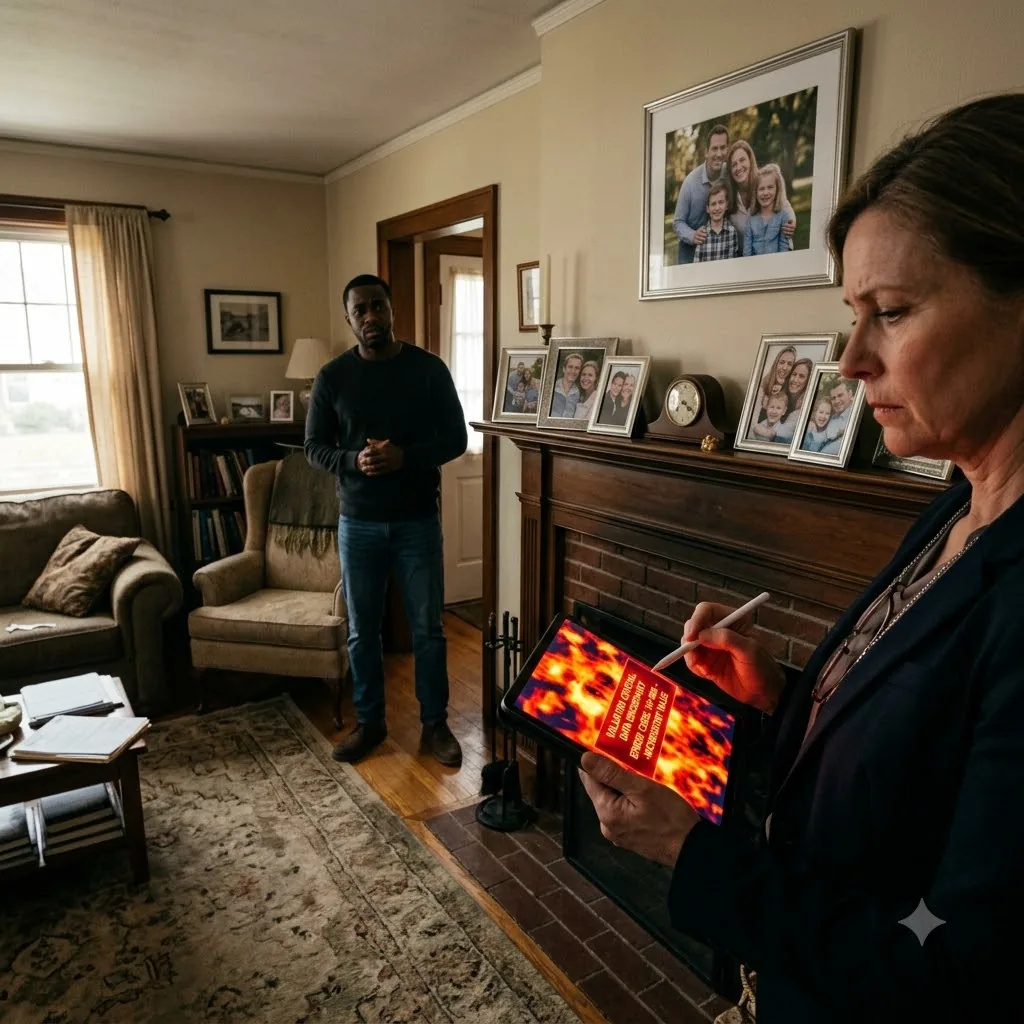
The numbers on the screen finally stopped falling, freezing on a dull orange figure that made Marcus’s stomach turn over. Three hundred and forty thousand dollars. It was barely half of what the property was worth yesterday. It was completely insufficient to cover his pending refinance.
The appraiser let out a dry, humorless chuckle. He didn’t look angry anymore; he looked deeply satisfied. The polite, professional mask melted away, replaced by the smug certainty of a man who had just caught a rat in a trap.
“A proxy,” the appraiser said, his voice dripping with condescension. “You aren’t a friend of the owners. You are the owner. And you just tried to manipulate a federal valuation with fraudulent staging.”
Marcus couldn’t speak. He stood frozen in the gypsum dust, staring at the exposed wires and blinking lights of his servers in the wall cavity. The fifty-thousand-dollar business loan he desperately needed to restructure was now a guillotine resting against his neck.
The appraiser tapped the top corner of the tablet, minimizing the 3D wireframe. “I’m finalizing the discrepancy report now. This property is being flagged for intentional algorithmic evasion. You’ll be lucky if the bank doesn’t call in your existing mortgage by Friday.”
As the man swiped downward to generate the final export, the slick, consumer-facing interface of the application slid away. For a fraction of a second, the software hung on a loading screen, exposing the raw backend diagnostic terminal.
Marcus blinked. The dust in his eyes suddenly felt very sharp.
The terminal wasn’t a standard Windows or iOS loading shell. It was a custom Linux environment, dominated by a stark, high-contrast dark mode with neon green text. But it wasn’t just the color scheme that caught Marcus’s eye. It was the cascading lines of syntax rendering the real-time valuation logic.
`[INFO] calc_baseline_demo__weight : executed`
`[WARN] array_shift_proxy_detected : true`
`[CRIT] override_deploy : bias_protocol_unpatched`
Marcus stepped forward, his sock-clad feet crunching over the broken drywall.
“Back up,” the appraiser warned, pulling the tablet toward his chest.
But Marcus didn’t back up. He leaned in, his eyes tracking the rapid scroll of the terminal block. He recognized the naming conventions. He recognized the specific, redundant double-underscore in `calc_baseline_demo__weight`. It was a syntax error he had made three years ago during a caffeine-fueled hackathon, a typo he had explicitly refused to fix because it would break a dozen dependent modules.
It was his code.
This wasn’t some generic enterprise software used by the municipal bank. This was a direct, raw build of *Axiom*, the real-estate valuation engine Marcus and his business partner, Chad, had been developing for the past three years.
But it wasn’t the current build.
Marcus’s eyes locked onto the top left corner of the terminal window before the appraiser could force the application to close. A tiny watermark sat in the header: `Branch: v.0.8.2-beta-CHAD_LOCAL`.
A cold, profound silence descended over Marcus. The panic that had been suffocating him evaporated, replaced by a chilling, absolute clarity.
Version 0.8.2 was a dead branch. It was a quarantined build from over a year ago. During their initial testing phase, Marcus had written a “bias protocol”-an aggressive, unfiltered algorithm designed to ingest historical redlining data, racial demographics, and systemic penalties. He hadn’t built it to be used; he had built it as a stress test, a baseline ghost in the machine to prove to investors how easily legacy software discriminated against Black homeowners. Once the system learned what the bias looked like, Marcus had written a patch to permanently block those metrics from ever influencing a real *Axiom* valuation.
The terminal explicitly stated: `bias_protocol_unpatched`.
The appraiser wasn’t just using their software. He was intentionally running a rigged, malicious beta version designed specifically to weaponize demographic data and tank property values.
“Why do you have that?” Marcus asked, his voice entirely devoid of the trembling fear from moments ago.
“Excuse me?” The appraiser scowled, tapping furiously at the screen to force the export to finish.
“The software,” Marcus said, taking another step forward, invading the appraiser’s space. “That’s Axiom. But it’s a localized beta shell. Why are you running branch zero-eight-two?”
The appraiser’s thumb froze hovering over the screen. The smug satisfaction drained from his face, replaced by a sudden, rigid tension. He looked up, his eyes darting to Marcus’s face. “I am using standard municipal diagnostic tools. Step back.”
“Standard tools don’t use my double-underscore typo in the baseline array,” Marcus said softly.
He looked through the archway at the framed photos on the mantle in the living room. Chad’s blonde wife. Chad’s freckled children.
*Just play the game, Marc,* Chad had told him over a beer three days ago, handing over the frames. *The appraisers are old school. Stage it with my family. Don’t let their system screw you. We need you focused on the launch, not your personal loans.*
Chad had known. Chad had suggested the staging because he knew Marcus would scramble to hide his own network to maintain the illusion. Chad knew the unpatched bias protocol on this specific build was designed to hunt for hidden data ghosts and trigger a catastrophic failure.
“You didn’t find my servers by accident,” Marcus said, the devastating reality snapping into place.
The business loan. Marcus had leveraged his fifty-percent equity in Axiom as collateral for his personal debts to keep the company afloat during year one. If Marcus defaulted on his refinance this week, his creditors would seize his assets. Chad’s custom operating agreement had a clause for that: if a partner became financially insolvent, their shares automatically reverted to the remaining founder to protect the intellectual property.
Chad had sent this specific appraiser. Chad had armed him with the rigged software. It was an assassination.
“I don’t know what you’re talking about,” the appraiser said, but his voice cracked slightly. He pressed the tablet against his ribs, shielding the screen like a guilty child. “The inspection is over. I’m leaving.”
“Who gave you the tablet?” Marcus demanded, his voice dropping an octave, echoing off the bare, eggshell walls.
“This is a bank-issued device-”
“No, it isn’t!” Marcus barked, his hands balling into fists. “Bank-issued devices don’t run local developer branches! Chad gave it to you. Didn’t he? He told you exactly where to stand. He told you to force me to break the drywall because he knew the unshielded MAC addresses would trigger the unpatched bias loop.”
The appraiser took a sharp step backward, his boots sliding slightly on the gypsum dust. The absolute authority he had wielded since he walked through the front door was gone. He looked at the gaping hole in the wall, then at the muscular, furious man standing between him and the front door, realizing far too late that he wasn’t dealing with a helpless, ignorant homeowner.
“I am an independent contractor,” the appraiser stammered, his eyes darting toward the hallway. “I was just told to run the scan.”
Marcus stepped into the man’s path, staring dead into his eyes. “Run it again.”
“What?”
“You heard me,” Marcus said, pointing a steady finger at the black-cased tablet. “Hand me the tablet, log into the developer shell, and let’s see exactly how much Chad paid you to steal my company.”
The appraiser swallowed hard, his knuckles turning white around the device, completely out of answers.