Story code: ST-001569
Part 2: The Name on the Pickup Log
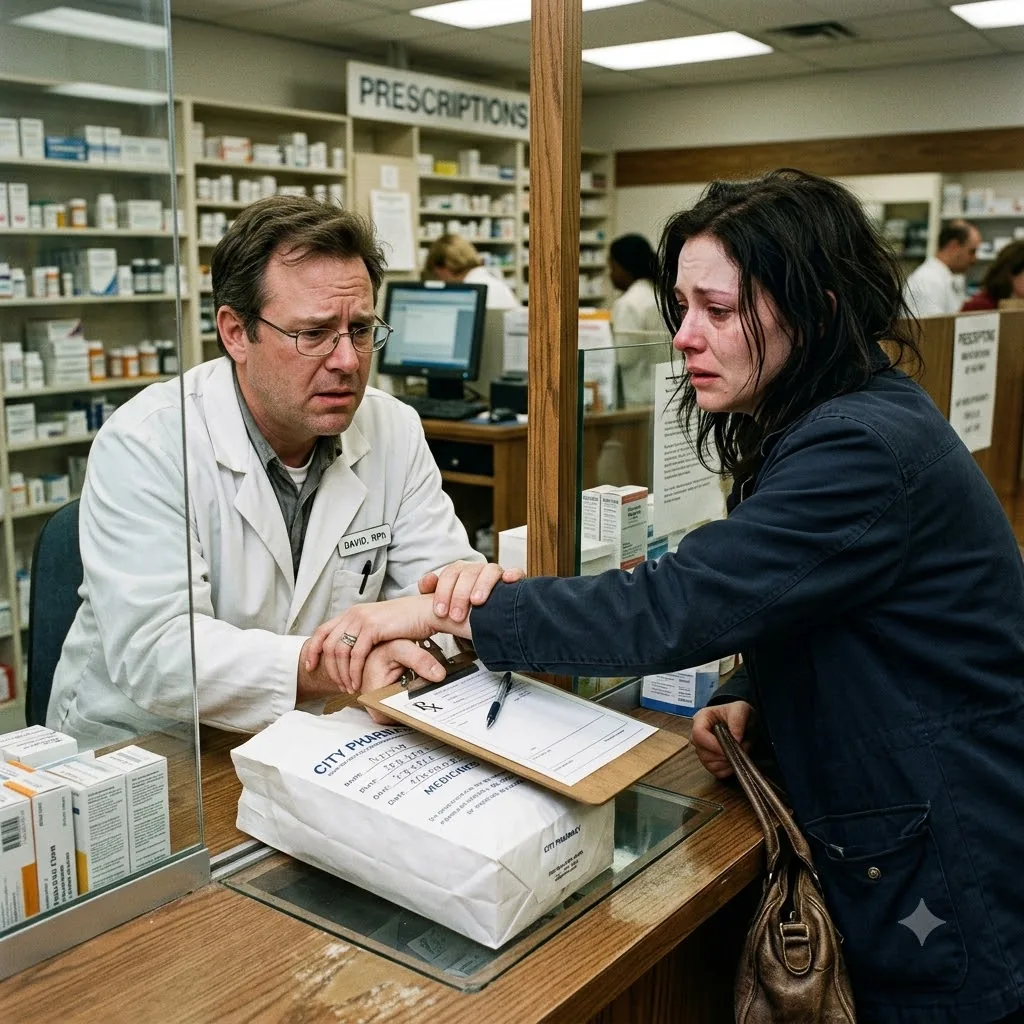
“David.” The pharmacist’s voice was low, meant for him alone, but in the hush at the counter it carried anyway.
David looked up too quickly. Rina had come from the back with the cordless phone still tucked against her shoulder, her white coat unbuttoned, a pen caught behind one ear. Her eyes moved first to his face, then to Martha’s hand spread over the laminated certificate, then to the papers aligned on the glass with the neatness of evidence.
“I need you to take window two,” she said.
It was an instruction, not yet a question.
Martha laid her palm flat over the top sheet before David could touch it. “No,” she said. “He stays here.”
Rina took the phone from her shoulder. “Ma’am, if there’s a concern, we can step into consultation and speak privately.”
“Privately is where things disappear,” Martha said.
There was nothing loud in her voice now. That made the people in line lean in farther. David could feel it happening along the counter like a shift in weather. A man near the greeting cards had stopped pretending to browse. The mother with the stroller had gone pale and intent. Mr. Denby, who complained at full volume about everything from deductibles to daylight saving time, had fallen completely silent.
Rina set the phone down beside the register. Her expression settled into the careful stillness she used with patients on the verge of shouting. “Mrs. Weller, let’s not do this at the front counter.”
Martha turned one of the papers so that it faced outward, not toward David this time but toward the space between all three of them. David saw the logo first. Then the date stamp. Then the pickup initials in the corner.
His stomach dropped so fast he had to lock his knee to keep from shifting backward.
It was one of their logs.
Not an original. A photocopy, crooked at the margin, dark where the toner had overbitten. But the columns were theirs: patient, medication, quantity, release time, released by. Enough of it was visible for David to recognize the form and enough was covered by Martha’s hand to make the gaps worse than the lines he could read.
Rina saw it too. Her face did not change much, but she reached over and turned the sheet back toward the counter in one quick motion. “Those documents should not be in your possession,” she said.
Martha’s fingers held firm. “And yet they are.”
David became aware of the white bag under his hand again, absurdly heavy, the paper already softening where his palm had dampened it. He tried to slide it farther under the clipboard. The bottom dragged against the laminate and made a thick scraping sound.
Martha heard that sound and looked down.
Rina did too.
For one bare second David thought she might tell him to put it in the safe, or in the narcotics cabinet, or anywhere except here where everyone could see him guarding it like a child caught with stolen cash. Instead she said, without looking away from Martha, “Release bin. Now.”
He should have moved at once. That was what made the hesitation visible.
Rina’s eyes flicked to him. “David.”
He curled his fingers around the bag handles and lifted. The weight dragged at his wrist. Bottles settled against one another with a dense plastic clatter that sounded far louder than it should have.
Somebody in line made a small noise. Not a word. Just the involuntary sound people make when they suddenly understand that the thing being hidden is larger than they imagined.
Martha’s gaze followed the bag all the way up. “How many days would that have bought him?” she asked.
David stopped with the bag half clear of the counter.
“Mrs. Weller,” Rina said sharply.
“No, answer me.” Martha’s eyes stayed on the white paper twisted in David’s fist. “A week? Two? Long enough for everyone to tell themselves the rules were being followed for somebody?”
David could feel the room narrowing around the bag, the certificate, the copied log. The question was impossible and it landed anyway. He opened his mouth, but nothing came out except air.
Rina stepped closer to the counter. “You need to stop. Right now. You cannot demand information about other patients, and you cannot bring internal records into this store and create a scene.”
“Create,” Martha repeated, almost thoughtfully. Then she tapped the covered portion of the photocopy. “Is that what this is called when it happens in public instead of behind a register?”
Rina’s hand went out, not touching Martha, just hovering over the papers. “David, take the bag to the release bin and call security on your way back.”
The word security changed the air. David felt it hit the listeners in line before he took a step. Bodies straightened. Eyes sharpened. The mother with the stroller drew back as if she had been standing too close to a spill.
Martha gave a single short laugh. “Of course.”
David wanted the bag gone. He wanted the papers gone. He wanted the certificate off the counter where the county seal kept flashing under the fluorescent lights. Most of all he wanted not to be the one carrying any of it. But Rina was looking at him now with that flat, professional expectation that left no room to refuse.
He turned sideways and took one step toward the swinging half-door.
“Don’t walk away,” Martha said.
He kept going.
Then she spoke his name.
Not loudly. Not angrily. Just clearly enough that he stopped before he reached the gate.
“David Larkin,” she said, and when he looked back she was holding one more paper he had not seen her pull free. “You signed this one yourself.”
The bag handles cut into his fingers.
Rina moved first. “Do not show that to anyone else.”
But the people nearest the counter had already heard the name. David saw recognition start where it always started in public trouble: with the person closest repeating the important part under their breath to the person behind them. Larkin. Signed. Himself.
Martha slid the page only an inch across the glass, not enough for the line to read, enough for David to see his own initials at the bottom of a release field and the date above them.
He knew the form before he could read the patient name. He knew the slant of his pen, the hurried second stroke on the K, the way he crowded letters when the line was building and the printer was jamming and the phone would not stop ringing.
His skin went cold.
“That cannot be out here,” Rina said, and now there was strain under the control in her voice. She looked past David toward the front end. “Tina, call the manager. Now.”
Somewhere beyond the vitamins, a cashier answered, “Already did.”
Which meant more people had noticed than David had realized.
He took another step back toward the counter despite the bag in his hand, pulled by the page the way a wound pulls attention. Martha watched him come. She did not smile. Her face looked worn through, the anger burned down into something steadier and harder.
“You told me there was no release,” she said. “You looked me in the face and told me nothing had left this pharmacy under his name.”
David stared at the initials, then at the line above them. The text blurred, sharpened, blurred again.
“I need to see that,” he said.
“No,” Rina said at the same instant.
Martha put one finger on the paper and held it where neither of them could take it without reaching across the death certificate. “That is the first true thing either of you has said to me today,” she said.
Then the side door buzzer sounded.
Not the front entrance. The side lane.
The pickup buzzer, sharp and impatient, the one meant for deliveries and discreet handoffs.
David felt the weight of the white bag drag his arm lower as all three of them turned toward the sound.