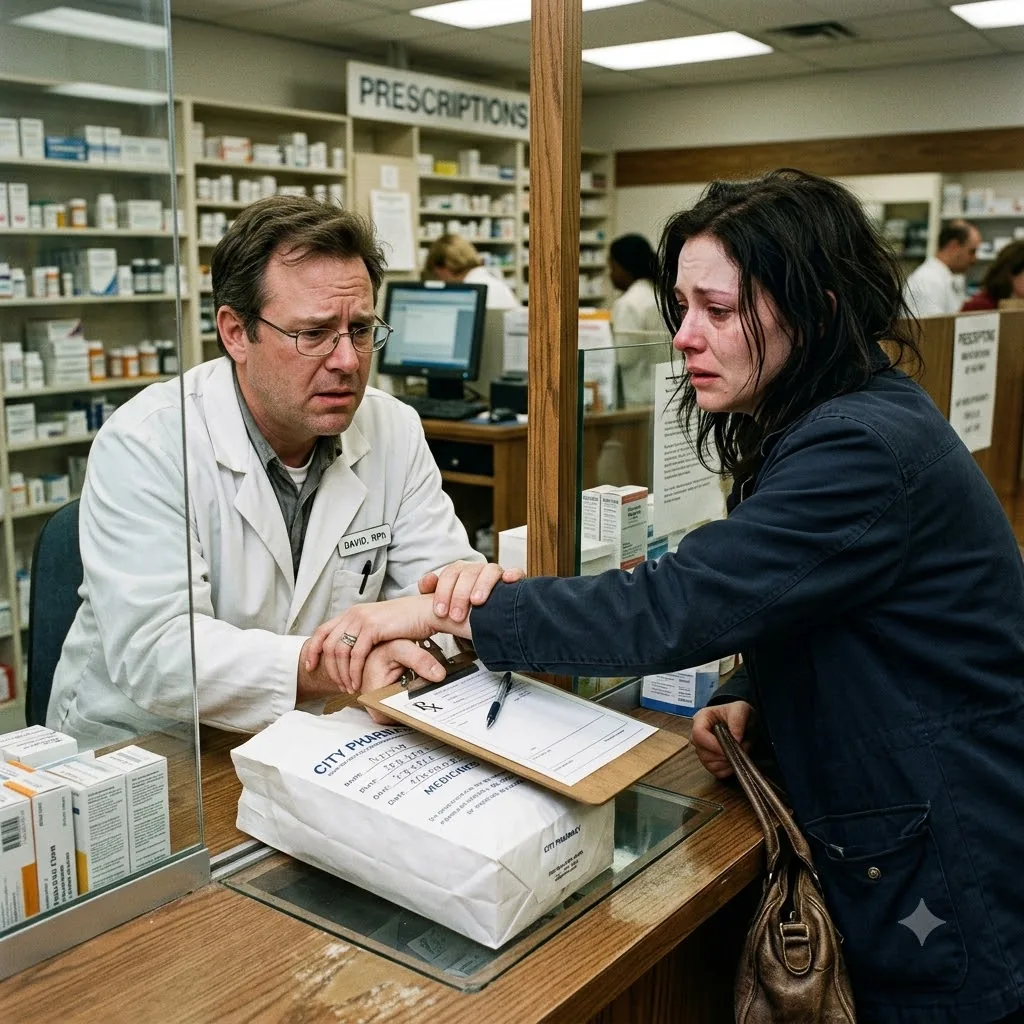
Story code: ST-001569
Part 4: The Bypass Code
The first police officer through the pharmacy gate did not look at David.
He looked at the broken glass, the woman in boots with bloodless lips and trembling hands, and the white bag hanging from David’s fist like the answer to a question nobody wanted said aloud.
Then he moved straight toward her.
“Step back, ma’am.”
The young woman opened her mouth, shut it, and stepped behind him so quickly it looked practiced, as if protection were a door she had used before and expected to find unlocked. A second officer came in behind the first and steered the line farther away from the counter. The stroller squeaked again. Mr. Denby started talking all at once, too loud, pointing in three directions while saying nothing useful.
David stayed on one knee for a moment longer because standing felt too complicated. Blood had reached his collar. He could feel it cooling there. When he finally pushed himself upright, his vision narrowed and widened again around the fluorescent lights.
“Sir, set the bag down,” the second officer said.
David obeyed at once.
He put it on the counter as carefully as if a rough landing might change what it contained. The torn paper mouth sagged farther open. One of the orange labels showed again before Rina turned the bag hard enough to hide it.
“He was assaulted,” Rina said, already reaching for gauze from the first-aid drawer under the register. “She threw bottles at him.”
But she was not pointing at the judge’s daughter.
She was pointing at Martha.
For one stunned second David thought he had misheard. Martha was still at the counter with one palm flat beside the death certificate, her coat buttoned wrong, a curl of gray hair hanging loose by one cheek. There was glass near her sleeve, but not in her hands. The young woman stood behind the officer, shielded from the glittering mess she had made.
“She incited it,” Rina said, voice clipped and fast. “She refused to leave, she produced stolen records, she was trespassing after repeated instructions, and she escalated the situation.”
Martha stared at her.
Not wild. Not shocked. Just with the kind of exhausted recognition that made David feel sicker than the blood loss did.
“Of course,” Martha said.
The first officer turned toward her. “Ma’am, I’m going to need you to step away from the counter.”
“That bag belongs in evidence,” Martha said.
Nobody answered that. The manager had arrived from the front end, breathless, tie skewed, keys already out. He came through the half-door with the frightened hurry of a man late to a disaster but eager to look useful inside it.
“Let’s calm down,” he said to everyone and no one. His eyes landed on the officer first, then on the young woman, and changed. Recognition flashed there, quick and unmistakable. His whole face softened into service. “Miss Harlow, are you hurt?”
So there it was. A name for the girl from rehab, and a tone reserved for people whose names mattered more than broken glass.
She shook her head once, hard, like a child refusing blame.
The manager turned to Rina. “Is her order ready?”
David looked at him.
Looked at the blood on the counter, the photocopies spotted with cough syrup, the county seal on the laminated death certificate, the officer positioning himself between the VIP and the mess, and still heard the manager ask the one question that protected the store’s habit of pretending this was all normal.
Rina hesitated only a breath. Then she took the white bag, folded the torn edge inward, and held it out.
“Yes,” she said.
The officer nearest the young woman accepted it before the manager could. Not confiscating it. Shielding it from the broken glass while he passed it back to her. The motion was almost gentle.
David watched her clutch the handles he had been cutting his hand on for the last twenty minutes. She would leave with the pills. That fact entered him with a dull, permanent force, more bruise than shock.
At the counter, the second officer was asking Martha for identification.
“You can’t seriously be arresting her,” David heard himself say.
Everybody looked at him then, and he wished at once he had stayed silent.
The room tipped toward him: the officer with his notebook half out, the manager’s warning stare, Rina with gauze in one hand and fury in the set of her mouth. Even Martha turned.
“Sir,” the officer said, “do you need medical attention?”
It was not an answer.
David touched the side of his head and looked at the smear on his fingers. He thought of the photocopy with his initials on it. Of the release field. Of Martha saying he had told her nothing left under her son’s name. He could no longer remember if that had been a lie, a script, or a sentence he had repeated so many times it had hollowed itself out into procedure.
“I need to finish the override queue,” he said, and heard how insane it sounded.
The manager seized on it immediately. “Exactly. We need to restore operations.” He pointed toward the consultation sink. “Rina, patch him up. Officer, we’ll cooperate, but we cannot have patients blocked from care.”
Blocked from care.
David almost laughed.
Martha did not resist when the officer took her arm. She only gathered her papers first, slow and deliberate, except for the photocopies Rina snatched away before she could reach them. The death certificate slid crooked, catching on syrup and glass. Martha straightened it with two fingertips.
When she looked at David, there was no plea left in her face. No expectation. Whatever she had come for had been taken from her long before today. This was only the public version.
“You know what that code means now,” she said.
The officer started to guide her toward the front.
David’s eyes went to the terminal beside register three.
The screen had timed out during the shouting. He tapped the mouse, and the pharmacy system woke with its usual blue-white glare. The pending override still blinked in the corner where he had left it before any of this began, a neat little box asking for confirmation on an access path he had used too many times to feel its shape anymore.
Bypass code required.
He could hear the young woman thanking the officer. Hear the manager apologizing to her in a hushed, urgent voice. Hear Rina telling the remaining customers there had been an unfortunate disturbance and service would resume shortly. Resume, as if trust were a receipt you could reprint.
Martha was almost at the gate when she glanced back once.
David did not raise a hand. Did not speak. He stood behind the counter with drying blood on his temple and the terminal blinking for him to continue.
He knew now, with a clarity that felt worse than confusion, what he was allowed to lose and what the store would protect.
The manager came back to the station, lowered his voice, and set a fresh phone by David’s elbow. “Take the next customer,” he said. “And put in the code.”
David stared at the screen until the numbers doubled in his vision, then steadied. Outside the gate, the officer led Martha past the greeting cards and the spring displays toward the front doors. Inside it, the line began to form again, smaller and quieter, but forming all the same.
He lifted the receiver, heard the next call connect in his ear, and looked at the blinking box waiting for his hand.