Story code: ST-001572
Part 4: The Time It Took
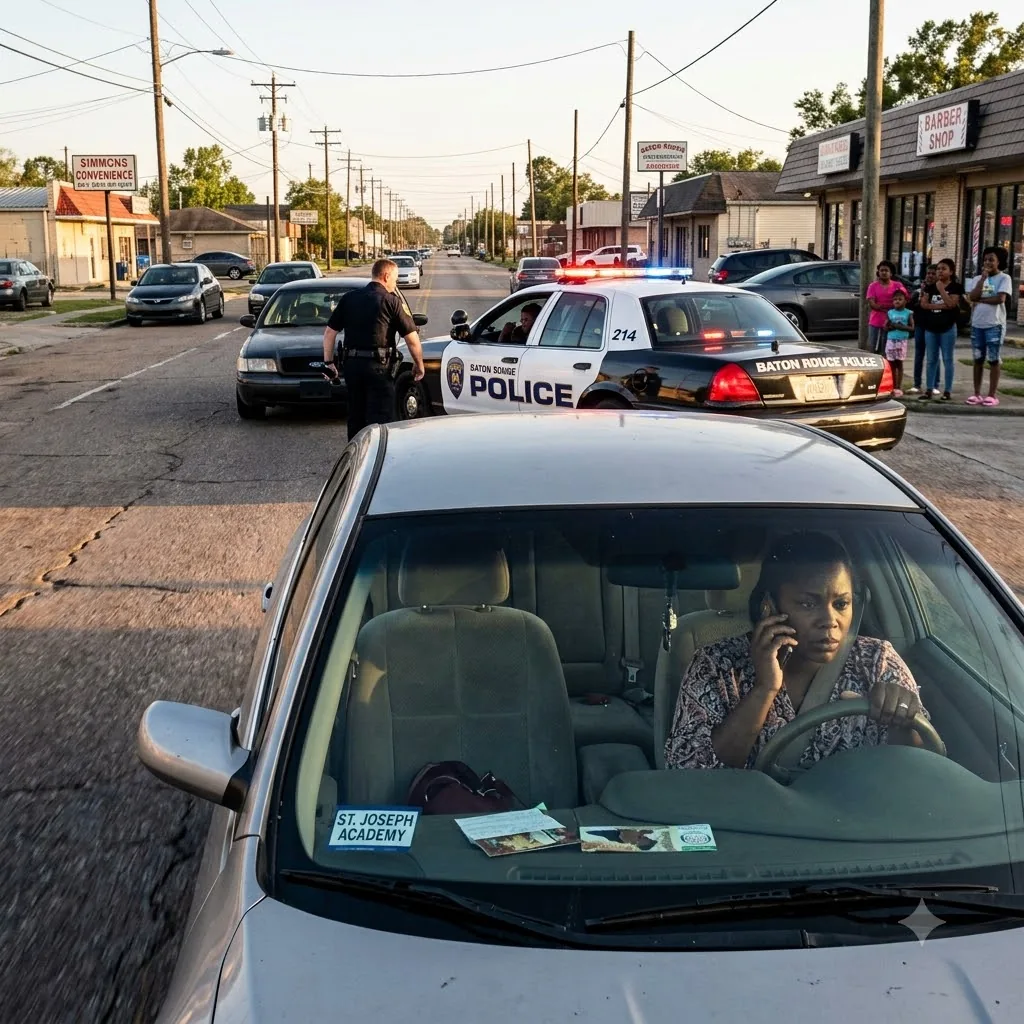
The officer’s hand came off Jabari at last, but not with the speed the moment deserved.
It lifted first in uncertainty, then fully, as if procedure had to unclench one finger at a time. Jabari pushed himself up on shaking arms and got one knee under him. He did not look at the officers. He looked only at the open medical bag on the pavement.
“Give me that,” he said.
His voice had gone flat in a way Lenora hated more than panic.
The officer nearest the bag picked it up and handed it over without answering. The receiver inside still flashed LOW in red, still beeped every few seconds like a small machine refusing to let any of them hide inside confusion now.
Lenora was already moving toward her son. Nobody stopped her this time. She reached him just as he got to his feet and saw the torn knee of his jeans, the grit stuck to his cheek, the wild rise and fall of his chest. She put both hands on his face for one second, checking for damage she could not fix here.
“Get in the car,” she said.
“We need to go.”
“I know.”
One of the officers started saying something-maybe an instruction, maybe an apology, maybe only words meant to slow bodies down because that was easier than admitting they had wasted the only thing that mattered. Lenora did not stay to hear which one it was.
Jabari snatched his phone from the hood of a patrol car where someone had set it. The screen was cracked across one corner. He climbed into the passenger seat with the bag hugged against his ribs. Lenora slid behind the wheel and pulled away before the door had fully settled shut.
Only after they turned onto Franklin did she realize her own hands were still trembling too hard to keep the car straight.
“Call Trina back,” she said.
Jabari already had. He put the phone on speaker between them. Trina answered crying, then talking, then crying again, her words colliding.
“He’s breathing but it’s wrong. I got orange juice in him, I think, but he won’t wake up all the way. His skin is cold. Where are y’all?”
“Seven minutes,” Lenora said, though she did not know if that was true. “Keep talking to him. Keep him on his side if he starts vomiting. If he swallows, give him more juice. If he doesn’t swallow, stop trying to pour anything in. Did you call an ambulance?”
The silence on the other end told her before Trina did.
“I thought Jabari was getting the stuff,” Trina whispered.
Of course she had. Everybody had made the next best decision inside the space left by the one before it. Curtis texted. Jabari drove. Lenora kept working because the bills did not care what kind of evening they were having. Trina waited because family was faster than money and often kinder. Then a traffic stop turned all of it into delay.
“Call now,” Lenora said. “Stay on with me from your other phone if you have to. Call now.”
Jabari stared out the windshield while Trina fumbled away from the speaker. In the glow from the dash, his face looked older and much younger at the same time. There was dirt in one eyebrow. His hoodie string had broken loose. He kept one hand on the black insulated bag as if someone might still try to take it.
“Are you hurt?” Lenora asked.
He shook his head.
A beat later he said, “He asked me what was on the floor, and I lied.”
Lenora swallowed. “You were scared.”
“I lied first.” He kept looking ahead. “Then when I told the truth, it was too late.”
That was the trade she had taught him for years without meaning to: survive the stop first, explain later. Be polite first. Be still first. Never give anybody a reason. The rules had always carried an ugly promise under them, that if he followed them perfectly, he could hold disaster back with manners and visible hands.
Now that promise was gone.
“No,” she said, and heard how thin the word sounded. “It should not have been too late.”
He did not answer.
At Trina’s duplex, the ambulance was already there, lights strobing silently against the sagging porch roof. That sight hit Lenora with mean clarity. Relief, because somebody had finally arrived with what should have been there sooner. And shame, because it had not been her. She had spent years being the dependable one, the woman who knew what medicine to bring and what form to sign and what number to call, and tonight she had not even known where her son was driving.
She stopped crooked behind the ambulance. Jabari was out before the engine died, carrying the bag toward the house at a run. Lenora followed and entered on the smell of spilled juice, sweat, and the sharp antiseptic tang of paramedics opening supplies.
Curtis lay on the living room floor beside Trina’s couch, one arm flung out as if sleep had dropped him there carelessly. A paramedic was fitting oxygen over his face. Another was checking a line, speaking in short clipped phrases Lenora knew too well from hospital rooms and home visits and every place where urgency had to sound calm.
Curtis’s eyes were half open. Not seeing. Then, as Lenora knelt beside him, they moved.
Not focus. Not recognition exactly. But movement.
“Hey,” she said, and the word tore on the way out. “Hey, Curtis. We’re here.”
Jabari dropped the bag beside the med kit the paramedics had opened, then stopped with both hands hanging empty at his sides. He had made himself necessary all night. Now professionals were in the room, and there was nothing left for him to do but watch his father breathe through plastic and listen to strangers say numbers.
That was another thing lost in the span of an hour: his role. He had been the one in motion, the one carrying the fix, the one trying to bridge the distance. Now he was just a boy with road grit on his face standing in his aunt’s living room while adults took over too late to make the lateness disappear.
Trina came in from the kitchen clutching two phones and collapsed against the wall, crying in exhausted little bursts. Lenora wanted to go to her, to Jabari, to Curtis, to all three at once. Instead she stayed where she was and pressed two fingers to Curtis’s wrist below the tape line, needing to feel for herself that something still answered there.
The pulse was present. Thready, but present.
One of the paramedics asked for his medication list. Lenora knew it. Another asked when he had last been responsive. Trina answered badly, then Lenora answered better, then both versions sat in the room together, neither one enough to buy back the curb, the commands, the hand on Jabari’s back, the minutes spent proving what should have been obvious.
Outside, a patrol car rolled slowly past the duplex and kept going.
Jabari saw it through the front window. His whole body stiffened, not dramatically, just once, deep and final. Lenora saw then that even if Curtis woke clear and speaking, even if the hospital said they had caught it in time, something would remain broken in her son that could not be packed back into a lesson about keeping calm.
She reached for him without standing, and after a second he came close enough for her to catch his wrist.
The monitor from the bag had finally gone quiet. The room was full of other sounds now-oxygen hiss, packaging tearing, Trina trying to steady her breathing-but Lenora could still hear the beeping in her head, measuring out exactly what fear had cost them.