Story code: ST-001572
Part 2: The Distance Does Not Care
Lenora was moving before she knew what direction she had chosen.
She shoved herself back into the driver’s seat, threw the car into gear, and pulled so hard from the curb the tires chirped. The phone was still connected to the car speakers, but the line had gone to that empty electronic silence that was worse than static. No breath. No voice. No officer. Just absence.
“Jabari.” She hit the call screen with one finger, missed, hit it again. “Come on. Come on.”
The red light at the corner held. She looked both ways, then drove through it anyway, one hand locked on the wheel, the other stabbing at his name. It rang once and dropped. The second time it went straight to voicemail.
“Baby, pick up.”
Her own voice sounded strange in the car, thin and useless.
She called back again and got nothing. She switched to messages with her thumb shaking so badly she had to correct three letters.
DO NOT MOVE. CALL ME NOW.
Then, because the first one felt too much like an order sent into a void, she sent another.
I’M COMING.
The map on the dash still showed her last patient address, not his location. She had been too focused on his voice to ask what cross street he was on. Now all she had was what she had heard: gravel under the officer’s shoes, a bassline from somewhere nearby, traffic moving fast enough to hiss, a dog barking, the officer asking where he was headed after the glove box opened. None of it was enough. It was all every street and no street.
Lenora grabbed her work phone from the console and called him from that number too. Straight to voicemail.
She dialed 911 before she could think herself out of it.
“911, what’s your emergency?”
“My son was on the phone with me during a traffic stop and the call cut off.” She took a turn too fast and heard something slide off the passenger seat onto the floor. “I need to know where the stop is. Please. He’s seventeen.”
“Ma’am, what’s his location?”
“I don’t know. I was trying to get it from him. He said he got pulled over, and then I heard an officer, and then-” She swallowed. “Something happened. I heard shouting.”
“Do you know what city he’s in?”
“Here. West side. He had my car. He was supposed to be coming home.” The words tripped over each other. “Dark blue Accord, plate-”
She recited the plate. Her mouth had gone dry by the last digit.
The dispatcher asked for Jabari’s full name, age, description. Lenora gave each answer with the terrible clarity of someone handing over pieces of a child to a stranger. Black male. Seventeen. Six foot one. Gray hoodie. The dispatcher asked if he was armed.
“No.” The answer came out so sharp it hurt her throat. Then, because sharpness could be mistaken for evasion, she forced herself to add, “Not that I know of. No.”
A pause. Keys clicked faintly on the other end.
“Can you tell me why he was stopped?”
“No. He just called me and said he’d been pulled over. The officer had him out of the car. Then he kept-” She stopped.
Kept looking at the floorboard. Kept saying he had to get something. Kept sounding less like a boy making a bad choice and more like someone watching a fuse burn down.
She did not know how to say any of that without making it worse.
“Ma’am?”
“He said there was something in the passenger side floor area, and the officer told him not to reach. Then the line went dead. Please tell them his mother is trying to contact him. Please tell them he was listening.”
The dispatcher said units were checking active stops matching the plate. The dispatcher said stay on the line. The dispatcher said if Lenora knew where he might have been coming from, that could help.
Lenora knew one thing he had lied about. He had not been headed home when the officer asked. She heard that in his voice as clean as if he had said the words outright. And now the lie stood between her and him like another locked door.
“I don’t know where he was,” she said.
The shame of it landed hot and immediate. She knew his laugh from the hallway when he was trying not to wake her. Knew the rhythm of his feet on the stairs. Knew when he was hungry by how hard he closed cabinets. But she did not know where he had been driving tonight, and now every place he had not told her about seemed to spread across the city all at once.
She took another corner and recognized the stretch ahead: auto body shop, boarded laundromat, liquor store with the flickering yellow sign. This was at least a direction. She rolled her window down at the next light and listened, ridiculous as it was, for bass from some nearby car or a dog losing its mind behind a fence.
Nothing. Just traffic and her own engine.
The dispatcher came back. “We may have a stop associated with that plate near Franklin and Givens. I can’t give you operational details, but officers are on scene.”
Lenora was already turning before the woman finished. Franklin and Givens was eight minutes away if the lights were kind and twelve if they were not. Eight minutes was impossible. Twelve was obscene.
“Tell them I’m his mother. Tell them not to let him move. Tell them-” Her voice broke, and she bit it flat. “Tell them he is scared.”
“Ma’am, for your safety, do not approach officers on scene. If you arrive, remain in your vehicle unless directed otherwise.”
Lenora laughed once, a sound with no humor in it. Remain in your vehicle. As if there were still such a thing as remaining.
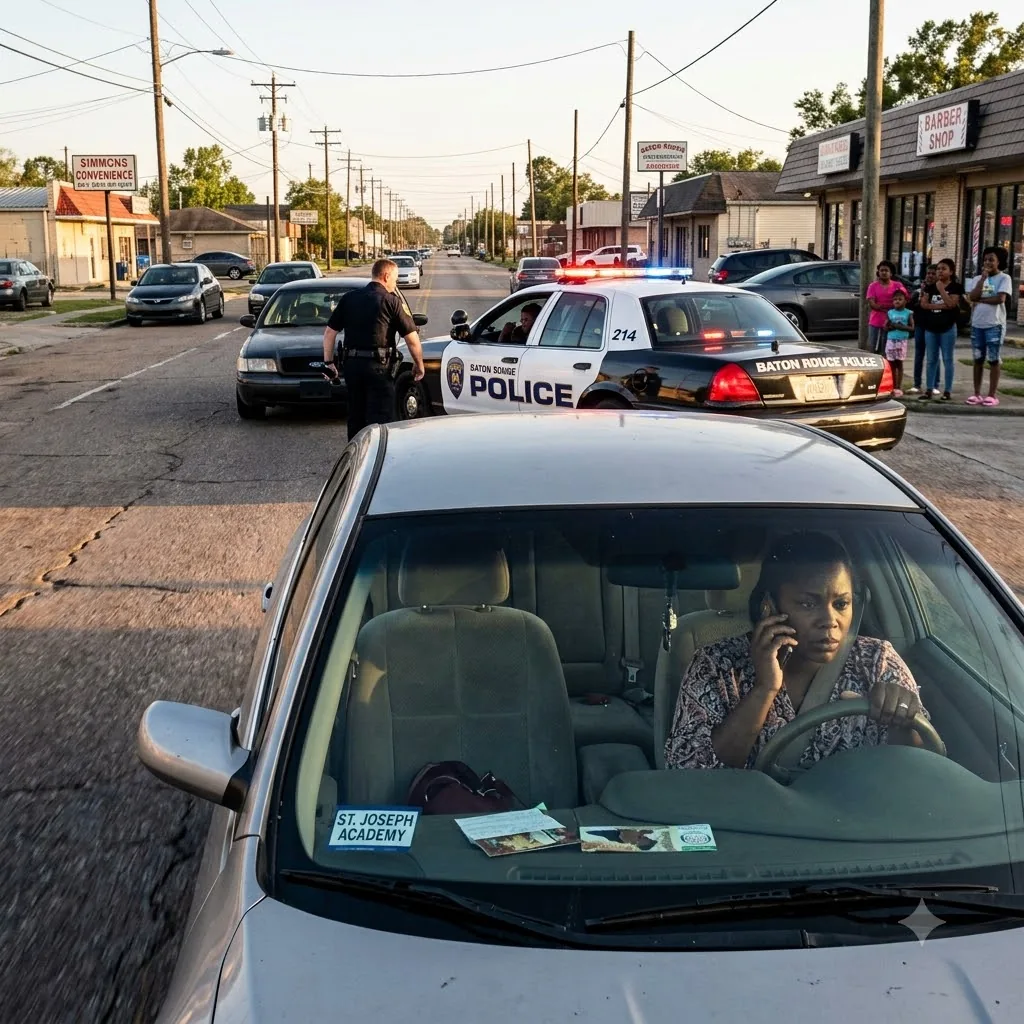
She reached Franklin on a stale green and saw nothing at first but a row of shut storefronts and a bus stop lit like an aquarium. Then, half a block down Givens, the red and blue wash hit the side of a cinderblock building and turned its wall into a pulse.
Her hands tightened so hard on the wheel that pain shot into her wrists.
Two patrol cars. No ambulance. One officer near the rear of her Accord. Another by the passenger side. The driver’s door stood open. The dome light spilled a weak yellow square across the pavement.
And on the ground, near the back bumper, a shape she knew by size before she could make out anything else.
Lenora pulled toward the curb and a third officer she had not seen stepped out fast, palm up, stopping her before the car had fully rocked to a halt. She hit the brakes anyway and leaned across the console.
“That’s my son.”
“Stay in the vehicle, ma’am.”
“That’s my son!”
The officer’s flashlight struck her windshield, bleaching everything beyond it. She could no longer see Jabari, only the smear of lights around where he had been.
“Turn the engine off and keep your hands visible.”
For one wild second she nearly got out anyway. Every nerve in her body pulled toward the street, toward him, toward the open car door and whatever was on that passenger-side floorboard that had been worth this much danger to him. Then she saw another movement past the glare: one of the officers bending, not to help Jabari up but to look inside the car.
At the same moment, from somewhere under the blue-red wash, she heard a thin, urgent sound begin inside her Accord.
Not a ringtone.
A beeping. Fast. Repeating. Coming from the passenger side floor.