Story code: ST-001626
Part 4: Dead Weight
Martin did not say a single word. The Vice-Chair’s meticulously maintained composure collapsed under the sheer, unhinged violence of Greg’s outburst. He took a staggering step backward, his silver-rimmed glasses slipping down the bridge of his nose. For a fleeting second, Greg thought Martin might try to salvage the ruined aluminum clipboard or gather the pink carbon-copy citations fluttering across the damp grass, but self-preservation won out. Martin turned on his heel and fled. He didn’t break into a full sprint-that would be unbecoming of an Oak Creek board member-but his stiff, panicked speed-walk was completely devoid of dignity. His expensive leather shoes slapped frantically against the wet asphalt as he scurried back toward his own property, casting one terrified glance over his shoulder before disappearing behind a perfectly trimmed row of arborvitae bushes.
Greg stood alone amidst the wreckage of his fabricated authority. His chest heaved, drawing in ragged breaths of the crisp morning air. His hands were shaking so violently he had to press them hard against his thighs just to steady himself. Across the street, the utility worker in the neon vest paused his work, pulling a pair of heavy, noise-canceling headphones over his ears. The worker offered a slow, indifferent shake of his head before turning his back on the cul-de-sac, returning to his diagnostic tablet and the deep, oscillating hum of the diesel generator. The world was already moving on.
The adrenaline that had spiked Greg’s heart rate to a dangerous rhythm finally broke, draining from his veins like ice water. It left behind a hollow, sickening exhaustion. His legs felt useless. Without a conscious thought, Greg turned and trudged toward the street. His hard-soled loafers dragged heavily across the manicured turf. He reached the edge of the driveway and sank down onto the curb. The cold, damp concrete immediately soaked through his thin pajama pants, but he couldn’t bring himself to care. He sat with his elbows resting heavily on his knees, his face buried in his trembling hands. He was a forty-two-year-old Senior Vice President of Operations sitting on a curb in a navy windbreaker, stripped of his security badge, his daily schedule, and the petty illusion that he possessed any real power at all.
He looked up at his own house. The colonial-style facade looked entirely foreign to him now. Somewhere behind those expensive windows sat his mahogany desk and the dead Dell Latitude. Sixteen years of precise route optimizations, endless conference calls, and perfect performance reviews, all wiped clean by an automated script in the dark. He wondered how long it would be before the bank ran a script of its own, flagged his missed mortgage payments, and dispatched a new crew to change the locks.
A faint rustling sound drew Greg’s gaze back to the lawn of number forty-two. The neighbor-the Russian engineer with the meaningless doctorates and the terrified eyes-was still standing by the heavy plastic storage bin. The man looked down at the framed diploma he had tried to thrust into Greg’s hands just minutes ago. Slowly, deliberately, the neighbor wiped a smudge off the glass with the thick sleeve of his faded gray sweatshirt. He lowered the frame back into the bin, nestled it gently among the heavy leather-bound portfolios and the hundreds of printed rejection emails, and securely latched the lid.
The neighbor looked across the grass at Greg. The frantic paranoia about black vans and grid sweeps had vanished completely from the man’s weathered face, replaced by a profound, weary resignation. Greg could see it in the sudden slump of the man’s broad shoulders-the realization that Greg wasn’t a master technician or a corporate agent. Greg was just another casualty. Another piece of obsolete machinery tossed out into the yard.
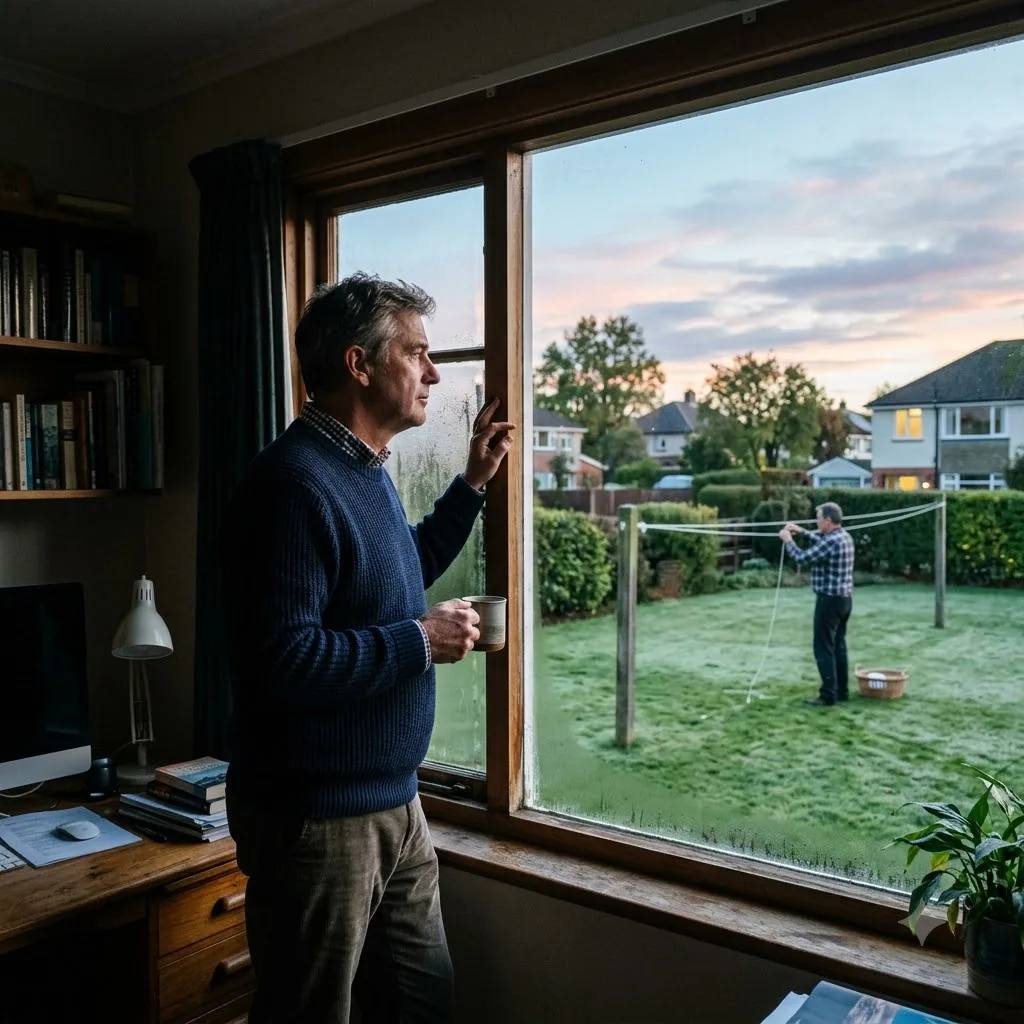
Without a word, the neighbor walked past the storage bin and approached the mature oak tree. He reached up and grasped the braided nylon rope. Greg watched, too exhausted to speak, too numb to explain that none of the neighborhood covenants meant a thing. As Greg watched, he realized the neighbor wasn’t looking at the shattered aluminum clipboard on the grass. He wasn’t taking down the clothesline out of fear of a fifty-dollar fine.
The neighbor untied the knot with thick, calloused fingers. The line went slack. The mother emerged quietly from behind the decorative white pillar, leaving the heavy steel crowbar resting uselessly against the brickwork. She picked up the brightly colored laundry basket. Together, they began unpinning the damp towels and shirts. They moved with a quiet, practiced synchronicity. It was a gentle dismantling of the morning’s bitter conflict.
To Greg, it was a gesture of pure solidarity. He knew the neighbor was packing away the infraction in silent, mutual understanding. It felt like the only grace the broken engineer could offer to a man who had just watched his own professional existence dissolve into thin air. When the last yellow towel was folded and the nylon rope was coiled neatly around his arm, the neighbor picked up his plastic storage bin. He paused at the edge of his driveway, looked directly at Greg on the curb, and gave a single, slow nod.
Greg swallowed the dry lump in his throat and nodded back. It was the truest exchange he had experienced in sixteen years. The neighbor carried his heavy bin of obsolete knowledge into the house, and the front door clicked shut. Greg remained on the cold concrete curb. The morning sun finally crested the rooftops, casting a bright, indifferent light over the perfectly identical houses of Oak Creek. The automated sprinklers at number forty hissed to life, spraying fine, mechanical mist into the empty air, leaving Greg to wait in the silence for the rest of his life to begin.