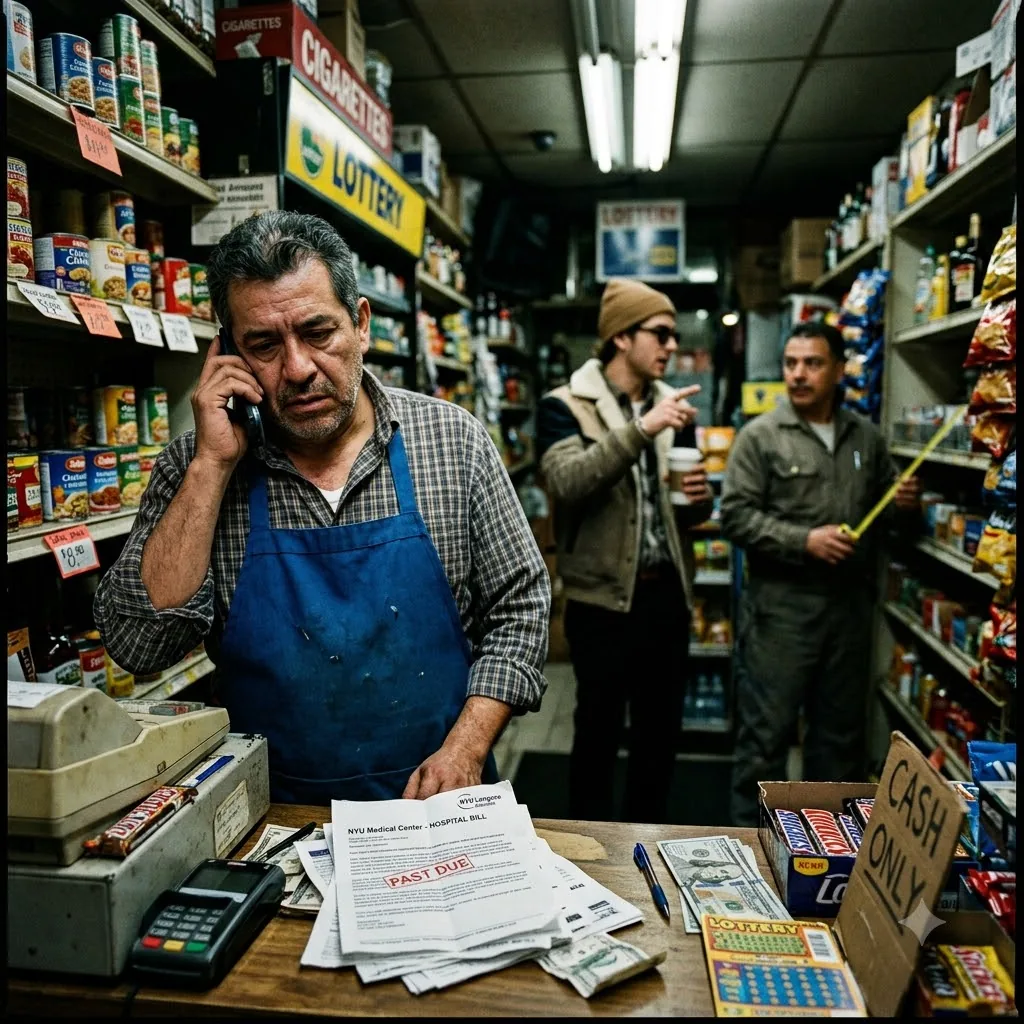
Story code: ST-001667
Part 4: The Maintenance Fee
Julian coughed violently, waving a manicured hand through the thick, gray concrete dust. He pressed his back so hard against the wooden stairs that they creaked in protest. Another flurry of dry plaster drifted from the bowing timber overhead, dusting the shoulders of his camel-hair coat in white powder.
“Okay!” Julian shouted, his voice cracking into a high, desperate register. “Stop! Don’t swing it again! I’ll pay it!”
Hector did not lower the sledgehammer. The heavy iron head hovered inches from the remaining, fractured cinder blocks. His heart beat with a slow, heavy rhythm that felt entirely disconnected from the sheer, suffocating panic radiating from the millionaire in front of him.
“Eighty-two thousand is just the current balance,” Hector said, his voice flat and echoing in the damp basement. The realization of what he needed to do crystallized in the cold air. He could not just take a check. A check could be canceled. A wire could be reversed the moment Julian left the building. He needed an ironclad cage, one as inescapable as the financial trap Julian and the hospital had built for him. “My wife’s treatments will continue for months. You are not just paying this bill, Julian. You are signing a new lease.”
Julian stared at him, bewildered and terrified. “A lease? I’m tearing this place-”
Hector shifted his weight, pulling the heavy hammer back another inch.
“Ten years,” Hector interrupted, his grip tightening on the hickory handle. “Standard commercial tenant rights. And a monthly building maintenance fee, paid directly to my business account. A fee that will exactly match the medical bills as they arrive.”
“That’s extortion,” Julian breathed, wiping the dust from his face and leaving a smeared, gray streak across his cheek. “You’re holding my property hostage.”
“I am holding your foundation hostage,” Hector corrected. “You bought a condemned building without an inspection. I am offering to keep it standing. Do we have a deal, or do I finish the demolition?”
He dug his work boots into the dirt floor. The rotting timber beam above them let out another agonizing shriek.
Julian looked at the shattered blocks, then at the massive, sagging wood holding up his multi-million-dollar vision. The color was completely gone from his face. “Deal. We have a deal.”
“We go upstairs,” Hector commanded. “You will use your phone. You will wire the eighty-two thousand directly to the hospital’s billing department. Then you will draft the lease amendment on your tablet. You will sign it, and you will email it to me.”
Hector stepped back, keeping the sledgehammer firmly in his right hand, and gestured toward the stairs. Julian scrambled up the wooden steps, stumbling in his expensive leather shoes, desperate to get out from beneath the literal crushing weight of his own investment.
Back in the main store, the silence was sharp. The foreman, still waiting by the front door, straightened up when he saw his boss emerge covered in debris, shaking visibly.
“Boss? What the hell happened down there?” the foreman asked, taking a step forward.
“Get out,” Julian snapped, pulling his digital tablet from his briefcase with trembling hands. “Wait in the car.”
The foreman looked at Hector, who stood by the dairy case, the twenty-pound sledgehammer resting easily against his leg. The younger man swallowed hard and left, the cheerful electronic chime mocking the heavy tension as the glass door swung shut.
For the next forty minutes, the bodega became a makeshift boardroom. Julian typed frantically on his screen, his corporate bravado entirely stripped away. He was a man fighting for his empire, terrified that a single swing of iron would turn it all to rubble. Hector stood behind the counter, forcing Julian to put the call to the hospital on speaker.
Hector listened to the automated medical billing voice-the same robotic woman that had tortured him for hours-suddenly yield to the influx of Julian’s capital. The eighty-two thousand dollars cleared. Maria’s account showed a zero balance. The next round of chemotherapy was authorized instantly.
Then came the contract. Julian turned the tablet around. It was a ten-year commercial lease, locking in Hector’s original rent, complete with an ironclad rider for a monthly ‘structural maintenance fee’ to be assessed and billed at the tenant’s discretion.
“Sign it,” Julian muttered, his voice hollow.
Hector tapped the digital line with his thick, calloused finger. A copy immediately arrived in his email.
Julian packed up his briefcase without another word. He didn’t look at the shelves. He didn’t look at Hector’s grandfather’s portrait. He just walked out the front door, getting into the idling black SUV, which sped away from the curb before the door was fully closed.
Hector stood alone in the quiet store. The threat of the neon measuring tape was gone. The shelves were safe. He walked to the front door, pulled the heavy metal security grate down, and locked it.
He walked back to the checkout counter and stared at the sledgehammer resting on the floor.
Upstairs, he could hear the soft, steady rhythm of Maria’s cane as she moved across the apartment. She was going to live. The suffocating weight of the hospital debt had vanished, replaced by the sterile, digital proof of the signed contract.
But as Hector looked up at the faded photograph of his grandfather Arturo, a cold, heavy stone settled in his gut. Arturo had built this place with honest sweat, trusting the store to protect them. Hector had saved it, but he had done so by becoming the exact kind of monster Arturo despised. He was no longer a simple grocer. He was a man holding a trigger, living every day with the knowledge that his wife’s survival was funded by terror.
He reached out and slowly peeled the blue painter’s tape off his grandfather’s face, but the feeling of dirt on his hands remained.