Story code: ST-001667
Part 2: The Price of Plaster
“Stop!” Hector’s voice cracked like a whip, surprising even himself with its raw, guttural volume.
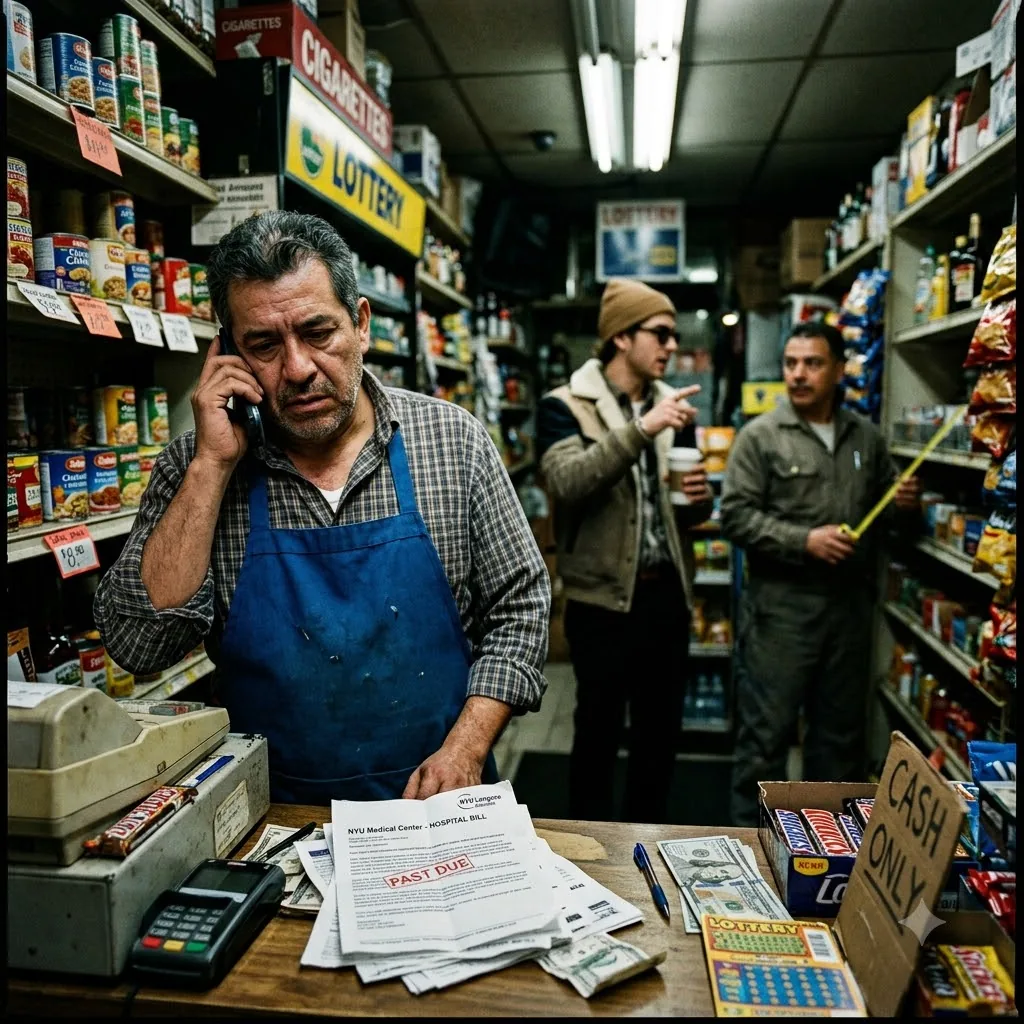
He dropped his smartphone onto the counter. The screen slammed against the sharp metal corner of the cash register, spider-webbing instantly and killing the harsh voice of representative four-two-nine. Hector didn’t care. He vaulted over the low swinging door of the checkout lane, moving with a desperate speed that belied his aching joints, and closed the distance to the back wall in three long strides.
His thick hands clamped around the cold steel of the pry bar just as its curved edge bit into the yellowing plaster. The younger contractor yanked back, his eyes wide with sudden alarm, but Hector’s grip was locked tight. He could feel the vibration of the scraping metal traveling up his forearms, a sickening tremor that threatened to shake the bodega to its bones.
“Hey, man, back off!” the young contractor shouted, trying to wrench the heavy tool free. “What is your problem?”
“You do not touch that wall,” Hector breathed, his chest heaving. His knuckles were bone-white against the dark iron. “You are measuring. Only measuring. That was the agreement until Friday.”
The older contractor, the one with the digital tablet, marched down the aisle, his heavy boots crushing a stray packet of dried chilies. “Let go of the bar, buddy. We’re just checking the stud depth. Julian said this place needs to be stripped to the skeleton by the weekend, and we aren’t getting behind schedule because you can’t read an eviction notice.”
“The notice says Friday at midnight,” Hector said, his voice dropping to a dangerous, quiet rasp. He released the pry bar so suddenly the younger man stumbled backward into a rack of potato chips. Mylar bags rained down around his work boots in a loud, crinkling cascade. “It is Tuesday. This is still my store.”
Hector turned his back on the men and pressed his palms flat against the plaster. The surface was uneven, scarred by decades of repainting, hiding the irregular bulge right between the two center studs. His grandfather, Arturo, had built this partition himself in 1974. Arturo had been a man who trusted no bank, no landlord, and no government. *’The store protects us, Hector,’* Arturo had told him on his deathbed, his breathing shallow and rattling. *’When the world takes everything, you break the plaster. But only when there is no other way. If you open it, the business is finished.’*
Hector had always known what was buried inside the wall. Cash. Gold. Old bearer bonds. Something substantial enough to start over, sealed away like a tomb in the very foundation of the building. But breaking the wall meant admitting defeat. It meant desecrating the physical structure of his grandfather’s life’s work.
“Look, pal, you’re making this way harder than it needs to be,” the foreman said, pulling a sleek cell phone from his belt. “I’m calling Julian. He told us you might get hostile.”
“Call him,” Hector said, turning around to block the wall with his own body. The crushing weight of eighty-two thousand dollars pressed down on his shoulders. Maria’s pale, exhausted face flashed in his mind. The hospital wouldn’t wait. The insurance company had slammed the door. The trap was fully sprung. “Tell Julian to come here himself.”
The foreman tapped the screen and put the call on speaker. The phone rang twice before Julian’s slick, practiced voice filled the dusty aisle of the bodega. “Tell me the demo is started.”
“We got a problem, boss,” the foreman said, glaring at Hector. “The tenant is getting physical. Won’t let us check the load-bearing partitions. Says we have to wait till Friday.”
A heavy sigh echoed through the tinny speaker. “Hector. I know you can hear me. We talked about this. You’re holding up progress. The neighborhood is changing, and you’re standing in the way of a multi-million-dollar development over a few days’ rent. I offered you five thousand dollars to leave quietly today. That offer expires the second my guys have to pack up their tools.”
Five thousand dollars. It was a joke. It wouldn’t even cover the interest on Maria’s medical debt.
“I am not taking your money, Julian,” Hector said, staring directly at the phone. “And if your men touch this wall before Friday, I will call the police. I have the signed lease in my hand. Trespassing is trespassing.”
There was a long silence on the line. “Fine,” Julian snapped, his veneer of corporate politeness dropping instantly. “You want to play it the hard way? I’m sending my lawyers with the sheriff on Friday morning. I will sue you for the delay costs. You’ll walk out of there with nothing, Hector. Not a single dime. Pack your bags.” The line went dead.
The foreman pocketed his phone, shaking his head. “You’re an idiot, you know that? Come on, Tyler. We’re leaving.”
The younger contractor scrambled to his feet, leaving the heavy steel pry bar exactly where it had fallen on the cracked linoleum. He didn’t bother picking up the spilled merchandise. The two men marched out the front door, the electronic chime singing a cheerful, mocking melody as the glass slammed shut behind them.
Hector was alone. The silence of the store rushed back in, heavy and suffocating. The hum of the ancient refrigerator compressors seemed impossibly loud. He walked slowly to the front counter and looked at his shattered phone resting next to the denial letter. The screen was completely black. His final tether to the outside world, to the hospital, to the insurance bureaucracy, was broken.
Eighty-two thousand dollars.
He walked back to the rear of the store. He stared at the blue painter’s tape the contractors had stuck to his shelves. They were going to destroy it all anyway. Julian was going to tear down the walls, rip up the floorboards, and erase Arturo’s name from the block entirely. The legacy was already dead; Hector had just been refusing to sign the death certificate.
Hector looked down at the steel pry bar resting on the floor. It was heavy, cold, and brutal. A tool of pure demolition.
He thought of Maria, upstairs, coughing in her sleep. He thought of the terrifyingly empty bank account. He bent down and wrapped his fingers around the rubberized grip of the pry bar. It felt deeply foreign in his hands, a weapon meant to kill the only life he had ever known. He lifted it, feeling the immense, unyielding weight of it, and turned to face the uneven plaster between the center studs.
He raised the iron bar high above his shoulder, bracing his work boots against the floor. He tightened his grip to swing, but froze as a loud, rhythmic pounding suddenly echoed from the ceiling directly above him-the frantic, desperate sound of Maria’s walking cane striking the floorboards of their apartment in rapid succession.