Story code: ST-001667
Part 3: The Rotting Foundation
The rhythmic, hollow thud of Maria’s cane against the floorboards shattered Hector’s trance. He dropped the heavy steel pry bar. It clattered loudly against the cracked linoleum, but he was already moving, taking the narrow, groaning stairs at the back of the store two at a time. His heart hammered violently in his throat.
He burst into their small apartment. Maria was not collapsed on the floor as he had feared. She was standing by the front window, leaning heavily on her aluminum cane, her breathing shallow and ragged. She pointed a trembling, pale finger toward the street below.
“He is outside,” she wheezed, coughing weakly into a tissue. “The man from the news. The landlord.”
Hector moved to the glass and looked down. A sleek, black Mercedes SUV was idling in the bus zone. Julian stepped out, buttoning a tailored camel-hair coat, his posture radiating impatient authority. He was flanked by the foreman Hector had just chased out. They were pointing at the bodega’s faded awning. Julian had not waited for Friday. He had come to force the eviction in person.
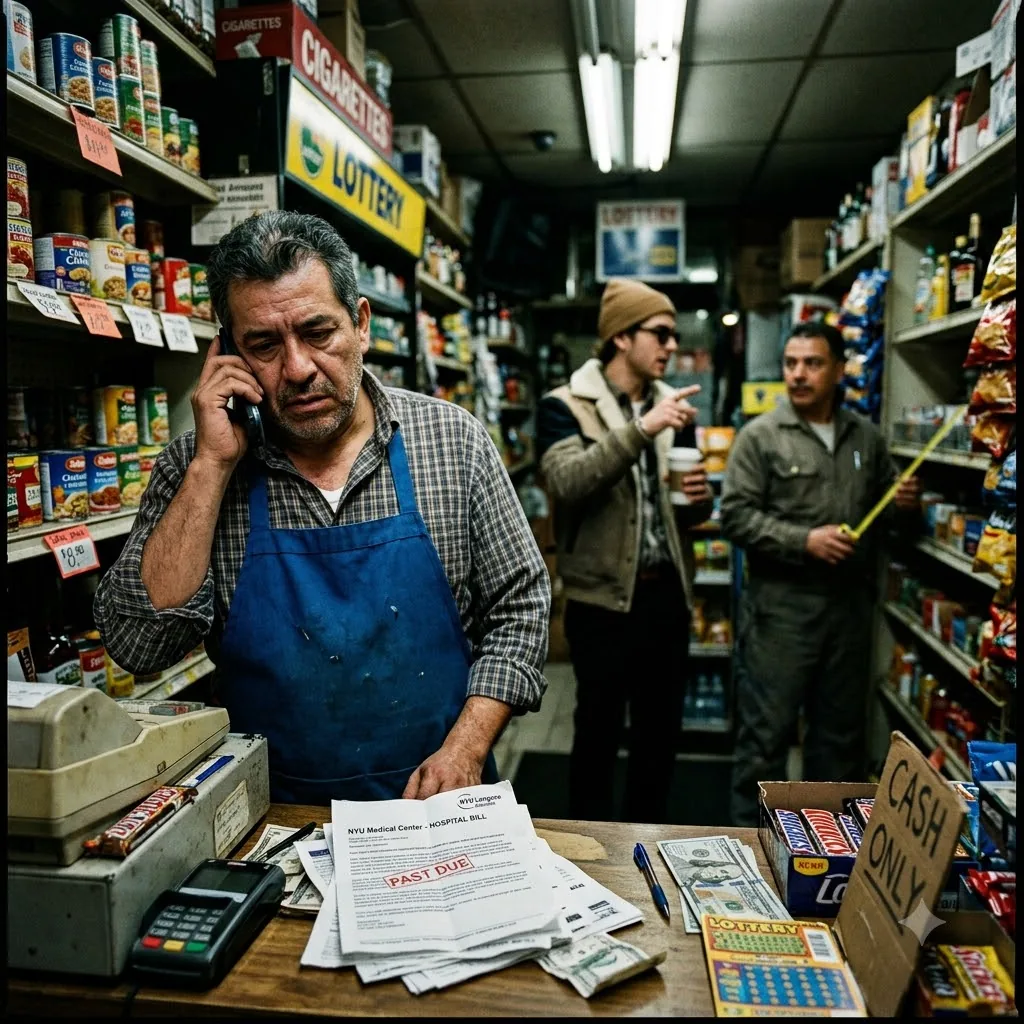
Hector looked back at his wife. Her skin was the color of old parchment, her energy entirely spent just walking to the window. The hospital’s eighty-two-thousand-dollar ransom demand echoed in his skull. *If you open it, the business is finished,* his grandfather had warned him. But Arturo had kept another secret, one he had sworn Hector to protect when they transferred the deed-a secret that had nothing to do with hidden cash, and everything to do with how the building was built.
“Stay here,” Hector told Maria, gently guiding her to the worn armchair. “Do not come downstairs, no matter what you hear.”
He descended the staircase with a terrifying, absolute calm settling over his shoulders. He walked straight to the front checkout lane and retrieved the crumpled medical denial letter from the counter, folding it neatly into his pocket. He was waiting by the front door when the chime sang its cheerful, electronic melody.
Julian stepped inside, his polished leather shoes clicking against the floor tiles. He looked at the dusty shelves and the peeling paint with undisguised revulsion.
“Hector,” Julian said, his voice smooth, practiced, and devoid of warmth. “My guys tell me you’re having trouble accepting the timeline. I came to explain the reality of your situation. You don’t have the capital to fight my lawyers. You are leaving today. The only question is whether you leave with a trespassing charge.”
“You waived the commercial inspection to close the sale fast,” Hector said quietly, ignoring the threat. “You wanted to bypass the city zoning board before the historic preservation committee could review the block.”
Julian smiled, a thin, predatory curving of his lips. “It’s called efficiency. This structure is a tear-down anyway. I’m gutting it to the studs. So, if you’re trying to leverage a leaky roof or outdated wiring to buy time, save your breath.”
“You are gutting the main floor,” Hector corrected, his voice dead flat. “You are keeping the foundation. To pour your espresso bar and build your open-concept tasting room, you need the original footprint.”
Julian checked his heavy gold wristwatch. “I have a lunch reservation, Hector. What is your point?”
“My point is that you have not seen the basement.” Hector turned and walked toward the back of the store. “If you want my family out of this building today, you need to see what you just bought. Unless you want the city to condemn your entire multi-million-dollar investment before you pour a single ounce of concrete.”
Julian hesitated, his eyes narrowing with suspicion, before gesturing for his foreman to wait by the door. He followed Hector to the heavy wooden door behind the dairy case.
Hector flipped a switch. A single, flickering incandescent bulb illuminated the steep wooden stairs. Hector led the way down into the damp, earth-scented gloom. The basement was a cramped, unfinished cavern, its floor a mix of poured concrete and exposed dirt. But the most prominent feature was in the dead center of the room.
Holding up the entire main floor was a massive, horizontal timber beam. It was severely bowed in the middle, splintering under the immense weight of the commercial refrigerators upstairs. Worse, it was supported entirely by an unpermitted, haphazard column of dry-stacked cinder blocks that leaned dangerously to the left.
Julian stopped at the bottom of the stairs, pulling a handkerchief from his coat pocket to cover his nose against the smell of mold. He stared at the improvised support column. The color rapidly drained from his face.
“My grandfather expanded the storefront in 1974,” Hector said, standing next to the rotting timber. “He didn’t have the money for a steel I-beam. He used salvaged shipyard wood. He didn’t pull permits. He just covered the structural load-bearing points in plaster upstairs so the inspectors wouldn’t see it.”
Julian stared at the bowing wood in horror. “This is… this is a catastrophic code violation. The entire foundation is compromised.”
“Yes,” Hector agreed. He reached into his pocket and held out the folded piece of paper.
Julian took it, unfolding it with a frown. He squinted in the dim, yellow light. “What is this? This isn’t a building plan. It’s a medical insurance denial.”
“Eighty-two thousand dollars,” Hector said. “Due immediately. For my wife’s chemotherapy.”
“What does that have to do with me?” Julian snapped, his corporate composure fracturing as he crumpled the paper in his fist. “I don’t care about your wife’s medical bills! I care that you sold me a structurally condemned building!”
Hector bent down and closed his hands around the heavy, iron shaft of a twenty-pound sledgehammer resting against the brick wall. It was Arturo’s old demolition hammer, left down in the dark for decades. Hector hoisted it up, feeling the immense, lethal weight of the iron head.
Julian stepped back, his expensive shoes slipping on the damp earth. “What are you doing? Put that down.”
Hector turned his body, bracing his boots into the dirt, and swung the sledgehammer horizontally. The iron head slammed into the unpermitted cinderblock column with a deafening, violent crack. Two blocks shattered instantly, blasting gray concrete dust into the stagnant air.
The entire basement groaned. The rotting timber beam above them shrieked as it dropped a fraction of an inch. A flurry of dust and plaster rained down from the ceiling, coating Julian’s expensive coat in white powder.
“Are you insane?!” Julian screamed, throwing his arms over his head and backing wildly against the wooden stairs. “You’ll bring the whole building down! You’ll kill us both!”
“My life is upstairs, choking in her sleep,” Hector said, his voice carrying clearly over the settling groan of the compromised floorboards. He slowly pulled the sledgehammer back, resting its weight against his hip, aiming the iron head directly at the remaining, fractured cinder blocks holding up the millionaire’s empire. “My life is already over. But this development is your flagship project. If this ceiling comes down, the city condemns the property. Your investors pull out. You lose the block. You lose everything.”
Julian stared at Hector through the drifting cloud of concrete dust, his jaw slack, his illusion of absolute power completely obliterated by the sheer, suicidal reality of the iron hammer.
“Eighty-two thousand dollars,” Hector repeated, tightening his grip on the handle. “Or I swing again.”