Story code: ST-001822
Part 3: The Flattened File
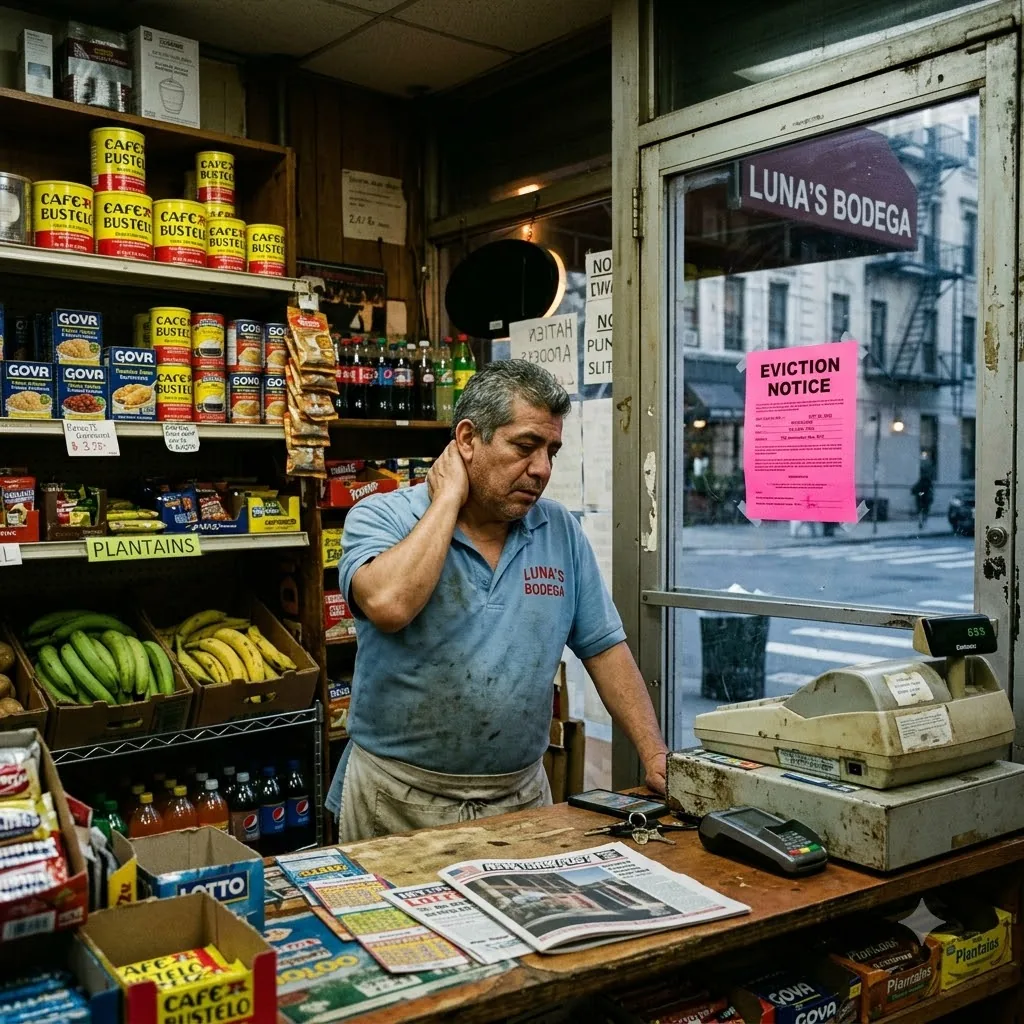
The morning sun did not reach the inside of the bodega. Just as Pierce had promised, a heavy barricade of plywood and steel scaffolding now entombed the storefront, transforming the bright, familiar corner into a stifling, neon-lit cave. Mateo stood behind the counter, bathed in the harsh fluorescent hum of the beverage cooler. He wiped down the laminate surface with a damp rag, his knuckles still stained with century-old black grease.
Behind his boots, the heavy trapdoor leading to the basement was still thrown open. Yesterday afternoon, Mateo had descended into the subterranean dark, matched the hand-drawn schematic to a massive, rusted manifold, and fitted the forged-iron hand crank onto the primary valve. It had taken all his strength to turn it, but when the iron gears finally ground into place, the deep, rushing vibration of the avenue’s water supply had gone dead silent. By routing the municipal flow through his family’s privately owned foundation, he had legally choked the water pressure for the entire commercial grid.
The brass bell above the front door jingled, muted by the heavy wooden shed outside. Pierce burst into the dim store, the developer’s calm, aristocratic sneer entirely gone. His cashmere quarter-zip was wrinkled, his hair disheveled, and his face flushed a dangerous shade of crimson.
Close behind him walked a tall, rigid man in a charcoal suit, carrying a slim leather briefcase. The man’s eyes darted around the cramped aisles with professional disdain.
“Turn it back on,” Pierce demanded, slamming a flat palm against the glass countertop. “You have effectively paralyzed a sixty-million-dollar construction site, Mateo. We cannot pour concrete, we cannot run sanitation, and the city cannot legally bypass a valve located inside a private foundation without a court order. Turn the water back on right now, or I will have you arrested for utility sabotage.”
Mateo did not flinch. He tossed his rag beside the cash register. “I’m well within my rights. I’m performing emergency maintenance on my structural foundation. The pipes are old. It might take me weeks to inspect them.”
“This is extortion,” the man in the charcoal suit said, his voice a smooth, icy baritone. “I am Arthur Vance, corporate counsel for the ownership group. What you are doing is a federal offense, and your ridiculous claim to the foundation will not protect you from criminal prosecution.”
“It’s not extortion, Arthur,” a new voice echoed from the back of the store.
Sofia stepped out from the shadowed aisle, holding a steaming paper cup of Bustelo. Mateo’s cousin wore a sharp, thrifted blazer and a calm, terrifying smile. She walked up to the counter and set her coffee down next to the display of plantain chips.
“It is leverage,” Sofia continued, pulling a thick manila folder from under her arm. “Mateo didn’t shut off the water to be petty. He shut it off because it was the only way to force the two of you into this room before the end of the month.”
Pierce glared at her. “And who are you supposed to be?”
“Sofia Vargas. Mateo’s attorney,” she said, leaning against the counter. “And contrary to your assumption, we aren’t here to discuss the 1974 partition deed. That just gave Mateo control of the dirt. We are here to discuss what his grandfather filed four years later.”
Mateo reached into the rusted steel lockbox, pushing aside the heavy iron crank. He pulled out a second, smaller document, encased in a yellowed plastic sleeve. He slid it across the scratched laminate toward Vance.
“In 1978, the city zoned this avenue for high-density commercial use,” Sofia explained, watching Vance’s eyes scan the page. “Mateo’s grandfather agreed not to block the new zoning laws with his subterranean rights. In exchange, the city granted this parcel a permanent commercial rent control covenant. It is bound to the foundation, not the structure. As long as a blood relative operates a business above that foundation, the rent cannot be increased by more than three percent annually.”
Vance stopped reading. He adjusted his glasses, tracing the embossed city seal and the signature of the former mayor at the bottom of the page. The silence in the dark bodega stretched out, heavy and suffocating.
“Your four-hundred percent overnight hike isn’t just aggressive, Arthur,” Sofia said softly. “It is a direct violation of a municipal covenant. It makes your eviction notice entirely void.”
Pierce barked out a harsh, desperate laugh. “A forgotten covenant from forty years ago? Good luck proving willful intent in court. Our title search firm missed it. We acquired the building in good faith. It is a clerical oversight. We will simply adjust the eviction to a buyout. Fifty thousand, Mateo. Right now.”
“You didn’t miss it,” Mateo said, his voice low and steady. “You just thought I didn’t have a copy.”
“That is defamatory speculation,” Vance said, though his rigid posture had suddenly lost its certainty. He shot a cautious, sideways glance at his client.
“It isn’t speculation,” Sofia said. She opened her manila folder and pulled out a single sheet of printer paper. “Last week, your firm filed an expedited environmental impact report with the Department of Buildings. It’s public record. A three-hundred-page PDF. On page 212, there was an appendix of internal communications regarding the acquisition of this specific lot.”
Sofia slid the printed page over the 1978 deed. It was an email chain, bearing Pierce’s official company signature.
“You redacted the text, Pierce,” Sofia said, tapping a manicured fingernail against the paper. “You drew black digital boxes over the paragraphs to hide them from the city inspectors. But your paralegal did not flatten the image before uploading the PDF. Anyone with a basic computer can drag their cursor over the black box, hit copy, and paste the text underneath into a blank document.”
Pierce stopped breathing. The faint, neon pink light from the beer sign caught the sudden sheen of cold sweat breaking out across his forehead.
Mateo leaned over the counter, closing the distance between himself and the developer. “Read it, Vance.”
Vance looked down at the un-redacted email. He read it in silence, his jaw tightening so hard the muscles jumped beneath his skin.
“‘The corner bodega holds a 1978 commercial rent control covenant attached to the foundation footprint,'” Sofia recited from memory, never taking her eyes off Pierce. “‘Do not alert the tenant to this anomaly. Issue an immediate four-hundred percent rent increase to force a default. We must starve him out and secure the vacancy before he retains counsel and discovers the covenant.'”
Mateo watched the corporate lawyer slowly pull his hands away from the documents, treating the paper as if it were coated in poison. Vance took one deliberate step away from Pierce.
“That is intentional fraud,” Sofia said, the silence amplifying her words. “It is a documented conspiracy to commit illegal eviction and extortion. And because you used the federal banking system to execute the initial property acquisition with fraudulent intent, it carries a mandatory minimum sentence.”
Pierce opened his mouth, but only a thin, reedy breath escaped. He looked at the printed email, then at the locked, subterranean trapdoor behind the register, realizing that every wall he had built around the bodega had just locked him inside.