Story code: ST-001822
Part 4: The Empty Castle
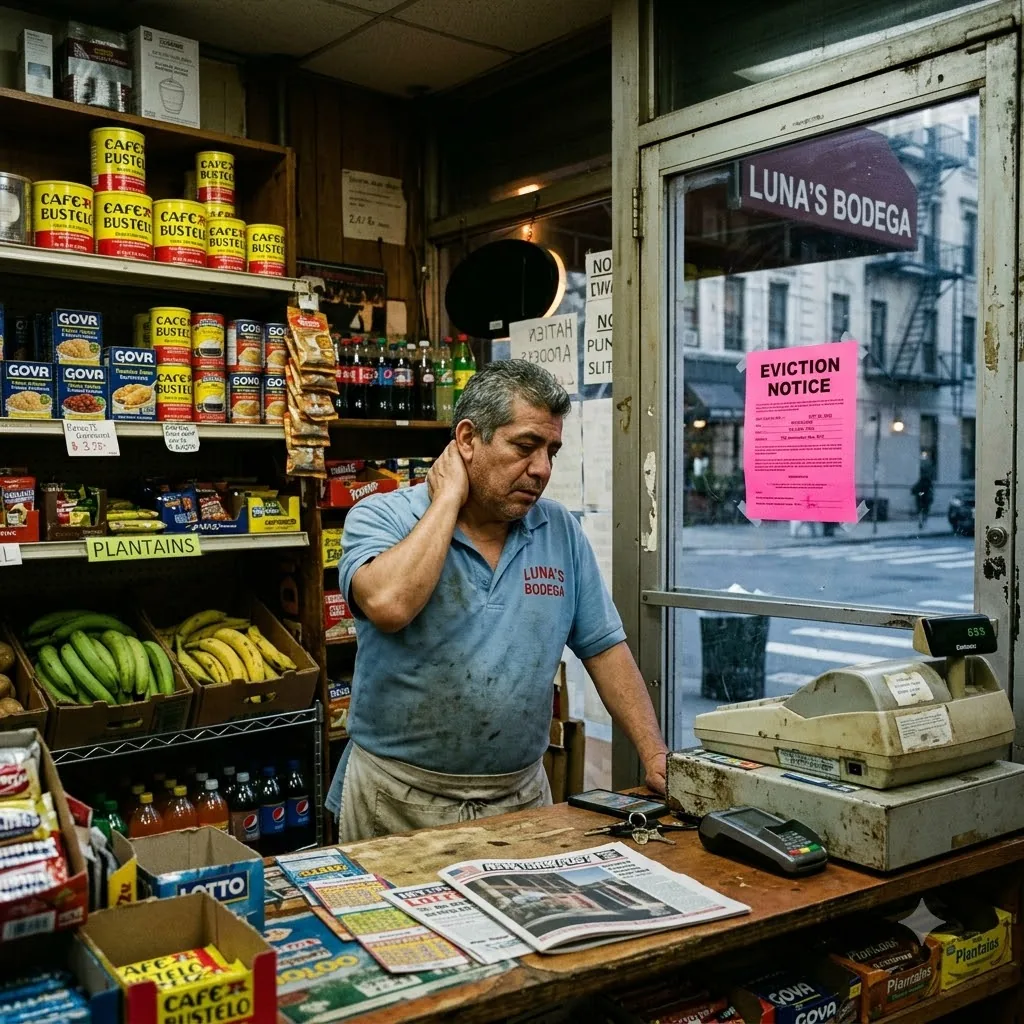
The heavy glass door of the bodega reflected a street that Mateo no longer recognized. Sofia sat at the laminate counter, her thrifted blazer replaced by a sharp, tailored suit she had bought with her new firm’s signing bonus. She slid a thick stack of stapled, watermarked paper across the glass.
“The judge signed the final order this morning,” Sofia said, her voice quiet. “Permanent injunction. The commercial rent control covenant holds in perpetuity. Pierce was terminated by the ownership group to avoid federal conspiracy charges, and the firm was fined heavily. Your rent is frozen forever, Mateo. You won.”
Mateo looked at the heavy black ink of the judge’s signature. He didn’t touch the paperwork. Instead, he looked at the empty space beside the deli slicer, where a worn wooden stool had sat for sixty years.
The scaffolding had stayed up for four agonizing months while the injunction wound its way through the municipal courts. Four months of darkness, of fighting the developer’s high-priced stall tactics. The water had been restored within days, but the damage to the air and the light had been catastrophic. The darkness had seeped into his grandfather’s bones. The old man hadn’t understood the legal maneuverings, only that his life’s work was suffocating in a plywood coffin. The stress had manifested as a quiet, relentless exhaustion. Two weeks before the judge slammed the final gavel, his grandfather’s heart had simply stopped in his sleep. He never got to see the heavy construction shed dismantled. He died believing the bodega was lost.
Mateo picked up a damp rag and wiped a perfectly clean spot on the counter. “He should have been here to see it.”
Sofia lowered her eyes, tracing the rim of her paper coffee cup. “I know.”
She left an hour later, stepping out into a neighborhood that had been surgically hollowed out and replaced. Mateo stood by the front window, watching the avenue. The scaffolding was gone, but the sunlight now illuminated a graveyard of memories. The family dry cleaner next door had been gutted, its brick walls sandblasted and painted a sterile matte black. It was now a boutique spin studio. Through their floor-to-ceiling windows, Mateo could see rows of wealthy strangers pedaling furiously on stationary bikes to deafening electronic music.
On the corner, where the dusty, familiar scent of the shoe repair shop had lingered for half a century, a minimalist natural wine bar stood. Its sign was written in tiny, unreadable neon script. There were no children playing on the fire escapes. There were no older women pulling wire carts full of groceries. The block was spotless, efficient, and entirely dead.
The bodega sat in the middle of it all, an ugly, colorful scar on a sleek corporate face. Mateo had kept the foundation. He had kept the walls. But Pierce and the ownership group had successfully bought the ecosystem. They hadn’t needed to evict Mateo to destroy him; they only needed to isolate him.
The brass bell above the door chimed. A young woman in expensive athletic wear walked in, her face glued to her phone screen. She didn’t greet Mateo. She wandered down the cramped aisle, her manicured fingers brushing past the cans of Goya beans and the packets of sazón, looking for something that didn’t exist here.
She stopped in front of the beverage cooler, frowning at the bright yellow and red labels. She grabbed a bottle of sparkling water and brought it to the counter, setting it down next to the stack of court documents.
“Do you guys have oat milk?” she asked, not looking up from her screen.
“No,” Mateo said. His voice sounded hollow in the quiet store. “Just regular.”
She sighed, a sharp sound of profound inconvenience. She tapped a credit card against the digital reader. Mateo watched the screen process the three-dollar transaction. The machine beeped. The woman walked out without another word, the brass bell chiming her departure.
Mateo stood alone in the silence. He reached under the counter and pulled out the rusted steel lockbox. He placed the heavy judge’s order inside, resting it on top of the 1978 covenant and the 1974 foundation deed. He closed the lid and snapped the tarnished brass padlock shut.
The scent of roasting Cafe Bustelo and fresh lemon Fabuloso still clung to the air, but there was no one left to smell it. Mateo looked out the glass at the sterile, wealthy strangers hurrying past his windows. He had fought a brutal war for a fortress, and he had won. But as he locked the drop-drawer and stood in the dim hum of the fluorescent lights, he finally realized the terrible truth of his victory. He was the king of an empty castle, standing guard over a ghost town.