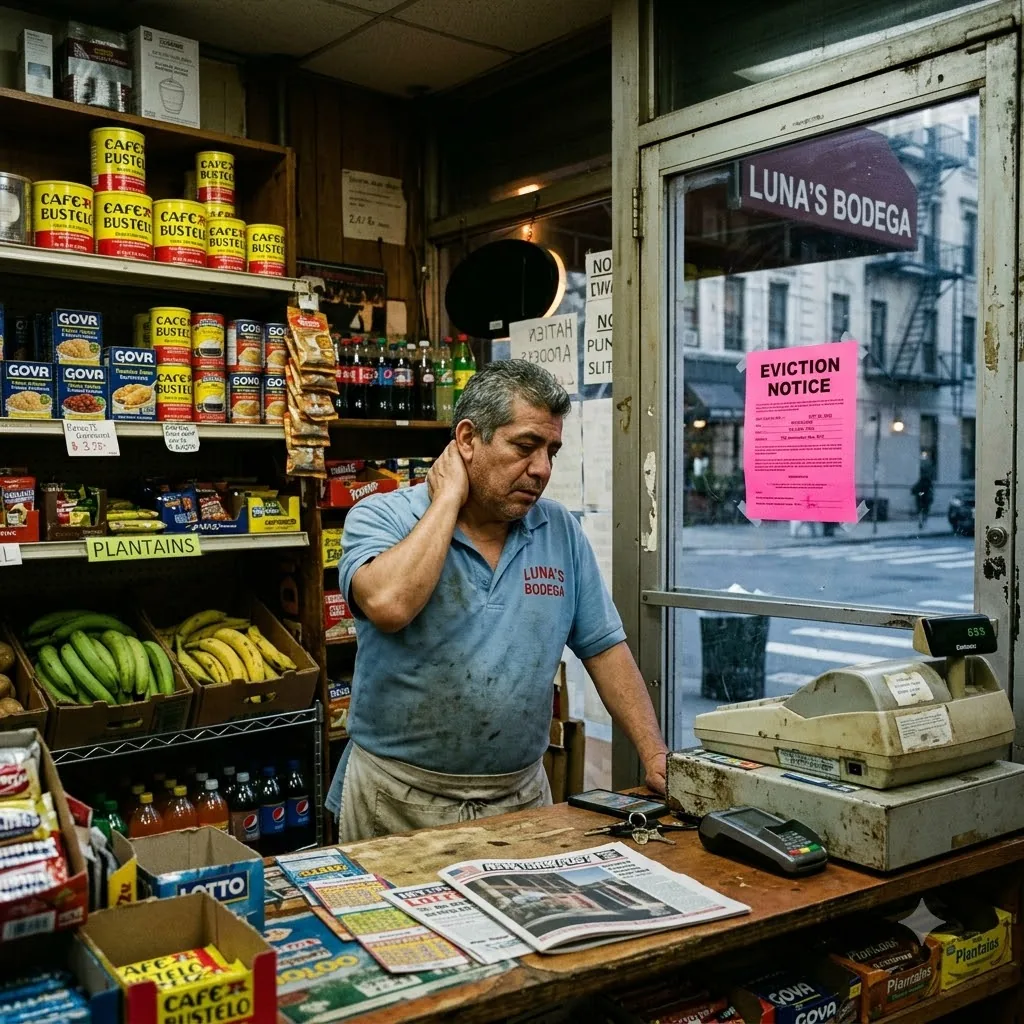
Story code: ST-001822
Part 2: The Foundation
The rusted iron handle of the drop-drawer fought back, groaning against decades of disuse, but Mateo yanked it with a sharp, practiced force. The heavy steel tray slid outward.
Across the counter, Pierce took a sudden, involuntary step backward, his pristine white sneakers squeaking against the worn linoleum. The smug amusement vanished from the developer’s face, replaced by a flash of genuine alarm. He likely expected a sawed-off shotgun or a rusted revolver, the violent last resort of a desperate man.
Mateo did not reach for a weapon. Instead, he reached into the dark recess of the drawer and pulled out a rectangular steel lockbox, heavy and caked in a thick layer of grey, undisturbed dust. He dropped it onto the scratched laminate counter. It hit the surface with a dense, solid thud that rattled the display of plantain chips.
“You think you bought the entire block,” Mateo said, his voice dropping into a low, even cadence. He brushed off the top of the box, revealing a tarnished brass padlock. “You think you inspected every brick, every window, and every commercial lease.”
“The firm acquired the master deed to the avenue three weeks ago,” Pierce said, recovering his composure. He smoothed the front of his cashmere sweater, though his eyes remained locked on the rusted box. “I assure you, there are no clerical errors. We own this building.”
Mateo produced a small brass key from his pocket and slid it into the padlock. It turned with a satisfying, mechanical click. He threw back the lid. Inside, resting on a bed of faded red felt, lay a thick bundle of heavy, yellowed parchment wrapped in protective oilcloth, bound tightly by a brittle leather cord.
“In 1974, this city was bankrupt,” Mateo said, carefully unwinding the leather cord. “The man who owned this building back then was going to lose it all to the banks. He needed forty thousand dollars in cash, immediately, to cover his municipal debts. My grandfather had that cash, saved dollar by dollar in coffee tins in the basement.”
Mateo unrolled the heavy parchment. It was a localized deed of partition, bearing the deeply embossed seal of the city’s historic zoning board, covered in the dense, looping signatures of a bygone era. He turned it around, pushing it across the counter so it rested right beside Pierce’s untouched twenty-dollar bill.
“My grandfather didn’t buy the building,” Mateo said, tapping a calloused finger against a specific, underlined paragraph in the center of the document. “He bought the ground it sits on. Specifically, the four hundred square feet of structural foundation beneath this store, and the subterranean rights extending fifty feet down. It is an inverted leasehold. You might own the walls and the roof, Pierce. But my family owns the concrete pillars holding them up.”
Pierce leaned forward, his perfectly groomed eyebrows knitting together as he scanned the dense legal jargon. He read the embossed stamps, the localized surveyor coordinates, and the perpetual sovereignty clause. For a brief, shining moment, Mateo saw a crack in the corporate armor-a flicker of realization that the ownership group’s multi-million-dollar high-rise development was currently sitting on top of land they did not legally control.
Then, the crack sealed. Pierce stood up straight and let out a soft, echoing laugh.
“An air-rights partition from the seventies,” Pierce said, shaking his head. “Fascinating. Truly, it belongs in a museum. But you are incredibly naive if you think a crumbling piece of parchment is going to stop a billion-dollar development firm.”
“It is an absolute title,” Mateo said, his jaw tightening. “You cannot demolish this building or dig a new foundation without my family’s signature. And you will never get it.”
“Mateo, we have an entire floor of lawyers in Midtown who specialize in crushing municipal anomalies,” Pierce countered smoothly. “By tomorrow morning, we will file a quiet title action and tie this deed up in the State Supreme Court. The litigation alone will drag on for six years. We will drown you in legal fees. And in the meantime, your eviction stands. You don’t have the millions required to fight a corporate injunction.”
Pierce pulled out his phone and tapped a few buttons, holding the screen up so Mateo could see a dispatched message.
“You want to play the long game? Let’s play,” Pierce said, his voice devoid of all previous faux-politeness. “I just signaled the staging crew. Within the hour, a flatbed truck is going to pull up to this curb. They are going to erect a Class-A heavy construction shed and scaffolding across the entire sidewalk, claiming emergency facade repairs. It is going to wrap your entire storefront in plywood and steel piping. It will completely block your signage, your windows, and your front door.”
Mateo looked past Pierce, staring through the front glass. A cold knot formed in his stomach.
“We are going to plunge this bodega into total darkness,” Pierce sneered. “Your foot traffic will drop to zero. The daily cash you need to keep your lights on will vanish by tomorrow afternoon. You won’t even survive the month, let alone a six-year legal battle.”
Pierce tapped the thick, cream-colored buyout envelope still resting on the counter. “The ten thousand dollars is on the table right now. By sunset, I withdraw the offer, the scaffolding goes up, and you slowly starve to death in the shadows. Your move.”
Outside, the heavy, pneumatic hiss of air brakes signaled the arrival of the flatbed truck. The harsh clanking of steel pipes hitting the pavement echoed through the front glass. Pierce offered a mock salute, turned on his heel, and walked out the door, the brass bell chiming a cheerful goodbye.
Mateo stood frozen behind the register, watching the workers in high-vis vests begin unloading the massive steel barricades that would soon entomb his family’s legacy. The deed of partition was useless on its own. Pierce was right; they would simply bleed him dry. A piece of paper was not enough.
He looked down into the rusted steel lockbox. The deed had only been resting on top. Beneath the faded red felt lay the true inheritance his grandfather had left behind for a day exactly like this. Mateo pulled the felt aside, revealing a heavy, forged-iron hand crank and a hand-drawn schematic of the neighborhood’s original, century-old subterranean water mains.