Story code: ST-001912
Part 2: Inventory Deficit
Elias pulled his hand back from the alternative sentencing form as if the paper had suddenly caught fire. He reached for the blinking red button on his phone console.
“I’ll take line two,” Elias said. His voice sounded remarkably steady, a stark contrast to the tightening in his chest.
He pressed the receiver to his ear. “Trent. What exactly am I looking at?”
“You’re looking at the end of the campaign, Elias, unless you fix it today,” Trent’s voice was a frantic, breathless hiss, lacking his usual polished bravado. “I told you Horizon Residential was a data-driven PAC. They don’t just write checks based on debate performances. They run analytics. They track yield.”
“Yield?” Elias echoed, staring at the nineteen-year-old’s name printed in block letters on the file. David Hayes. “Trent, these are human beings. This is a court of law, not a fulfillment center.”
“To them, it’s inventory,” Trent snapped. “Horizon gets a state subsidy for every occupied bed in their facility. But they only get the maximum tier payout if the bed is filled for a minimum of ninety days. They backed you because you promised to be tough on crime, Elias. You promised to utilize rehabilitative incarceration. But your new diversion program? Letting first-time offenders walk with community service? It’s starving their pipeline.”
Elias squeezed his eyes shut, pressing the bridge of his nose. “My diversion program is working. Recidivism is down. I’m not going to manufacture convictions to inflate a private facility’s profit margins.”
“Then you’re going to lose the appellate seat,” Trent said, his tone turning brutally cold. “Judge Albright raised two hundred thousand dollars this weekend alone. If Horizon pulls their funding, we are completely broke by Friday. You’ll be stuck in this miserable county courthouse until you retire, handing out traffic fines and smelling mildew. Albright will take the appellate seat, and you know what he’ll do? He won’t send this kid to ninety days of rehab. He’ll send him to county jail for a year.”
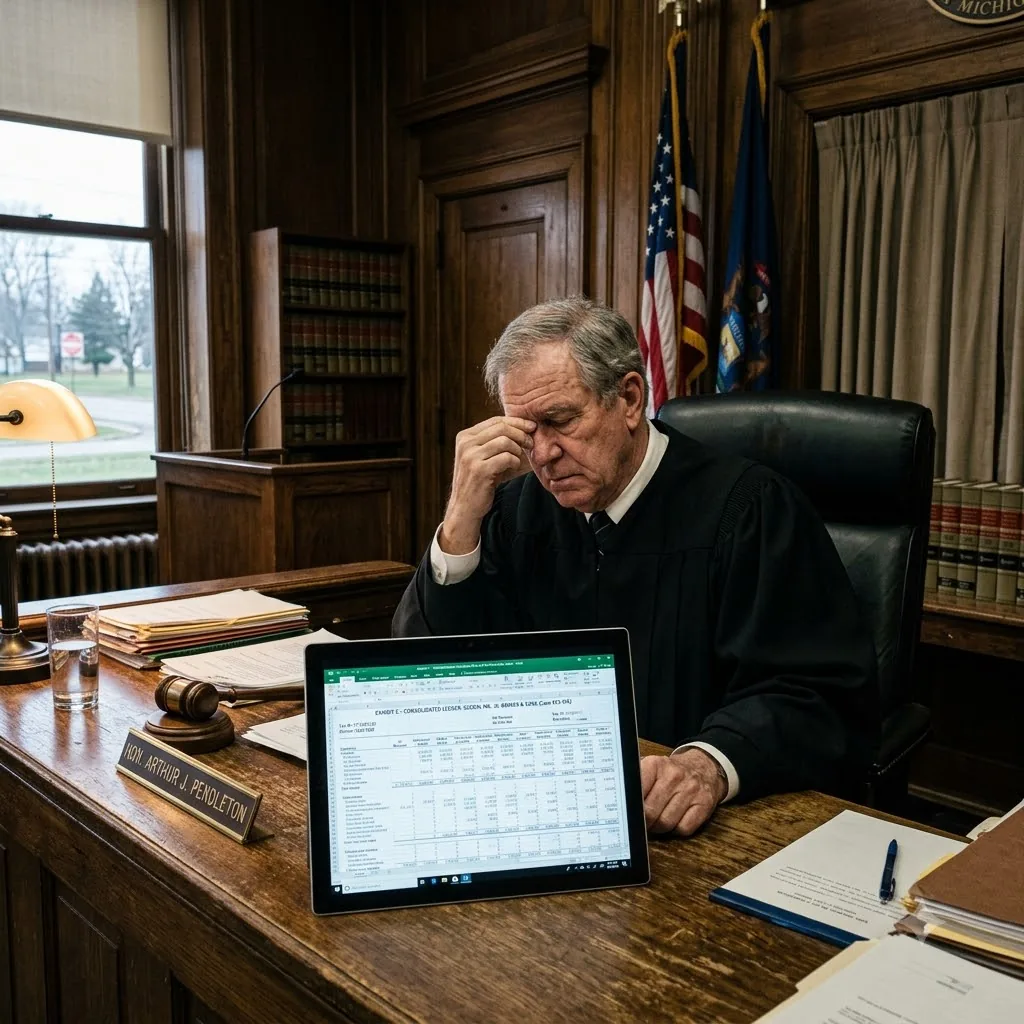
Elias opened his eyes. The glowing iPad screen seemed to mock him, the bright red bar chart screaming failure.
“You’re doing them a favor by sending them to Horizon,” Trent rationalized, his voice softening into a persuasive purr. “It’s a clean facility. It’s treatment. But they need three more ninety-day mandates by noon today to hit their Q3 targets, Elias. Three. You have five possession charges on the morning docket. Do the math. I have to call their regional director back in ten minutes.”
The line went dead.
Elias held the silent receiver for a long moment before placing it gently on the cradle. He looked back down at the two forms. The dismissal. The mandatory ninety-day residential rehabilitation order.
Three quick knocks rapped against his chamber door before it pushed open. His clerk, Brenda, stood in the doorway, a massive stack of folders balanced on her hip. She adjusted her reading glasses, looking at him with mild impatience.
“We’re ten minutes behind, Judge,” Brenda said. “The gallery is packed today. The AC is barely holding on out there, and the public defender is already complaining about the heat.”
“I’m coming,” Elias muttered. He grabbed both forms for David Hayes’s case, slipping the iPad into the leather portfolio he carried to the bench.
He stood, pulling his heavy black robe from the brass coat tree in the corner. The fabric felt unnaturally heavy as he draped it over his shoulders. He followed Brenda out of the quiet, insulated sanctuary of his chambers and down the narrow hallway that led to the courtroom.
The moment he stepped through the heavy wooden door behind the bench, the wall of sound and heat hit him. The courtroom was a sea of shifting bodies, coughing, murmuring, and the relentless, rhythmic squeak of the wooden pews. The bailiff called the room to order, and Elias took his seat, placing his portfolio on the polished mahogany surface.
He opened the leather flap. He arranged the paper file on the left. He propped the iPad up on the right, hidden from the courtroom’s view by the elevated lip of the bench. The spreadsheet was still open. The red deficit line glared at him.
“First call,” Elias said, his voice carrying easily through the microphone. “State versus David Hayes.”
A collective shuffle moved through the first row. A young man stood up, his ill-fitting suit hanging loosely off his thin frame. His hands were trembling so violently that he had to grip the wooden partition to steady himself. Beside him stood Sarah, a county public defender who looked incredibly overworked, juggling three different manila folders.
And behind them, in the second row, sat a woman in a faded floral dress, her hands clasped tightly under her chin. The mother.
“Your Honor,” Sarah began, her voice carrying a practiced, exhausted efficiency. “We have reviewed the prosecution’s file. Given Mr. Hayes’s clean record, his standing on the community college Dean’s List, and the negligible amount of the substance in question, we respectfully request the court grant the standard diversion program. Eighty hours of community service, with charges dismissed upon completion.”
Elias looked down at the nineteen-year-old. The boy’s eyes were wide, terrified, pleading for the grace of the court. He was exactly the kind of kid Elias had designed the diversion program to protect. A kid who made a stupid mistake but didn’t deserve to have his life derailed by the heavy machinery of the justice system.
Elias picked up his fountain pen.
He glanced to his right. The iPad screen dimmed slightly to save power, but the yellow highlight over David Hayes’s zip code-49032-was still clearly visible. *High potential yield.*
If he ordered community service, he saved the boy, but he destroyed his own campaign, leaving the appellate seat to a judge who would be far crueler. If he signed the alternative sentencing form, he secured his future, but he became a supplier for a corporate cage.
“Judge?” Sarah asked gently, breaking the heavy silence that had fallen over the courtroom. “The prosecution has already signaled they have no objection to the diversion.”
Elias stared at the blank signature line on the ninety-day residential order, feeling the eyes of the entire courtroom burning into the side of his face.