Story code: ST-001912
Part 4: Political Ruin
Elias moved through the rest of the afternoon docket with a mechanical, detached efficiency. He approved three minor civil settlements, granted two continuances, and completely ignored the persistent, pulsing vibration of his cell phone in his suit pocket. By four o’clock, the gallery had emptied. Brenda, his clerk, took the final stack of signed orders without a word, casting a cautious glance at his stoic expression before retreating to her desk.
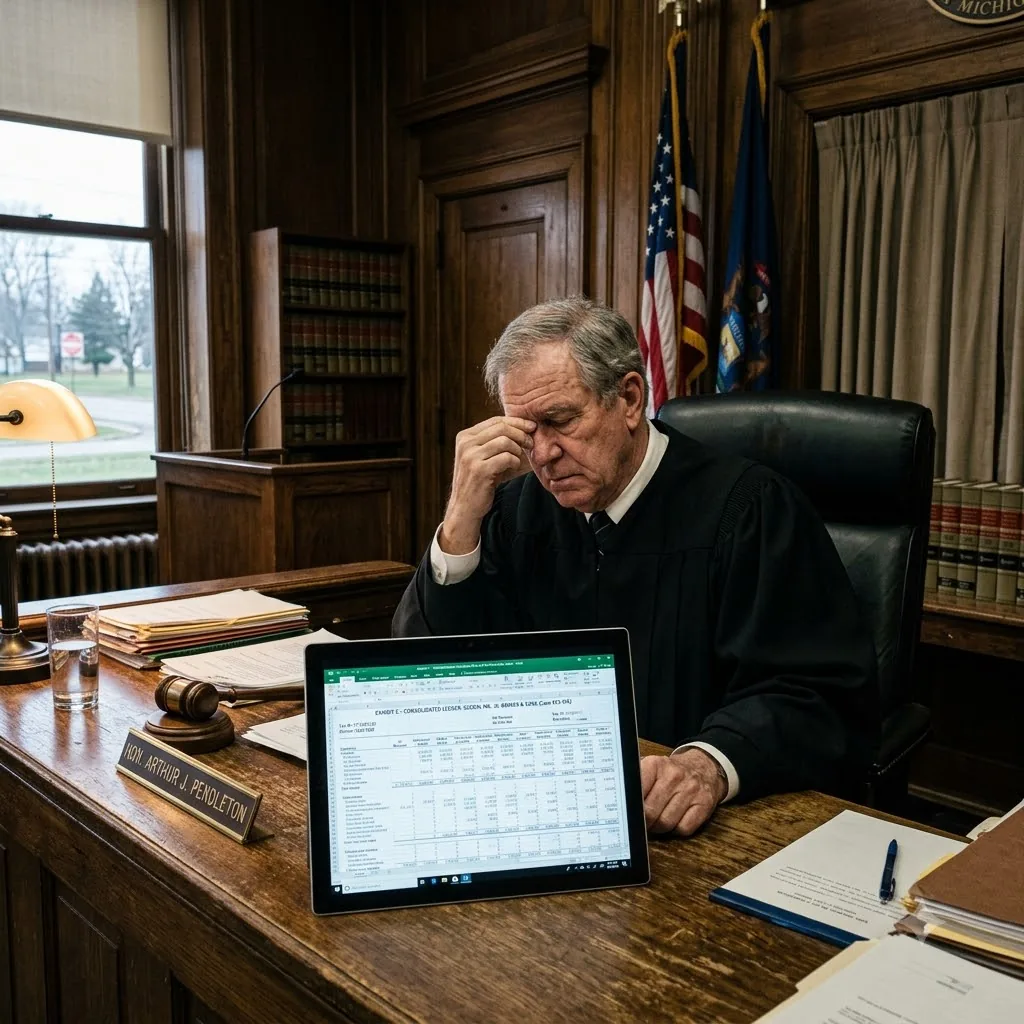
In the quiet sanctuary of his chambers, Elias unfastened his heavy black robe. It slipped from his shoulders, and for the first time in six months, the garment felt like just a piece of fabric rather than a suffocating shroud. He draped it carefully over the brass coat tree. He packed his leather briefcase, dropping the dead iPad into the bottom compartment. He didn’t plug it in. There was no longer any need to check the battery life, let alone the data.
The late afternoon sun was blinding as Elias pushed through the courthouse’s rear exit and stepped onto the cracked asphalt of the judges’ parking lot. The oppressive humidity immediately clung to his skin, but the air felt remarkably clean.
Trent was waiting for him beside Elias’s ten-year-old sedan.
The campaign manager had shed his polished exterior entirely. His tailored navy suit jacket was crumpled carelessly on the hood of Elias’s car. His crisp white collar was unbuttoned, the silk half-Windsor tie pulled loose and hanging askew. Trent was pacing a tight, furious circle, muttering frantically into his cell phone. When he saw Elias approaching, Trent yanked the phone away from his ear and ended the call with a vicious jab of his thumb.
“Do you have any idea what you just did?” Trent’s voice cracked, echoing sharply off the brick wall of the courthouse. He didn’t wait for an answer. He threw his hands into the air, a frantic, vibrating mess of nervous energy. “It’s gone, Elias. All of it. The regional director didn’t even let me finish my sentence. Noon hit, the quota was empty, and they pulled the plug.”
Elias stopped at the trunk of his car, resting his hand on the hot metal. “Trent-”
“No! Don’t give me a lecture from the bench!” Trent shouted, his face flushed a dangerous, mottled crimson. He stepped closer, his chest heaving. “They are liquidating the PAC accounts right now. The digital media buys for next week? Canceled. The direct mailers? Pulled from the printers. Do you know how much equity I had tied up in this run? My agency took a reduced upfront fee for a backend percentage of the media spend! I spent six months of my life building this infrastructure, and you burned my equity to the ground for one community college kid!”
Elias watched the younger man unravel. A bead of sweat rolled down Trent’s temple, but Elias felt only a profound, hollow calm. “I am a judge, Trent. I am not a broker. I told you I wouldn’t sell convictions.”
“You sold your future!” Trent spat, pointing a shaking finger at Elias’s chest. “Judge Albright’s campaign just got a massive anonymous donation. It’s over. Albright is going to take the appellate seat in November. And you know what the worst part is? That appellate seat was a guaranteed lock for the State Supreme Court vacancy in two years. We had a map. We had the analytics. You were on a glide path to the Supreme Court, Elias. And you threw it away!”
Trent grabbed his suit jacket off the hood of the sedan, nearly tripping over his own polished shoes as he stumbled backward. He looked at Elias with a mixture of absolute disgust and profound pity.
“You are going to rot in this miserable, mildew-infested county building until they force you into mandatory retirement,” Trent sneered, his voice dropping to a harsh, venomous whisper. “You’ll spend the next ten years handing out parking fines and eviction notices, and nobody outside of this zip code will ever know your name.”
Without waiting for a response, Trent turned on his heel. He marched across the sweltering asphalt toward his rented luxury SUV. He slammed the door so hard the glass rattled, the engine roaring to life before the vehicle tore out of the parking lot, leaving a faint cloud of exhaust hanging in the humid air.
Elias stood alone in the empty lot.
The silence settled over him, thick and absolute. He looked down at his scuffed leather shoes, then up at the faded brick facade of the courthouse. Trent was right. The appellate campaign was dead. The Supreme Court pipeline was a fantasy. He would likely spend the rest of his career in this exact building, adjudicating the small, quiet tragedies of Oakhaven. Albright would win. The corporate PACs would find another judge to feed their inventory.
Elias unlocked his sedan and slid into the driver’s seat. He placed his briefcase on the passenger side. As he turned the ignition, the old AC vents rattled, blowing a stream of warm, dusty air into his face.
He shifted the car into drive. He had no campaign dinners to attend tonight. No fundraising calls to make. No analytics dashboards to review. He pulled out of the parking lot and turned toward home, watching the courthouse shrink in his rearview mirror. He was politically ruined, left with nothing but his insignificant, local docket. And as he drove down the familiar, tree-lined street, Elias gripped the steering wheel and realized he had never felt so entirely, perfectly free.