Story code: ST-001913
Part 4: The Silent House
Marian’s words hung in the air, vibrating against the stainless steel of the diner’s pie case. Arthur stared at her back, the venom of her outburst still ringing in his ears. She had turned away, her shoulders rigid, aggressively scrubbing a pristine patch of formica. She was done with him. The town was done with him.
Arthur looked past her, toward the swinging aluminum door of the kitchen. It was propped open by a rubber wedge. A young busboy in a stained apron and the morning fry cook stood frozen in the threshold. They hadn’t missed a single word. But it was the movement outside that caught Arthur’s eye.
Through the large plate-glass window, the morning sun cast long, frosty shadows across the sidewalk. Tom and Henry, the two retirees who had scurried out moments before, had not actually left. They stood clustered together on the pavement, their coats pulled tight against the wind, peering back through the glass.
Arthur met their gaze. He braced himself for anger, for the defensive hostility Marian had just violently demonstrated. But that wasn’t what he saw.
Their faces were slack with pity. It was an agonizing, alienating pity, the kind reserved for a town eccentric who had finally lost his grip on reality. They were looking at an old, broken man who had driven away his own children, a widower screaming about ghosts and hundred-year-old sins because he couldn’t cope with his own empty life. In their eyes, he wasn’t a historian. He wasn’t a whistleblower. He was a pathetic, lonely tragedy.
That look stripped away the last protective layer of Arthur’s dignity. It was worse than Principal Hayes’s administrative fear. It was worse than Marcus Vance’s legal threats. It was the complete, structural dismantling of his identity. His final illusion of community-the belief that he belonged here, that these people were his peers-evaporated into the smell of stale coffee and hot grease.
Arthur looked down at his feet. The 1842 bill of sale lay facedown in a dirty puddle of melted snow.
He lowered himself to one knee. His joints popped loudly in the heavy silence. His slacks soaked up the icy water from the linoleum. He reached out and carefully pinched the corner of the paper. It was heavy, sodden, and ruined. As he lifted it, the archival ink of Elijah Vance’s signature bled into a shapeless, dark smudge. The price of an eight-year-old boy, the foundational transaction of the town’s prosperity, dripped gray water onto his dress shoes.
He folded the crumpled, ruined document in half and slid it into his battered leather satchel. He snapped the brass clasps shut.
Arthur stood up. He did not say goodbye to Marian. She did not turn around.
He pushed through the front door. The cheerful jingle of the bell mocked his exit. On the sidewalk, Tom and Henry immediately averted their eyes, suddenly fascinated by the brickwork of the bank across the street. Arthur walked past them without a word.
The walk home felt entirely different than the walk there. The crisp Tuesday morning was now painfully bright, illuminating the town of Oakridge in high relief. He passed the Vance Memorial Library, its stone columns standing resolute. He passed the community clinic, funded by the Vance family trust. The town was a beautifully manicured fortress built on a graveyard, and everyone inside the walls had silently agreed not to look down. The cost of admission was complicity. Arthur had stopped paying, and so he was being evicted.
He turned down his street, his dress shoes crunching against the frost-heaved pavement. The black SUV was gone from his curb. There was no need for intimidation anymore. The massive regional law firm and their manila envelopes were redundant. They didn’t need to freeze his assets or destroy him in court. The town had already neutralized him.
Arthur climbed his front steps and unlocked his door.
The deadbolt clicked. He pushed the door open, stepping into the stagnant air of the hallway. The grandfather clock ticked, indifferent and rhythmic, marking time in a space where time no longer mattered.
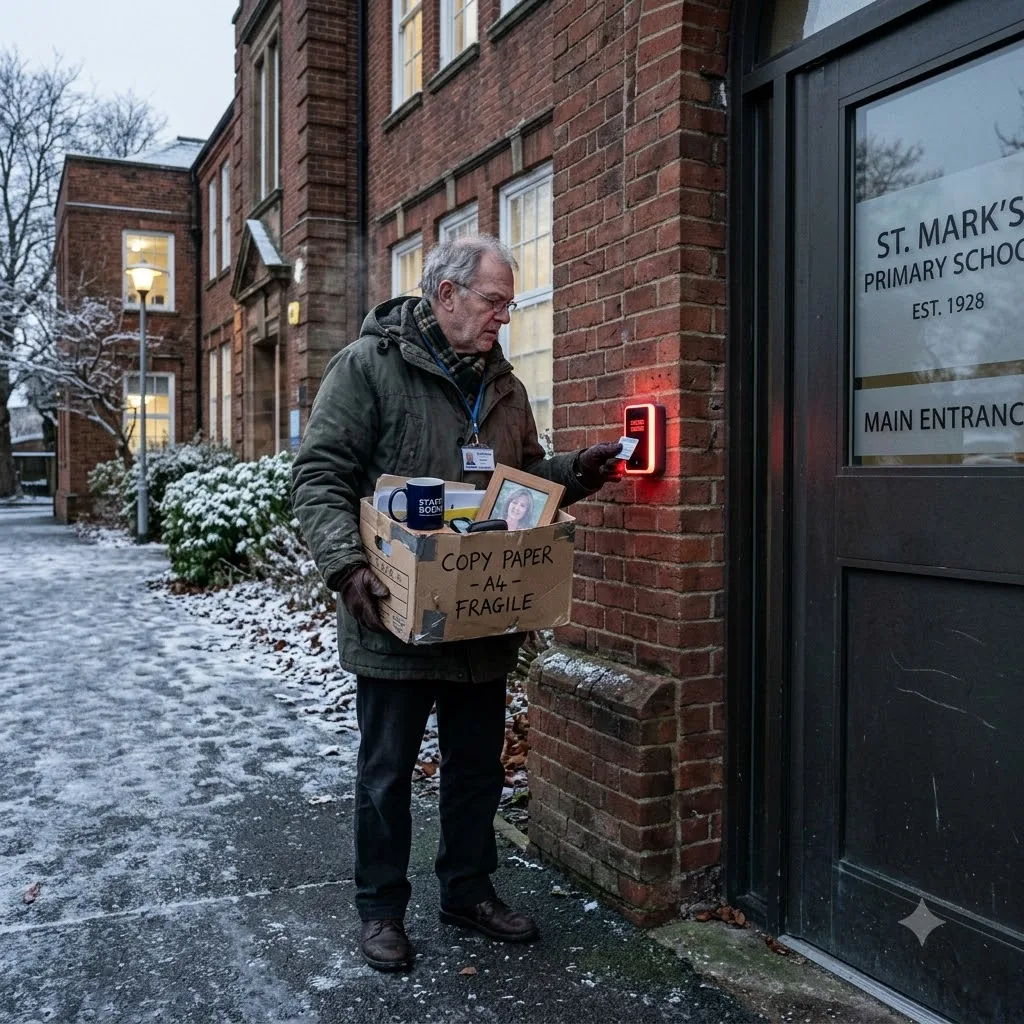
He walked into the kitchen. His cardboard box from the school still sat on the island. The brass apple paperweight rested against a stack of ungraded essays. Beside it, the framed photograph of Miriam stared out at the empty room.
Arthur set his satchel on the floor. He did not take off his coat. He pulled his phone from his pocket and pressed the screen. It remained dark. No messages from Elena or his former colleagues. No calls from his union rep. No notifications from his son in Seattle or his daughter in Chicago. The silence was absolute.
He pulled a chair out from the kitchen table and sat down. The house was perpetually dark, the winter sun failing to reach through the tightly drawn blinds. Arthur sat in the center of the gloom, staring at the cardboard box that contained the entirety of his existence, and listened to the clock tick away the remains of his life.