Story code: ST-001913
Part 2: The 1924 Ledger
The wind off the concrete bit through Arthur’s thin wool cardigan, but the chill settling in his chest had nothing to do with the weather. He stood on the top step, the heavy cardboard box pressing against his ribs, and listened to the dead silence of the school grounds. Behind him, the reinforced glass door reflected his own pale, stunned face.
He shifted the box to one hip and fumbled in his coat pocket for his phone. His fingers were stiff. He opened his email app. A small gray wheel spun at the top of the screen before a stark message appeared: *Account Error. Please contact your administrator.* They had severed his digital tether before he even reached the parking lot.
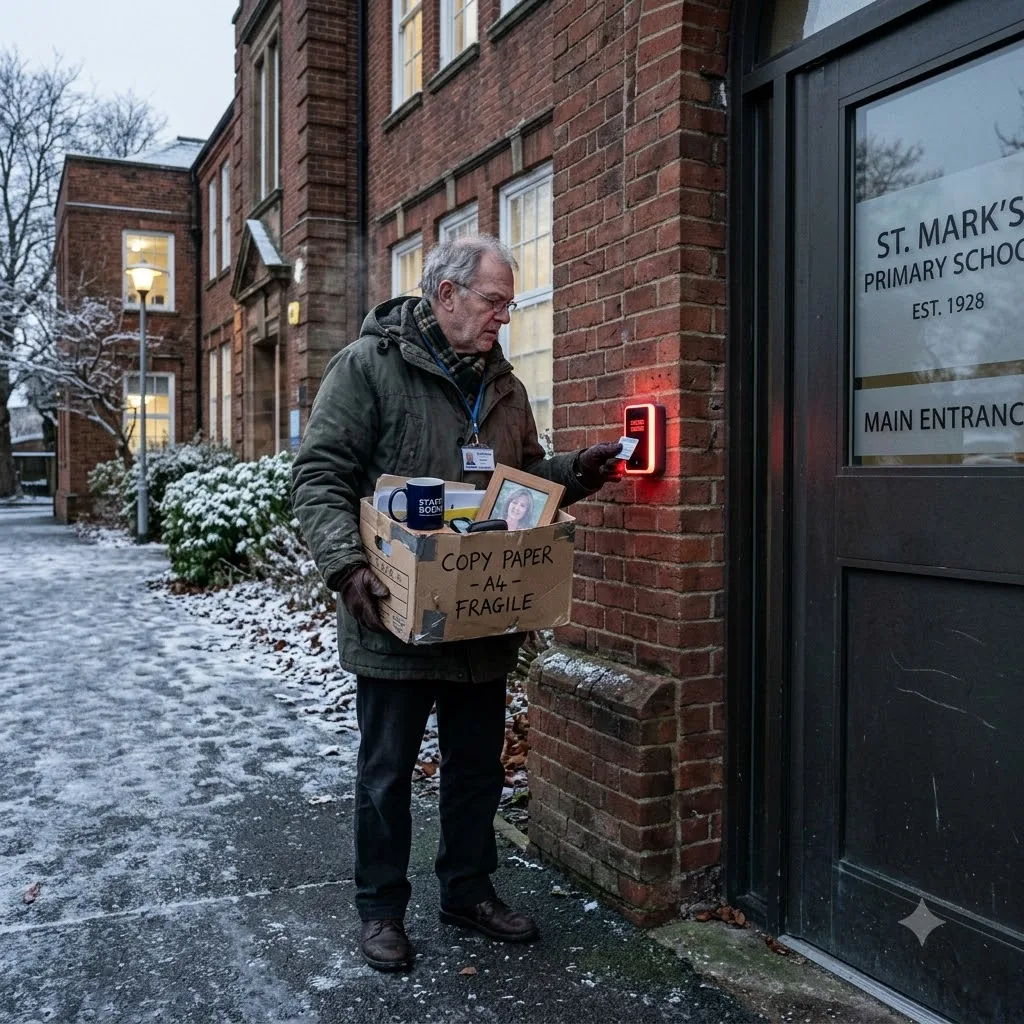
Arthur walked toward his ten-year-old sedan, his dress shoes crunching loudly on the frost-heaved pavement. The brass apple shifted in the box, threatening to topple over the edge. He barely caught it, scraping his knuckles against the cardboard. When he reached the car, he dropped the box onto the passenger seat with a heavy thud. The framed photo of his late wife, Miriam, slid sideways. Her smiling face stared up at him from beneath a tangled mess of red grading pens. Without Miriam, without the school, Arthur’s world consisted entirely of an empty three-bedroom house and a silent phone.
He started the engine and turned the heat on high, though it only blew cold air. Desperate for a lifeline, he opened his text messages and typed a quick note to Elena, the biology teacher whose classroom was directly across from his. They had eaten lunch together every Tuesday for six years.
*Elena. Hayes just suspended me and locked me out. Vance was with him. What is going on?*
He watched the screen. A few seconds later, the three animated dots appeared, signaling she was typing. He let out a breath he didn’t know he was holding. The dots vanished. They appeared again. Then they disappeared entirely.
A minute later, a single message came through.
*Arthur, I am so sorry. Vance’s people are in the staff lounge pulling hard drives. Hayes told us anyone who contacts you will be considered insubordinate. Please do not message me again. I need this job.*
Arthur stared at the screen until it went black. The erasure was total. Thirty years of shared lesson plans, faculty parties, and quiet solidarity, wiped out by a single command.
He drove home in a daze, the familiar route through Oakridge feeling suddenly alien. The town was prosperous, its streets lined with restored Victorian homes and manicured parks, much of it funded by the Vance family’s generational wealth. Arthur pulled into his driveway, killed the engine, and carried his box inside.
The silence of the house hit him like a physical blow. The grandfather clock in the hallway ticked, loud and indifferent. He set the box on the kitchen island. He needed representation. He dialed Greg Patterson, his union representative, using Greg’s personal cell number.
Greg picked up on the second ring. His voice was a harsh whisper. “Arthur. I’m in my car. I can’t talk long.”
“Greg, Hayes didn’t even give me a hearing,” Arthur said, pacing the length of his narrow kitchen. “He just handed me a box and barred me from the property. I need to file a formal grievance.”
“A grievance?” Greg let out a frantic, humorless laugh. “Arthur, you detonated a bomb in that classroom. Why didn’t you clear those documents with the department chair?”
“Because they are public record!” Arthur’s voice cracked. “They’re from the state historical archives. It’s the 1924 municipal surveyor’s ledger. I was teaching the primary source unit.”
“You were teaching them that Marcus Vance’s grandfather didn’t buy the valley, but orchestrated a fake typhoid quarantine to force the mill workers out and steal their deeds!”
“I didn’t say that,” Arthur insisted, his hands shaking. “The ledger said it. The town council minutes from October 1924 said it. It’s the truth about how this town was founded. I just put it on the projector.”
“You put it on a projector in front of thirty teenagers, including the mayor’s daughter and two kids whose parents are on the school board!” Greg hissed. “Marcus Vance is running his entire campaign on town legacy. You just called his family a syndicate of thieves.”
“It’s history. It’s my job.”
“Not anymore,” Greg said, his tone softening into something closer to pity. “Vance is pushing the board to revoke your teaching license under the new community standards clause. They’re claiming you fabricated the documents to incite panic. Arthur, no one in the union is going to stand with you on this. They’re threatening our pension fund. I’m sorry.”
The line clicked dead.
Arthur slowly lowered the phone. Revoking his license meant losing his pension. It meant losing his health insurance. At fifty-eight, he would be destitute.
Desperate for information, he walked into the living room and turned on the television, switching to the local public access channel. They were broadcasting live from the Oakridge High gymnasium. The 8:00 AM press briefing.
Marcus Vance stood at the podium, looking grave and authoritative in his tailored suit. Principal Hayes hovered in the background, staring fixedly at the floor.
“…a severe breach of our community’s trust,” Vance was saying into a cluster of microphones. “A rogue educator chose to distribute altered, malicious materials designed to sow division and defame the founding families of Oakridge. This was a targeted political stunt, not a history lesson.”
Arthur’s chest tightened. Altered? The documents were certified copies. They bore the embossed seal of the state archivist.
“We have confiscated the forged materials,” Vance continued smoothly. “The teacher has been removed, and we are pursuing all available civil and criminal avenues to ensure our children are protected from this kind of radical indoctrination.”
They had confiscated the folder he left on the projector cart.
Arthur turned away from the television, his eyes falling on his battered leather satchel resting by the front door. He had only taken the first three pages of the ledger to class. The rest of the certified copies, along with the digital flash drive containing the high-resolution scans, were still zipped inside his bag.
A sharp, heavy knock rattled the front door.
Arthur froze. He crept to the window and peered through the edge of the blinds. A sleek, black SUV was idling at his curb. A man in a dark suit stood on his porch. He wasn’t a police officer.
The man knocked again, violently, then pulled a thick manila envelope from his coat. He taped it directly over the peephole of Arthur’s door, turned on his heel, and walked back to the SUV.
Arthur waited until the vehicle turned the corner before he opened the door and tore the envelope down. Inside was a legal injunction from a massive regional law firm. It demanded the immediate surrender of all “stolen municipal records” and included a draconian gag order. The cover letter stated that if Arthur contacted the press, the Vance campaign would freeze his assets and sue him for millions in defamatory damages.
He stood in his silent doorway, holding the threat in his trembling hands. His colleagues were terrified into silence. His union had abandoned him. His career was evaporating on live television. And the only proof he had left to defend himself was sitting in his satchel, turning him from a suspended teacher into a hunted man.