Story code: ST-000037
Part 2: The Rule Changed Every Time It Was Touched
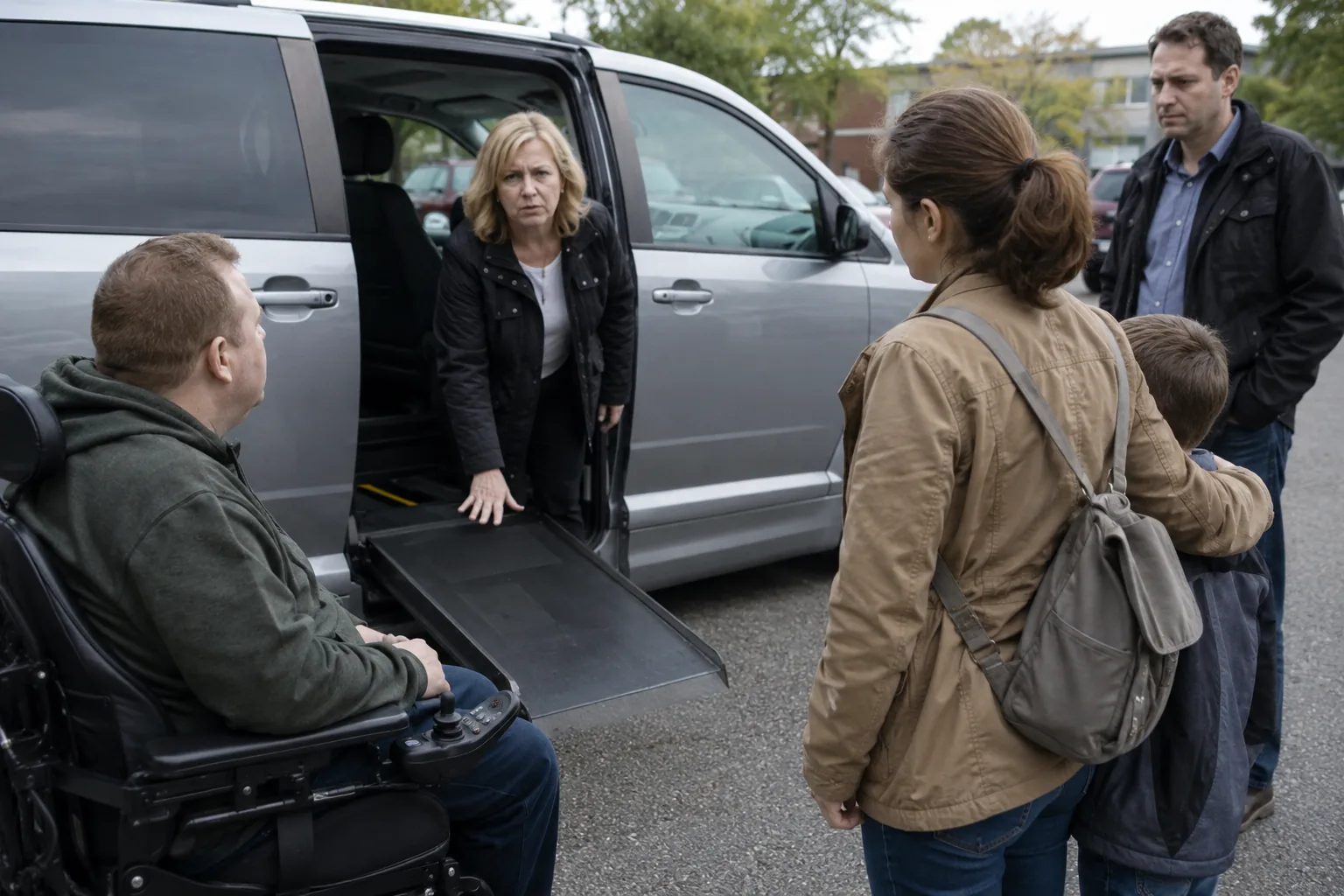
Marlene did not answer Tessa’s question. She looked down at her phone, tapped the dark screen once, and said, “I’m trying to handle it.” Eli was still sitting in the doorway track of his own morning, stuck halfway between arriving and being allowed to arrive, and the only thing moving was the language around him.
Denise shifted her clipboard to her other arm and asked the kind of question staff ask when they want one thing pinned down before the story gets any larger.
“What number are you calling?”
“Transport,” Marlene said again.
“Which transport office?”
“The main one.”
“For this route?”
Marlene’s thumb moved over the phone screen without bringing up a call. “Yes.”
That exchange told Tessa more than any dramatic accusation would have. Not because it proved everything. It didn’t. But the rule was still surviving on labels instead of specifics, and every label had to be replaced the second someone touched it.
Eli spoke directly to Denise. “I use this van every week. The ramp comes down, I get out, we do the day, I get back in. That’s the whole system.”
Denise nodded once. “That’s my understanding too.”
Marlene cut in before either of them could say more. “Routine doesn’t override safety.” She said it in the tone people borrow when they need an argument to sound too responsible to question.
Tessa kept her voice level. “What’s the safety issue?”
“Liability.”
“With what?”
“The ramp.”
“What’s wrong with the ramp?”
Marlene glanced at the metal edge as if the object itself might rescue her sentence. “I’m not saying something is wrong with it. I’m saying approval is required before use.”
There it was again: not a defect, not a hazard in the loading zone, not a mechanical warning. Just a floating approval that existed only when somebody tried to make her define it.
Denise stepped up high enough to see into the van. The tie-down area was clear. The floor rails were clear. The ramp housing showed no tag, no tape, no mark that would signal the equipment had been taken out of service.
“Did dispatch tell you this this morning?” Denise asked.
“We were told to be careful,” Marlene said.
“By who?”
“People above me.”
The wording had changed again. Transport. Safety exceptions. Dispatch. People above me. Tessa did not need to guess at motives to see the pattern. The source kept moving because no fixed source was being offered.
A man loading supplies into another van slowed down just enough to look over, then looked away. A parent with a lunch tote steered wide around the side door. Public scenes like this often stay quiet not because nobody notices, but because everybody recognizes a family-care moment and hopes not to touch it. Marlene had counted on that kind of silence so far.
Denise didn’t give it to her.
“Okay,” she said. “Then let’s keep this simple. If there is a stop-specific rule, I need the wording. If there is a route-specific rule, I need the person who gave it. If the equipment is out of service, I need that confirmed.”
Marlene lifted one shoulder. “I don’t have to prove procedure in the parking lot.”
That line sharpened the whole scene. Tessa could almost feel the shape of the bluff through it. Fairness was no longer the issue. Convenience wasn’t either. The question had narrowed to verifiability.
“You actually do,” Tessa said, still controlled. “If procedure is the reason Eli can’t get out of the van, then procedure has to be real enough to identify.”
Eli gave a short nod. “Exactly.”
Denise held out her hand. “Let me see the route sheet.”
For the first time, Marlene hesitated before handing something over. It was just a clipboard with the day’s stops, pickup times, and contact boxes. Denise scanned it with one finger. No notation about ramp restrictions. No handwritten alert. No highlighted exception at the program stop.
“There’s nothing here,” Denise said.
“They don’t always put everything on paper,” Marlene replied.
Tessa looked at the side of the van where the company number was printed in fading blue letters. “Then call them on speaker.”
Marlene’s head came up fast. “No.”
The refusal landed harder than anything before it.
Denise watched her for a second, then pulled out her own phone. “Fine. I’ll call the routing desk myself.”
Marlene stepped half a pace into the doorway, blocking not just the ramp controls now but Denise’s line of sight to them. “You don’t need to do that.”
“If there’s a real approval requirement, they’ll confirm it,” Denise said.
“It’s more complicated than that.”
“How?” Tessa asked.
Marlene opened her mouth, closed it, and changed direction.
“Because if he gets out here,” she said, “then he’d need the ramp again later to get back in. And that also takes approval.”
The absurdity arrived so plainly that nobody had to decorate it. A rule that had started as a reason not to unload Eli was now being stretched to cover reloading him hours later. Same van. Same ramp. Same route. Same equipment she had already treated as normal enough to bring him there.
Denise’s phone was already up, thumb over the routing desk number printed on the van sheet.
Tessa looked from the phone to Marlene to the folded ramp that had somehow become restricted only after it was time for Eli to use it in front of witnesses.
And that was the moment the story changed from a delay to a test: if the real office answered, either the policy would finally exist, or everybody standing there would hear that it never had.