Story code: ST-000557
Part 3: The Floor Supervisor Asked Her To Tie The Screen To A Real System
Eli Mercer did the useful thing first. He checked what could be checked in public before he let anybody turn the moment into an argument about tone.
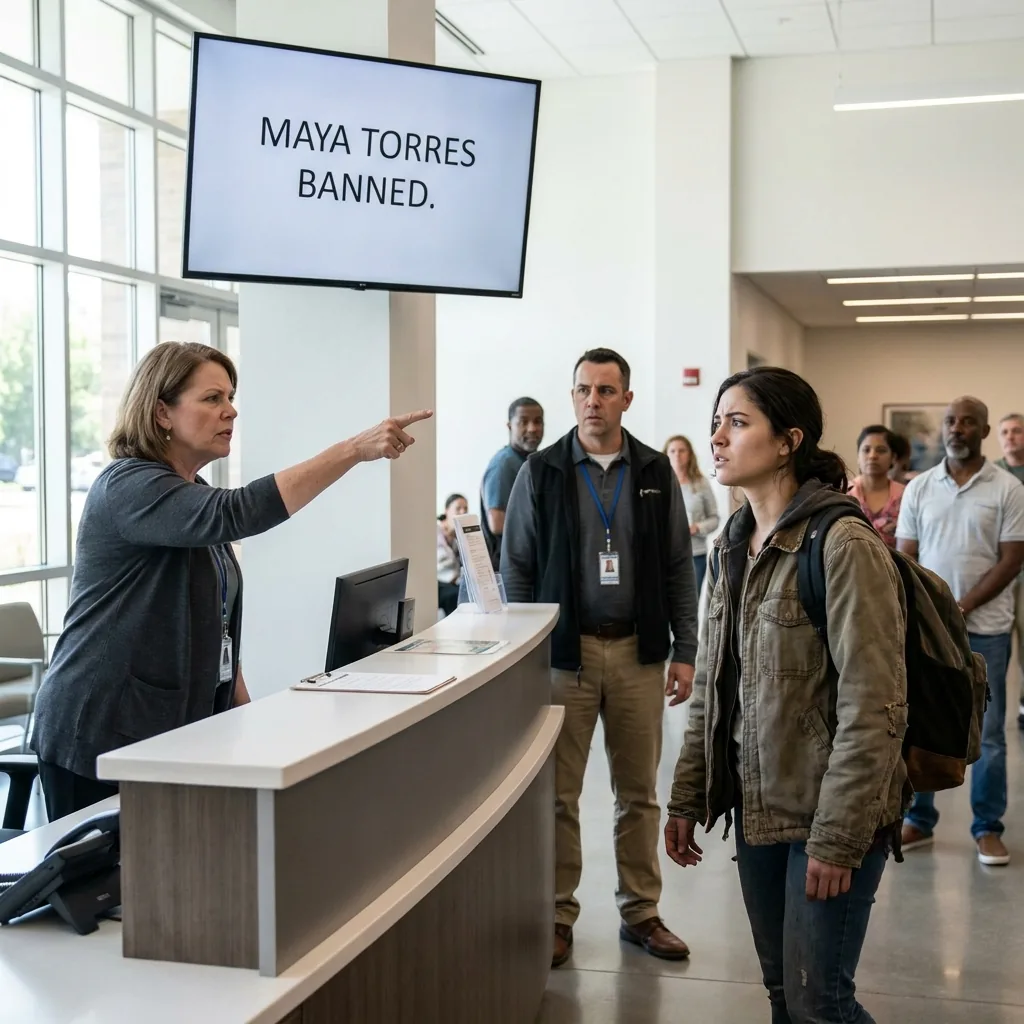
He stepped behind the front-desk counter just far enough to see Denise Park’s screen and asked her to show him the account page, the access page, and the notes tab in that order. Denise clicked through each one while the announcement screen still hung over the lobby with Maya Torres’s name in block letters. Eli did not rush. He looked at the room schedule board, then back at the monitor, then up at the slide again.
“I’m not seeing a building access hold,” he said.
Kendra Walsh answered from Maya’s side of the counter instead of from the staff side. “Because I told you, this is program-level conduct screening pending review.”
Eli turned toward her. “What system records that review?”
Kendra said, “It doesn’t always start in the member account system.”
“Then where does it start?” he asked.
That was the question the room had been moving toward since Part 1. It was not dramatic in itself. It was procedural. But it forced the claim onto a track with only a few possible exits. If the rule was real, it had to live somewhere visible to staff besides Kendra’s voice and the slide she had pushed to the announcement screen.
Kendra pointed up at the screen again. “I issued the notice so desk staff would know not to admit her.”
Eli looked up once, then back at her. “The notice tells people what you want done. It doesn’t tell me what authorizes it.”
Nobody near the counter said anything for a second. A child bounced a basketball farther down the hall and somebody called for him to stop. The scanner at the desk beeped once when another patron checked in at the far end. The ordinary center noise kept going around a conflict that had now become very specific.
Maya kept her hands on the strap of her tote bag and asked, “Can he see any rule that says my access can be blocked this way?”
Eli answered her without adding extra language. “Not yet.”
That “yet” gave Kendra one more chance. He asked for the source three different ways. He asked whether there was a posted conduct policy tied to room access, whether there was a supervisor note or incident restriction in the system, and whether any standing program rule allowed an organizer to impose a same-day center-wide room ban. Denise checked the desk binder again while he spoke, then the posted notices beside the counter, then the digital daily listings. Nothing matched the words Kendra had been using.
Ron Patel stayed in line with his yoga mat tucked under his arm and said what everyone else had already started comparing. “If she can ban one person from every room with a slide, then any program lead can do that to anybody, right?”
Eli did not answer him immediately. He asked Denise, “Who has permission to send slides to rotation?”
“Program leads and admin users,” Denise said.
“And do slides change account status?”
“No,” Denise said.
That was the cleanest line spoken all morning.
Kendra tried to narrow the claim. “I wasn’t changing her account status. I was enforcing an active restriction while review catches up.”
Eli asked, “Who started the review?”
Kendra said, “I did.”
“When?”
She named that morning.
“Before the slide went up or after?”
Kendra’s answer took a beat too long. “At the same time.”
Eli looked at Denise. “Is there a review entry?”
Denise shook her head once. “Not that I can see.”
Maya asked the next question in the same even voice she had used all along. “So the first thing entered was the public slide?”
Nobody at the counter contradicted that immediately. That silence did more than another round of argument would have done. The sequence was now visible: screen first, verifiable process nowhere, and a claimed rule expanding wider each time it was questioned.
Eli straightened and stopped treating Kendra like a colleague making a quick floor call. His tone changed into formal desk language. “Then here’s where we are. You issued a do-not-admit instruction affecting all program rooms. It is not supported by posted guidance at this counter, not reflected in the access system, and not attached to a recorded restriction I can verify. Because it affected public access and other patrons are now asking whether it applies to them, this is no longer an informal program matter.”
Kendra said, “So remove the slide and let me handle it privately.”
Eli said, “No. Not yet.”
He pointed at the announcement screen so everyone could follow what he meant. “That slide stays visible long enough for me to document exactly what was ordered and who entered it. After that, we fix the screen and the account trail in the right order.”
Denise pulled a center incident form from under the counter, but Eli didn’t hand it to Maya. He slid it toward Kendra.
“You entered the instruction,” he said. “You are going to write the basis for it, the time you posted it, and the system or policy you relied on. If there is no source, that goes in the report too.”
Kendra stared at the paper without touching it. The lobby had stopped treating the announcement screen like proof. Now it was being treated like evidence.
Then Eli added the part that made Part 4 unavoidable.
“And until this is resolved,” he said, looking at Denise’s monitor, “admin access to the announcement rotation and any account-level restriction request tied to this incident will be processed in front of me, by the person who created the slide.”