Story code: ST-000557
Part 2: The Rule Started Catching People It Was Never Supposed To Touch
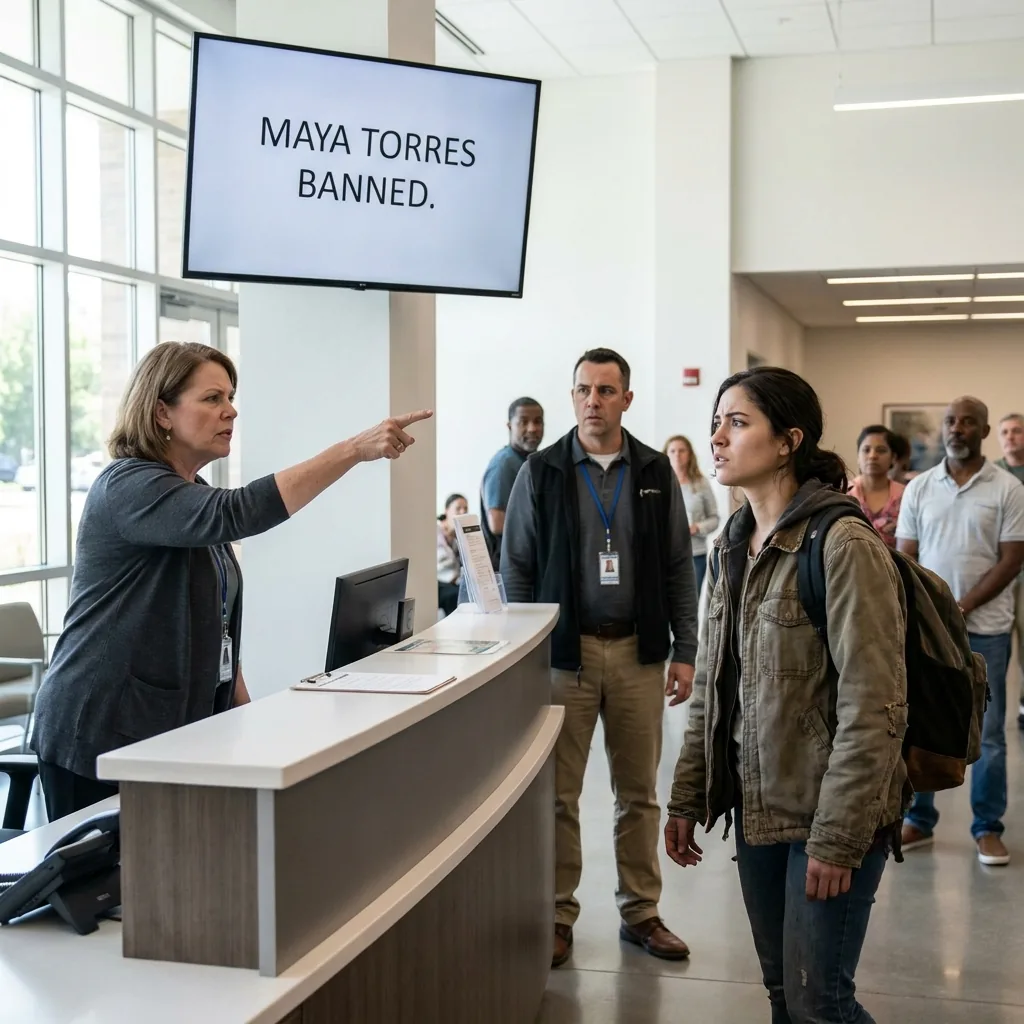
By the time Part 2 starts, the worst thing about that screen was no longer Maya’s name on it. It was that other people in the Riverton Community Center lobby had started testing Kendra Walsh’s rule out loud, and every test made it stranger.
Ron Patel was the first to force it into the open. He shifted his yoga mat to his other arm, pointed at the room schedule board, and asked, “My class is in Studio B. If somebody in my group gets flagged by this screening thing, are we all blocked from entering, or just them?” Kendra said, “Just the restricted participant.” Ron followed with the next obvious question: “Then why does the screen say do not admit to program rooms instead of do not admit to one class?”
There was a short pause after that. It stood out because the lobby had been moving all morning. Sneakers on tile, scanner beeps, somebody laughing near the vending machines, a child asking where the art room was. Kendra looked up at the announcement screen, then back at the desk, and said, “Because access control has to be broad until review is complete.”
That phrase had not been used a minute earlier. Maya caught it immediately. “Review by who?”
Kendra replied, “Center administration.”
Denise Park was still at the desk with the member account system open. She said, careful and plain, “If administration blocks access, it usually shows on the account notes. I still don’t have anything except regular check-in history.”
Kendra told her, “You’re looking in the wrong place.”
Denise did not argue. She turned the monitor slightly toward herself, clicked into another tab, and checked again. People close enough to the desk could see the rhythm even if they couldn’t read the fields: account page, access page, notes, room reservations. Nothing on her face changed much, but she stopped nodding along with Kendra’s wording. That was new.
Maya kept the conversation pinned to visible facts. “If this is center administration, call the floor supervisor. If it’s posted, show it. If it’s in the system, Denise should be able to see that I can’t enter.”
Kendra answered none of those directly. She said, “You’re creating disruption now.” It was the kind of sentence people use when the questions are becoming more dangerous than the original accusation.
Then the rule spread beyond Maya exactly the way a bad bluff always does. A woman near the hallway seating asked whether the same screening could stop her teenage son from going to open gym if he had a disagreement in one club. Another man asked whether a late fee on a rental room counted as a flag. Ron repeated Kendra’s wording back to the room: “Broad until review is complete. So broad means what, exactly?”
No one was yelling. That made it harder for Kendra to dismiss. These were practical questions from people who needed to know if the center’s access rules had quietly changed while they were standing there.
Denise reached for the printed desk procedures again, then the posted notices by the card reader. Guest pass rules. Youth supervision. Refund policy. Program cancellation. No conduct screening notice, no broad access hold language, nothing that matched what was now on the screen over everyone’s heads.
Maya asked one more direct question. “Did you put that slide up before or after I walked in?”
Kendra said, “It was necessary once your status was confirmed.”
“Confirmed where?” Maya asked.
Kendra’s hand went toward the keyboard, not toward any binder, wall notice, or system printout. That detail mattered. The one thing in the room she controlled without anyone else’s help was the announcement screen.
Ron leaned enough to see around the monitor. “Can she just type names up there?”
Denise answered before Kendra did. “Program leads can send slides to the rotation.”
That answer changed the room in a very quiet way. The screen had looked official because it was above the counter and everyone was used to trusting it. Now it also looked editable.
Maya did not need to say much after that. She asked Denise what happens when access is really suspended. Denise said it normally comes through the member account/access system or from a supervisor, and desk staff can see the restriction. Maya asked whether today’s restriction was visible there. Denise said, “Not on my side.”
Kendra cut in: “Because this is a program-level decision.”
Ron lifted his mat slightly and asked, “Then why is the front desk being told not to admit her to any room in the building? That’s not one program.”
Kendra started answering with the same words she had been using since the beginning, but now the repeated wording worked against her. Participant conduct screening. Broad access control. Center administration. Program restriction. The labels got larger while the proof stayed smaller.
A few seconds later, Eli Mercer came out of the side office after Denise called for a floor supervisor. He did not start by talking. He looked at the screen, at Maya at the counter, at the open account page on Denise’s monitor, and then at Kendra. “Before I say anything,” he said, “who entered that slide, and what system is this restriction coming from?”
Kendra’s voice lost some of its early smoothness when she answered, because for the first time the person asking could compare the screen claim to the actual process in the same room. And that was the point where the proof trail stopped being public embarrassment and started becoming evidence.