Story code: ST-000139
Part 4: Who Carried It Out
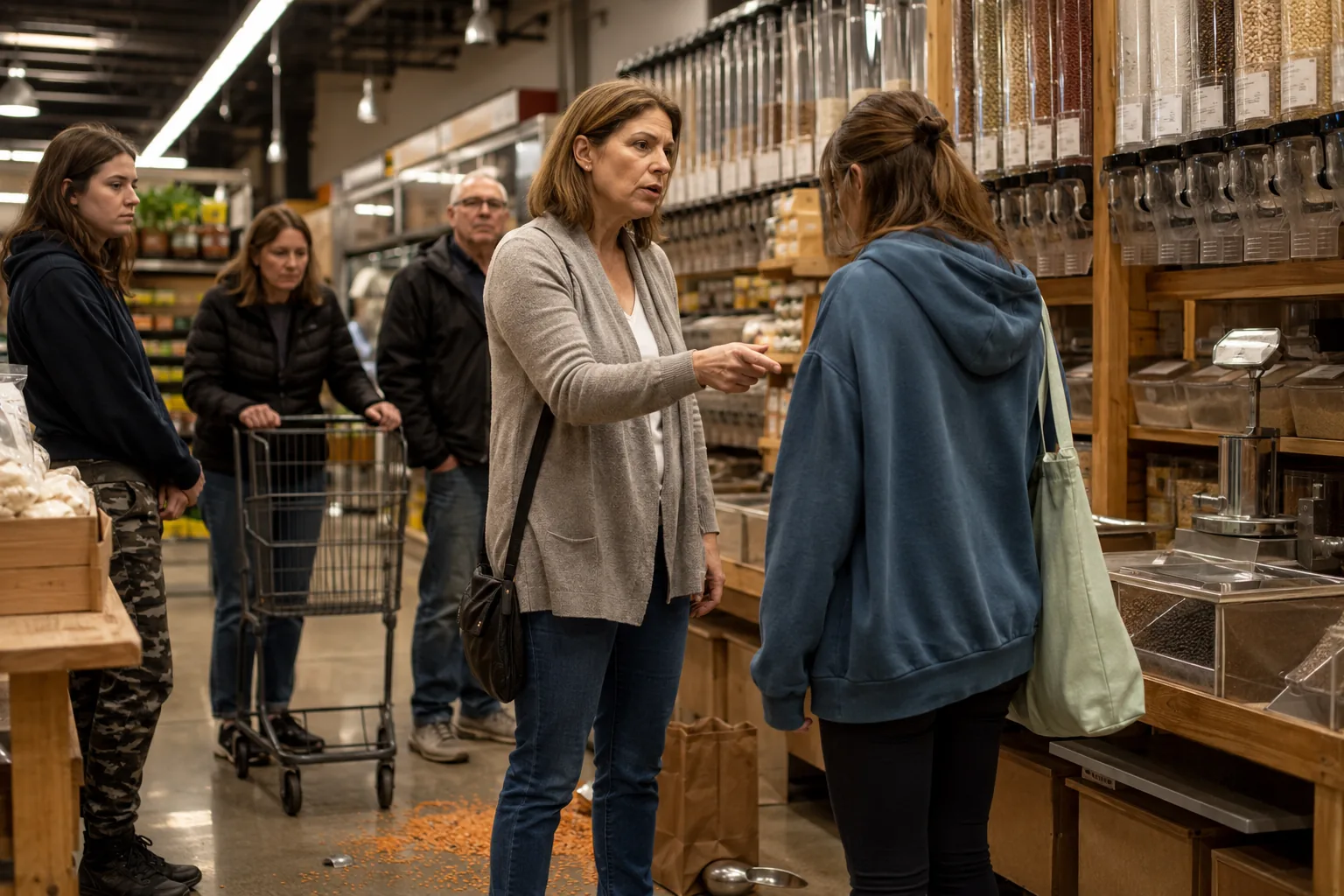
Leah followed at a distance only because everyone in that short stretch of aisle drifted the same way. Nobody crowded. Nobody made a show of it. Rosa led with the dustpan and broom, Dana came after her with the tote and the cracked clear jar, and Mia and Owen trailed a step behind like they had learned that spacing by repetition. The checkout-adjacent endcap sat in full view of the aisle but just outside its center. It was close enough for a cashier to help, far enough that the people at the grain bins could go back to shopping if they wanted. That was where Rosa stopped. “Set the tote here,” she said. Dana placed it on the narrow shelf beside a display of local honey. The jars knocked together softly. Up close, the chalky residue on the canvas looked impossible to miss. Rosa pointed to a stack of brown paper towels and a roll of produce stickers behind the register stand. “I need the damaged bulk product weighed as loss,” she said. “And any compromised jar contents from the tote need to be removed before you keep shopping.” It was Dana’s own language returned to her in store terms. Dana gave a quick look toward Mia, then toward the cashier, a young man who had clearly caught only the edge of the story. Rosa kept it that way. She did not repeat the whole argument. She only said, “Broken customer container, spill from the tote, product loss. I have to document the damaged goods.” That small choice mattered. Leah could see it in the way Mia’s shoulders lowered one inch instead of locking higher. The full scene stayed at the endcap instead of being announced down the whole front of the store. Rosa slid a shallow compost tub onto the shelf. “Please empty the cracked one first. Then anything from the broken amber jar that transferred into the tote fabric needs to be discarded too.” Dana stood very still for a moment with the clear jar in her hand. Then she did the thing she had demanded for someone else. She tipped the jar over the compost tub. A pale stream of flour fell out in a soft rush, clinging at first, then letting go. It made a low powdery sound against the bottom of the bin. No one gasped. No one clapped. The cashier looked down at the scale. Rosa wrote something brief on a store pad. Owen watched the flour fall. Mia kept her eyes on the tote straps. Dana tapped the base of the jar twice with her palm to shake out the last packed flour from the crack line and threads. The motion was neat, practiced, and final. Leah thought of the sentence Dana had thrown through the aisle earlier: If you create waste, you own it. Rosa pointed next to the flattened side pocket. “That divider too. There is residue along the seam.” Dana’s jaw tightened. She pulled out one jar after another, setting them on the shelf so Rosa could check for loose lids and powder transfer. Then, with two fingers, she peeled the canvas pocket open and turned the tote sideways over the compost tub. Lentil dust, flour, and tiny dry crumbs slid from the seam. Not much by grocery standards. Plenty by the standard she had announced. The visible cost kept building in small pieces. Discarded flour. A tote taken out of use. Rosa marked down the spilled lentils and, after checking with the cashier, tagged the damaged jar loss to Dana’s purchase. Then she said, “I don’t recommend carrying glass in that tote again until the divider is replaced.” Dana nodded once, sharp and mechanical. She did not argue the charge. She did not repeat the lesson. She folded the empty tote in half, then stopped because the cracked jar was still in her hand. For a second she looked as if she might tuck it back inside by habit. Rosa set a small box on the shelf. “Glass disposal only.” So Dana completed the last part too. She dropped the cracked jar into the box herself. The sound was brief and hard. It ended the scene better than any speech could have. Mia reached for the tote then, maybe to help, maybe to carry it, but Dana kept hold of it and slung the collapsed canvas over her own shoulder instead. The rule about losing the right to carry it was still sitting there between them. Dana did not say it again. She did not have to. The tote never went back to Mia. Rosa handed over the receipt with the added loss charge and the note for damaged bulk goods. It was not dramatic, just a narrow strip of paper and a store memo clipped behind it. Still visible. Still real. “You’re cleared to finish shopping if you switch to paper bags,” Rosa said to Mia, and only to Mia. Then, after a brief glance at the empty tote, she added, “Or you can head to the front.” Mia looked at Dana’s shoulder, at the folded canvas, at the receipt in Rosa’s hand, and then toward the aisle exit. “I’m done,” she said. She left with nothing in her hands. That was the freedom and the cost of it. She was no longer standing under the accusation. She was also leaving her own shopping behind, walking out past the registers with lentil dust still on one cuff and no tote, no jars, no clean public ending. Owen set his jar in the cart and followed her after a half second. Dana stayed at the endcap to pay for the waste she had assigned so neatly to someone else. Leah watched Mia reach the front doors without anyone calling her back. The truth had held where it needed to hold and nowhere wider. By the time Leah returned to the oats bin, shoppers were scooping grain again as if the aisle had swallowed the sound. But the image that.