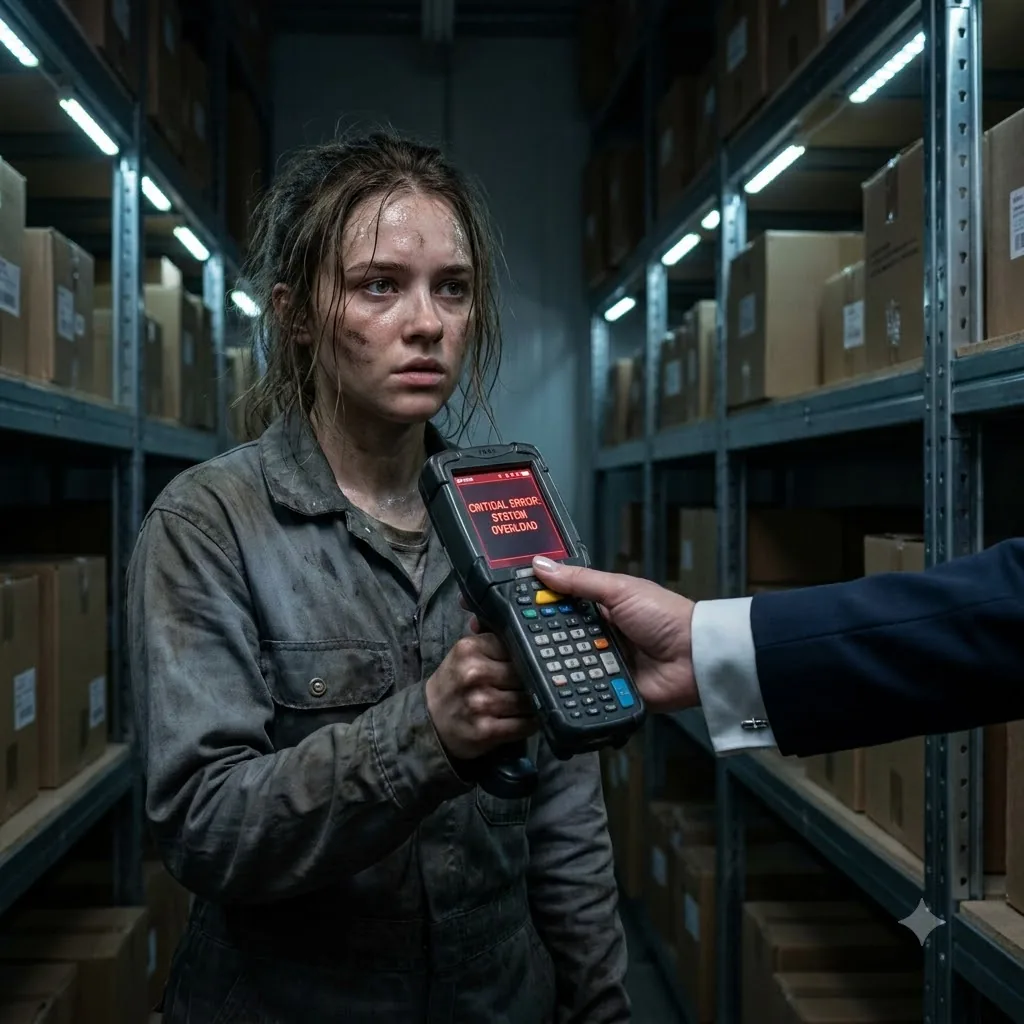
Story code: ST-000137
Part 3: Fourteen Shifts
I slammed my trembling palm flat against the pulsing biometric outline on the scanner’s screen.
A vacuum of sound sucked the air from my lungs. The frantic buzzing of the security drones and the deafening red-alert sirens vanished, replaced by the violent hiss of heavy pneumatics. The section of steel grate beneath my boots simply dropped. It wasn’t magic; it was a high-speed maintenance lift hidden directly inside the incineration chute. I was rocketing upward in utter darkness, the G-force pinning my shoulders down, multiplying the agony in my spasming lower back. The ivory-suited woman did not follow. I was entirely alone in the pitch black.
Before I could even scream, the lift jerked to a brutal halt. Seamless metal doors slid open.
The harsh, metallic stench of the warehouse floor was instantly replaced by the scent of filtered, climate-controlled air and expensive espresso. I stumbled forward, my boots sinking into plush, sound-dampening carpet. I was in a massive, glass-walled office suspended directly over Sector Four. Through the floor-to-ceiling windows, the chaotic robotic grid below looked like a silent, harmless video game.
Then, the adrenaline evaporated.
Without the sheer terror of the drones keeping me upright, my body registered the catastrophic damage of my labor. The impossible quota-four hundred items picked, scanned, and stowed per hour-finally collapsed on top of me. My sciatic nerve detonated, sending a shockwave of blinding white fire down my left leg. I hit the floor hard, my knees bruising against the pristine wool rug. I couldn’t breathe. I was gasping, coughing up the bitter metallic dust of the warehouse, my muscles trembling so violently I couldn’t push myself up. My vision blurred at the edges as the physical toll of surviving the system crushed me flat.
Footsteps approached. Soft, unhurried, leather-soled.
“Jesus, not another one,” a voice muttered. It was nasal, dripping with exhausted condescension.
I forced my heavy head up. A man in his early thirties stood over me. He wore a perfectly tailored cashmere hoodie and pristine, limited-edition white sneakers. He held a translucent data tablet, his face illuminated by the scrolling lines of the exact code that dictated my bathroom breaks.
“Julian,” a synthetic voice chimed from his tablet. “Unauthorized perimeter breach via maintenance shaft.”
Julian sighed dramatically, rubbing his temples before stepping over my twitching leg to reach his expansive mahogany desk. “I see her. She must have panicked and crawled up the chute when the suppression drones deployed. You people are unbelievable.”
I tried to speak, to defend myself, but my chest just heaved, pulling in desperate, ragged breaths.
“Look at you,” Julian sneered, leaning back against his desk and looking down at me with utter disgust. “Completely defeated by a basic productivity algorithm. My generation actually understood grit. You think this is hard? You think walking air-conditioned aisles is oppression? I slept under my desk for two years to code the Aether system. I drank liquid meal replacements. I put in hundred-hour weeks, staring at monitors until my retinas bled, just to build the most efficient fulfillment matrix on the planet.”
He gestured expansively toward the glass floor beneath his feet, where the yellow pods zoomed in perfect, silent harmony. “I gave you a perfectly optimized path! The software literally hands you the shortest route, the easiest pick, the perfect workflow. And instead of following the logic, your generation just complains about the quota. Total laziness masquerading as victimhood.”
*Laziness.*
The word echoed in the sterile, quiet air of the skybridge.
Something cold and incredibly sharp snapped behind my ribs. The violent trembling in my arms stopped. The blinding pain in my lower back didn’t vanish, but it suddenly hardened into a weapon. The rage completely overrode my nervous system.
I grabbed the polished edge of his mahogany desk and hauled myself up. My grimy, steel-toed work boots stained his expensive rug. I smelled like diesel exhaust, stale sweat, and utter desperation, and I brought all of it directly into his personal space.
“Hey, back off the desk,” Julian snapped, his arrogant bravado wavering slightly as I towered over him, my chest heaving.
I jammed my trembling hands into the deep cargo pockets of my mandated work pants. I pulled out a crumpled, sweat-soaked fistful of paper and slammed it down onto his pristine glass tablet.
“What is this trash?” he demanded, recoiling.
“My life,” I hissed, my voice cracking from the cardboard dust coating my throat. I spread the crumpled papers out with dirty, tape-wrapped fingers. “Notice of Arrears on my rent. Final Warning on my student loans. Medical bills from your own company clinic for chronic back spasms. Payroll deductions for ‘Time Off Task’ because I took sixty-two seconds to drink a cup of water.”
“I don’t care about your financial mismanagement,” Julian said, reaching out to swat the papers off his tablet.
I slammed my palm over his hand, pinning it flat against the desk. He flinched, his eyes widening in shock at the raw, unyielding grip of a hand that lifted four tons of merchandise every single shift.
“You coded an optimized path,” I whispered, leaning in until he was forced to smell the metallic sweat on my skin. “Let’s talk about your hard work, Julian. Your code requires an item scan every nine seconds to hit the four-hundred-unit quota. You factored in the travel time of the automated pods. You factored in the spatial layout of the bins.”
I snatched a heavy red fountain pen from his desk organizer and dragged it violently across my clinic bill, drawing a crude, jagged diagram. “But you modeled the workforce using a rigid titanium chassis. You didn’t code for human ligaments.”
“Security-” Julian stammered, trying to rip his hand free. I squeezed his knuckles until the bones ground together.
“Nine seconds,” I repeated, my voice dropping to a terrifying, absolute calm. “Bend. Twist forty-five degrees. Lift an average of twelve pounds. Pivot. Reach overhead. Drop. Nine seconds. No micro-pauses for lactic acid clearance. That is exactly 126,000 pounds of load-bearing torque on the L4 and L5 lumbar vertebrae per shift.”
He froze, staring at my face, the color rapidly draining from his cheeks as the mechanical reality of the numbers hit him.
“You didn’t code for recovery,” I pressed on, tapping the heavy pen against the paper like a judge’s gavel. “Human muscle fibers require a minimum of zero point eight seconds of static rest between torsional lifts to prevent micro-tearing. Your algorithm grants zero point three. You didn’t optimize productivity, Julian. You created a depreciation schedule for human tissue.”
“The beta tests-” he whispered, his eyes darting frantically to the glass floor below. “The data models showed a sustainable output…”
“The models assumed we were machines,” I snarled. I released his hand and stabbed the red pen straight through my eviction notice, burying the gold nib deep into the wood of his mahogany desk. “At a deficit of zero point five seconds of recovery per lift, compounded over a ten-and-a-half-hour shift, the lactic acid buildup induces severe cellular necrosis. The spinal discs compress by two millimeters every week. You didn’t build a fulfillment matrix.”
I leaned closer, trapping his terrified gaze, watching his arrogant certainty completely shatter.
“You built a meat grinder,” I said, pointing a bruised finger at the date printed on my clinic bill. “And according to your own brilliant, hundred-hour-week math, the complete physiological destruction of a healthy adult worker isn’t just possible. It’s guaranteed. In exactly fourteen shifts.”