Story code: ST-000137
Part 2: Code Scarlet
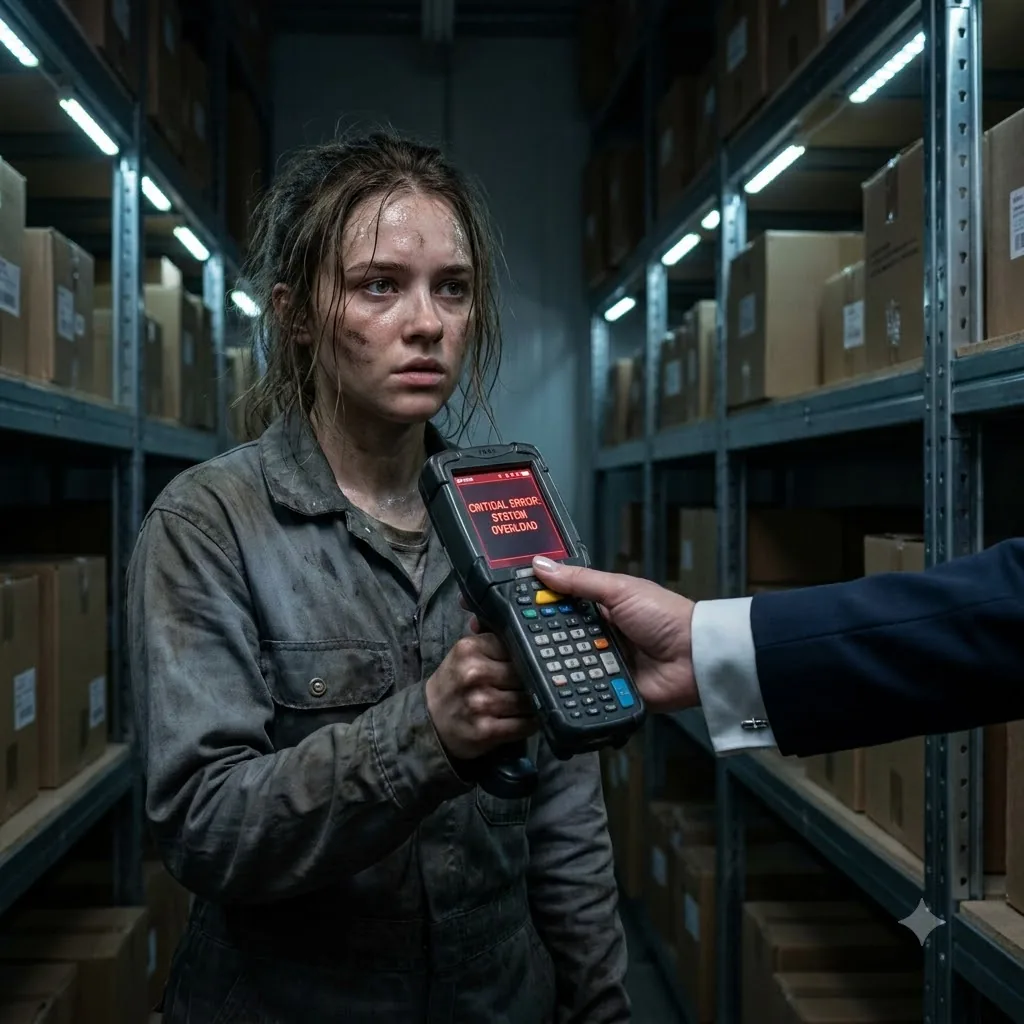
A blinding silver strobe erupted from the face of my scanner. There was no sound, just a wave of displaced air that popped my ears and tasted faintly of copper. Jenkins didn’t scream. The color didn’t return to his splotchy gray face. He simply folded. His knees buckled, his heavy frame collapsing like a discarded pallet against the steel upright of Aisle 404. His radio clattered onto the metal grating, sliding to a stop against the toe of my worn boot.
I gasped, taking a stumbling step toward him. “What did you do?” I choked out, my voice barely audible over the mechanical hum of the conveyor belts overhead.
I reached down, my grimy fingers trembling as I hovered over Jenkins’s chest. He was breathing-shallow, rapid intakes of air-but his eyes were locked wide open, staring sightlessly at the fluorescent strips above. His jaw hung slack.
“He is trapped in a loop,” the woman in the ivory suit said. Her voice was smooth, carrying a strange, metallic resonance that cut perfectly through the warehouse din. “He will experience the last ten seconds of his consciousness for the next hour. Stand up, Maya.”
I froze. I hadn’t given her my name. It was printed on the back of my badge, but my badge was tucked tightly inside my high-visibility vest.
“You… you broke his brain,” I stammered, backing away from her. The sciatic pain flared violently in my leg, nearly dropping me next to Jenkins. “The cameras. Sector Four is covered. They saw my scanner do that. They saw *me*.”
“They saw an unauthorized energy spike,” she corrected, glancing up at the black dome of the security camera mounted above the bulk dog food. “Which means the automated defense perimeter will seal this sector in exactly fourteen seconds.”
Right on cue, the ambient warehouse hum was shattered by a piercing, two-tone siren. The overhead lights snapped from dim yellow to an aggressive emergency strobe red. The robotic female voice of the fulfillment center’s central AI echoed from a thousand hidden speakers.
*”Code Scarlet. Sector Four anomaly. Biological containment protocols engaged.”*
“Move,” the woman commanded. She didn’t wait for my legs to obey. Her pristine hand clamped onto my safety vest, the sheer force of her grip yanking me forward with terrifying strength.
“I can’t!” I shouted, dragging my boots against the grating. “If I run, I’m guilty! If I stay, maybe I can tell them-”
“Tell them what?” She didn’t stop dragging me toward the end of the aisle. “That a ghost bypassed an enterprise-level firewall in three seconds and incapacitated a supervisor with a warehouse scanner? You are an expendable variable. They will lock you in a holding cell and let the algorithm dissect your life. Walk.”
A massive steel shutter slammed down at the end of the main walkway, sealing off the exit to the breakroom. The booming crash vibrated up through the soles of my feet. She was right. The company didn’t care about the truth; they cared about quota, containment, and liability. I was a zero-hour employee with a dead scanner and an unconscious manager. I was already guilty.
I stopped fighting her grip and forced my spasming back to cooperate. We bolted down the adjacent row, dodging abandoned pallet jacks and towering stacks of flat-pack furniture. The red strobe lights stretched our shadows into grotesque, dancing shapes. Behind us, I heard the heavy, rhythmic thumping of the warehouse security drones deploying from their charging bays-heavy, multi-rotor units designed for crowd suppression.
“Where are we going?” I yelled over the deafening siren.
“The grid,” she said.
My blood ran completely cold. “No. No, no, no. The exclusion zone is active! Humans aren’t allowed in there! The bots won’t stop for us!”
The robotic fulfillment grid was a sprawling, fenced-off expanse where hundreds of automated drive units-squat, heavy robots-carried towering yellow pods of inventory at twenty miles per hour. It was a high-speed, synchronized dance of mechanical death. If a human stepped onto the floor, they were required to wear a specialized vest that broadcast a localized stop-signal. We didn’t have one.
She ignored my panic, leading us straight to the chain-link barrier of the exclusion zone. A heavy magnetic lock secured the gate. The woman pressed my modified scanner against the lock’s receiver. The heavy iron latch clicked open instantly.
“Stay exactly behind me. Match my stride,” she ordered. She pushed the gate open.
The moment we stepped onto the smooth concrete of the grid floor, the air rushed past my face. A drive unit carrying three tons of canned goods zoomed past me, missing my nose by less than six inches. The floor was a chaotic highway of blurring yellow shelves. The noise was a mechanical roar of whirring gears and grinding wheels.
“Follow!” she shouted, darting forward into a gap between two speeding units.
I had no choice. The sound of the security drones buzzing furiously at the gate behind us forced me forward. I pushed off my agonizing leg and sprinted into the mechanical meat grinder. I kept my eyes locked on the back of her ivory blazer, mimicking her every pivot, stutter-step, and sudden dash. Shelves zoomed past us from all directions. The wind off the passing metal sheared through my hair. A massive pod of car parts hurled toward me from the left. I screamed, but the woman grabbed my collar, jerking me hard to the right. The pod clipped my elbow, sending a jolt of raw agony up my arm.
We burst out of the main transit lanes and collapsed against the reinforced steel wall of the perimeter chute-the massive, trash-compactor-like tunnel where damaged goods were sent for incineration.
I fell to my hands and knees, gasping for air, the metallic dust of the grid coating the back of my throat. My back was a screaming knot of fire.
The woman stood over me, not a single hair out of place, her suit miraculously free of grease. But the silver glow from my scanner was flickering now, dimming like a dying star.
“They are rerouting the grid,” she said, looking down the long row of shelves. “The bots are circling us to form a barricade. We have forty seconds before the suppression drones breach the perimeter.”
She held out my fading scanner. The screen shifted from alien script to a harsh, pulsing biometric outline of a human hand.
“What is that?” I choked out, clutching my ribs.
“An exit,” she said coldly. “But I cannot open it. The hardware is registered to your biometric signature. Place your hand on the screen and authorize the bypass.”
I stared at the device. “Bypass what? What does it do?”
“It removes you from the system,” she said, her eyes narrowing as the buzzing of the drones grew louder, echoing off the steel walls. “Completely. You will no longer exist in their database, their census, or their world.”
The red emergency strobes caught the pure panic in my reflection on the dark metal wall. I was cornered against the incineration chute. A swarm of corporate security was seconds away. But wiping away my entire existence? Erasing everything I was?
“Decide, Maya,” the woman said, shoving the glowing screen toward my chest. “Five seconds.”