Story code: ST-000137
Part 4: The Null Value
Julian didn’t move. He sat perfectly still, staring at the red fountain pen I had driven through his mahogany desk. The droplet of ink bleeding into my eviction notice looked exactly like blood. I stepped back, letting the silence of his climate-controlled skybridge crush him.
His eyes finally dragged themselves away from the paper, drifting downward to the glass floor. The robotic grid below was a mesmerizing, silent ballet of yellow inventory pods. Ten minutes ago, he saw an optimized matrix of pure efficiency. Now, I watched his pupils dilate as he saw exactly what I had forced him to see: a mechanized slaughterhouse.
“I…” Julian started, his nasal voice cracking into a wet, breathless wheeze. “I just wrote the pathing logic. I didn’t… the physical tolerances were provided by Human Resources. They said…”
“They said whatever kept the stock price up,” I rasped, rubbing the brutal, spasming knot in my lower back. “And you made the math work. Fourteen shifts, Julian.”
The pristine, untouched illusion of his genius shattered completely. He didn’t argue. He didn’t call security. Instead, a violently physical wave of nausea washed over his pale face. He slapped a hand over his mouth, stumbling backward out of his ergonomic chair. He tripped over the plush wool rug, scrambling away from me-and away from the glass floor-like the ground itself was covered in acid. He grabbed his keys from a side table, his hands shaking so violently he dropped them twice before bolting through the heavy oak doors of his office. He didn’t look back. He just fled.
I was alone in the quiet hum of the executive suite. I didn’t try to run. My sciatic nerve was a screaming wire of fire down my leg, and I knew exactly what was coming.
It took less than thirty seconds. The doors blew open, and three corporate security officers in black tactical vests stormed the room. They didn’t ask questions. Two of them slammed me face-first against the nearest wall, pinning my arms with terrifying efficiency. The cold glass of the window pressed against my cheek.
“Hold her,” the lead officer barked, ripping the scanner off my belt. He keyed his radio. “We have the anomaly in the skybridge. Processing termination now. Pull her employee file.”
I braced myself for the final, automated judgment. The arrest, the civil liability suits, the crushing weight of corporate retribution.
“Command, repeat?” the officer said, tapping his earpiece, his brow furrowing in deep confusion. “What do you mean, ‘null value’?”
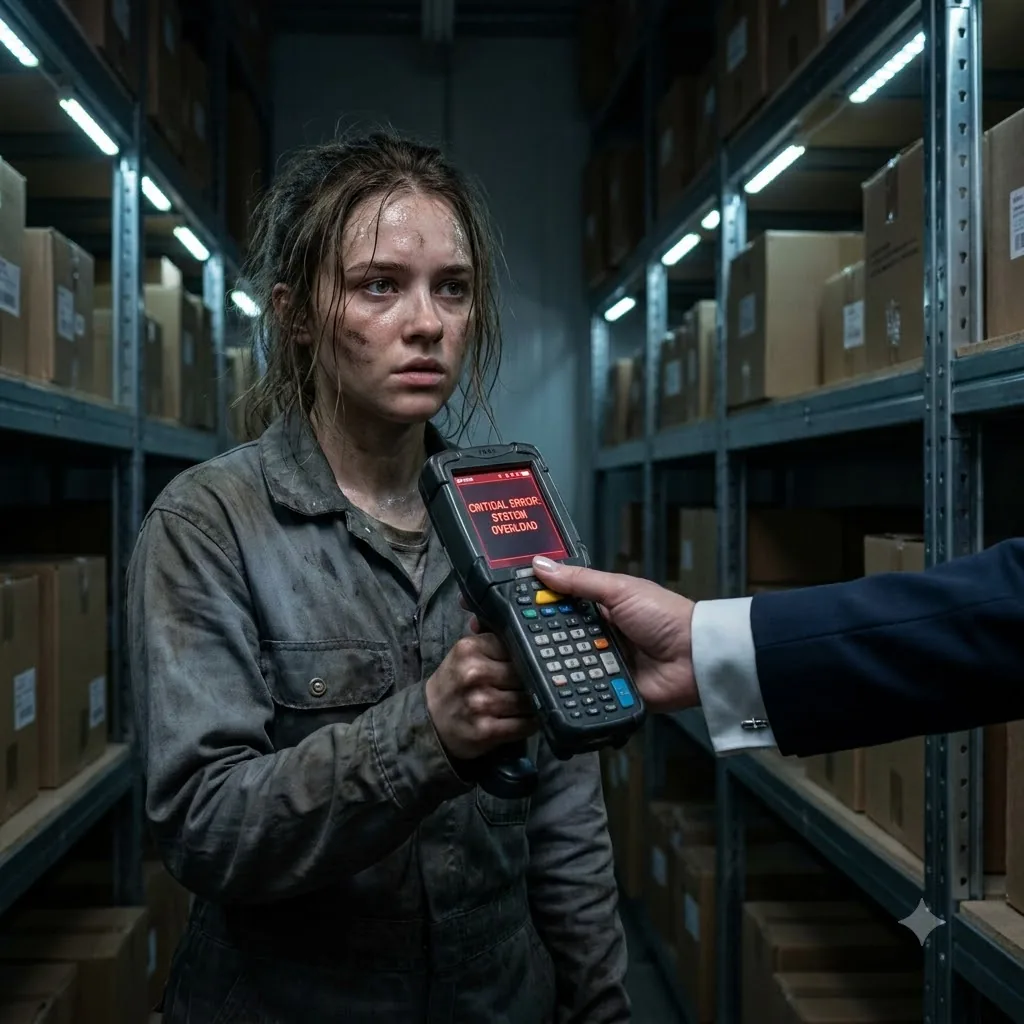
He grabbed the barcode hanging from the lanyard around my neck and pointed a handheld device at it. It beeped, flashing an angry yellow warning. *Error: Unassigned Asset.*
“There’s no file,” the officer muttered, looking at my grimy, sweat-stained face as if I were a ghost. “Biometrics, badge number, scanner ID… she’s not in the database. She doesn’t exist in the system.”
The woman in the ivory suit hadn’t lied. My five-second choice in the exclusion zone hadn’t just bypassed a door; it had meticulously purged every digital trace of my employment, my quotas, and my liabilities from their servers. I wasn’t an employee who had assaulted a supervisor and breached a restricted zone. Technically, legally, I was just a hallucination that had wandered into the building.
“Just get her off the property,” the lead officer snapped, clearly unwilling to deal with the paperwork of a non-entity. “Strip the company gear and dump her outside the perimeter.”
They didn’t call the police. You can’t press charges against someone your own infallible system claims was never there. Instead, they marched me down the freight elevator, their grips bruising my biceps. In the stark, fluorescent purgatory of the security vestibule, they stripped me of my high-visibility vest, confiscated my safety blade, and snapped my lanyard in half. They shoved me through the heavy steel turnstiles for the last time. The glass doors locked behind me with a definitive, echoing thud.
I stumbled out into the sprawling asphalt expanse of the employee parking lot. The predawn air was freezing, biting through my thin, sweat-soaked t-shirt. The sky was the bruised purple of an incoming storm.
At the far end of the lot, tires screeched against the pavement. I watched Julian’s silver sports car tear out of the VIP parking zone, running a stop sign as it swerved onto the highway. He was running back to his gated community, desperately trying to outrun the bloody reality of his own algorithms. But he would never unsee the math. Every time he closed his eyes, he would see the meat grinder.
I stood alone in the cold. My lower back throbbed with a sickening, persistent heat. My bank account was empty. I had no job, no reference, and no safety net. The crumpled final warnings for my student loans were still shoved deep in my cargo pockets, a paper anchor tying me to insurmountable debt.
But as I started the long, agonizing walk toward the bus stop, I realized something impossible. The suffocating, leaden weight in my chest was gone.
For years, the debt had been a source of crushing personal shame. I had believed their narrative: that I was failing, that I wasn’t working hard enough, that my inability to keep up with the interest rates was a moral flaw. I had absorbed the guilt of my own poverty.
But Julian’s terrified face had given me a radical, terrifying clarity. The system wasn’t broken by my laziness; it was perfectly, mathematically designed to consume me. It was an extraction machine, operating exactly as intended. I hadn’t failed. I had survived.
The debt in my pocket didn’t matter anymore. It was just imaginary numbers printed by the same people who coded the slaughterhouse. I took a deep breath of the cold, exhaust-choked air, feeling the sharp pain in my spine. I was bruised, exhausted, and completely erased from the world.
And for the first time in my life, I was entirely free.