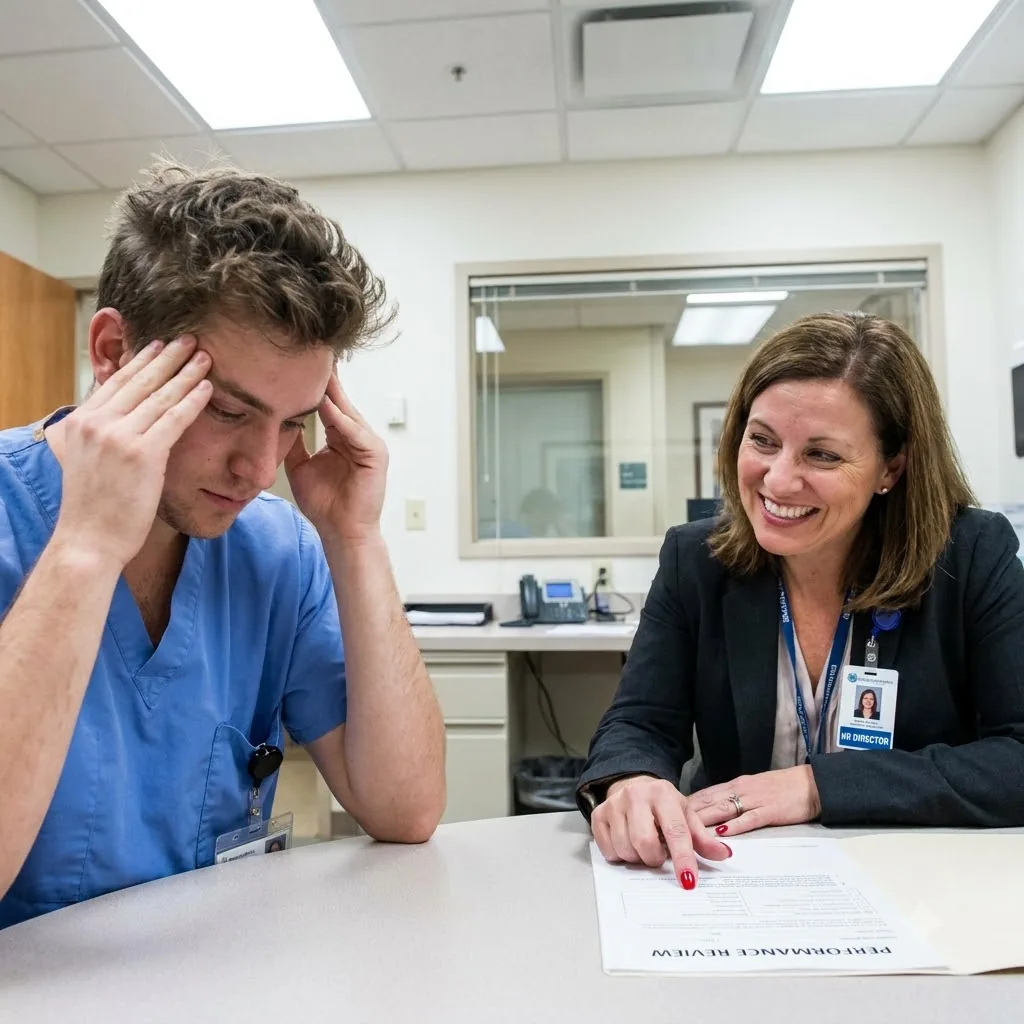
Story code: ST-000277
Part 3: Time-Stamped
Mateo stared at the heavy wooden door leading out of the disciplinary suite. The red ‘V’ on his temporary paper visitor pass burned against his palm. *Just past the Level B loading dock.* The directions echoed in his ears, perfectly confirming every instinct that had kept him paralyzed in his dented Honda Civic at four in the morning.
Going to the Sub-Basement Annex wasn’t just a walk to a mandatory clinic. The Annex was separated from the main hospital by a long, unmonitored concrete corridor. To get to Occupational Health, he would have to walk directly past the oversized rolling doors of the loading dock. If he walked down there stripped of his employee badge, clutching only a paper pass, he wouldn’t be a nursing student on his way to an evaluation. He would be an unauthorized civilian with no secure access, walking directly into a blind spot controlled by whoever was holding that staging area. He wouldn’t make it to Dr. Aris’s office for a toxicology panel. He would simply vanish into the shadows, and the hospital would have all the justification they needed to expel him for abandoning his medical hold.
Mateo did not step toward the door. Instead, he turned his body back toward the glass conference table. He planted his feet squarely on the industrial carpet, locking his knees to keep his legs from shaking.
“I’m not going to the Annex,” Mateo said.
Ms. Gable paused, her hands hovering over her expensive keyboard. The aggressive, spa-director smile stretched tight across her face, but her eyes were cold, calculating slits. “Mateo. We just discussed this. You don’t have a choice. You are on an administrative medical hold.”
“You towed my car to isolate me on campus,” he said, his voice dropping into the flat, hyper-focused cadence he used when an ICU monitor started blaring a flatline. “You took my badge so I have no digital footprint on the secure floors. And now you’re sending me to a clinic located down a blind corridor past the exact loading dock where I was parked this morning.”
Ms. Gable sighed, a deeply exaggerated sound of pity that filled the windowless room. She reached for the heavy black receiver of her desk phone. “This is exactly what I mean by hyper-vigilance and paranoia. You are constructing a massive, terrifying conspiracy out of standard hospital protocols. You need help, Mateo. I’m going to call campus security to escort you to Dr. Aris so you don’t hurt yourself.”
“Call them,” Mateo challenged, though his heart was slamming against his ribs so hard he felt it in his throat. His entire future in the country-his DACA renewal, his nursing license, his safety-hung over a terrifying precipice. But he knew that if he let her control the narrative, he was already finished. “Call campus security. But you should know that a university subpoena for the garage security tapes isn’t my only insurance policy.”
Her fingers stopped a fraction of an inch from the phone’s keypad.
“The tapes from Level B can be overwritten,” Mateo continued, keeping his empty hands entirely visible. “A hard drive can malfunction. Footage can get accidentally corrupted before my academic liaison files the grievance paperwork. I knew that when I sat in my car. I knew that just hiding wasn’t enough.”
Ms. Gable’s pastel pink nails drummed once against the plastic receiver. “You are having a severe paranoid episode.”
“I’m not having an episode,” Mateo said.
He reached slowly into the front pocket of his scrub top. Ms. Gable tensed, her posture going rigidly upright, ready to call for the guards, but Mateo only extracted his cracked smartphone. His fingers brushed against the hard plastic casing. He had debated deleting the photo the second he took it, terrified that simply possessing the image was a death sentence for his family’s immigration status. But the survival instincts that had kept him alert for the past decade had told him to hold onto it.
He unlocked the screen with his thumb. His hands were shaking, just a microscopic tremor in his fingertips, but he forced them steady as he opened his encrypted photo gallery. He hadn’t just sat in the freezing dark for an hour out of blind terror. He had watched the synchronized, heavy movements by the service elevator, realized the magnitude of what he was seeing, and carefully lowered his window just enough to bypass the glare of the dirty windshield glass.
Mateo took one step forward and placed his phone face-up on the sterile white desk, right on top of the yellow Administrative Hold form.
Ms. Gable did not immediately look down. She glared at Mateo, attempting to maintain her wall of therapeutic authority, but the sheer silence in the room forced her eyes downward.
The photo on the screen was crystal clear, completely devoid of the grainy pixelation from the hospital’s overhead security cameras. The digital timestamp in the bottom corner read 04:17 AM. The image was heavily zoomed in on the loading dock directly across from Mateo’s parking space.
Under the harsh, sickly yellow glare of the sodium-vapor lamps, three unmarked black transport vans were backed flush against the concrete platform. But it was the foreground that held the undeniable truth. Standing by the heavy rolling doors was a man with a clipboard, illuminated perfectly by the floodlights. The bold, reflective yellow letters I-C-E were starkly visible across the back of his tactical windbreaker.
Mateo didn’t need to guess who the man was. The face was turned in three-quarter profile, barking orders at the heavy shapes moving unmarked crates and equipment into the hospital’s subterranean corridors. It was Director Thomas Vance, the local Immigration and Customs Enforcement field director. Mateo had seen Vance’s face on local news broadcasts for years, a recurring phantom in the anxieties of every undocumented family in the state. Vance was using St. Jude Memorial’s unrecorded sub-basement as a staging area, completely bypassing federal oversight and public scrutiny.
And Ms. Gable was running interference for him.
“I backed up the file to a secure cloud server forty minutes ago,” Mateo lied, though his voice remained perfectly steady. “I shared the access link with my sister. If my DACA status is flagged by a suspension, or if I don’t walk out of the main lobby doors in exactly ten minutes, she sends the timestamped photo to the local ACLU chapter and the university chancellor.”
Ms. Gable stared at the illuminated screen of the phone. The aggressively cheerful mask did not slip this time; it shattered completely. The color drained from her face, leaving her expensive foundation looking like a chalky paste against her skin. Her hand slowly slid away from the desk phone receiver. She didn’t offer a patronizing whisper. She didn’t diagnose him with emotional burnout. She just stared at the undeniable proof of the federal staging area operating in her hospital, her lips parted in utter, panicked silence.