Story code: ST-000420
Part 4: Chemical Warfare
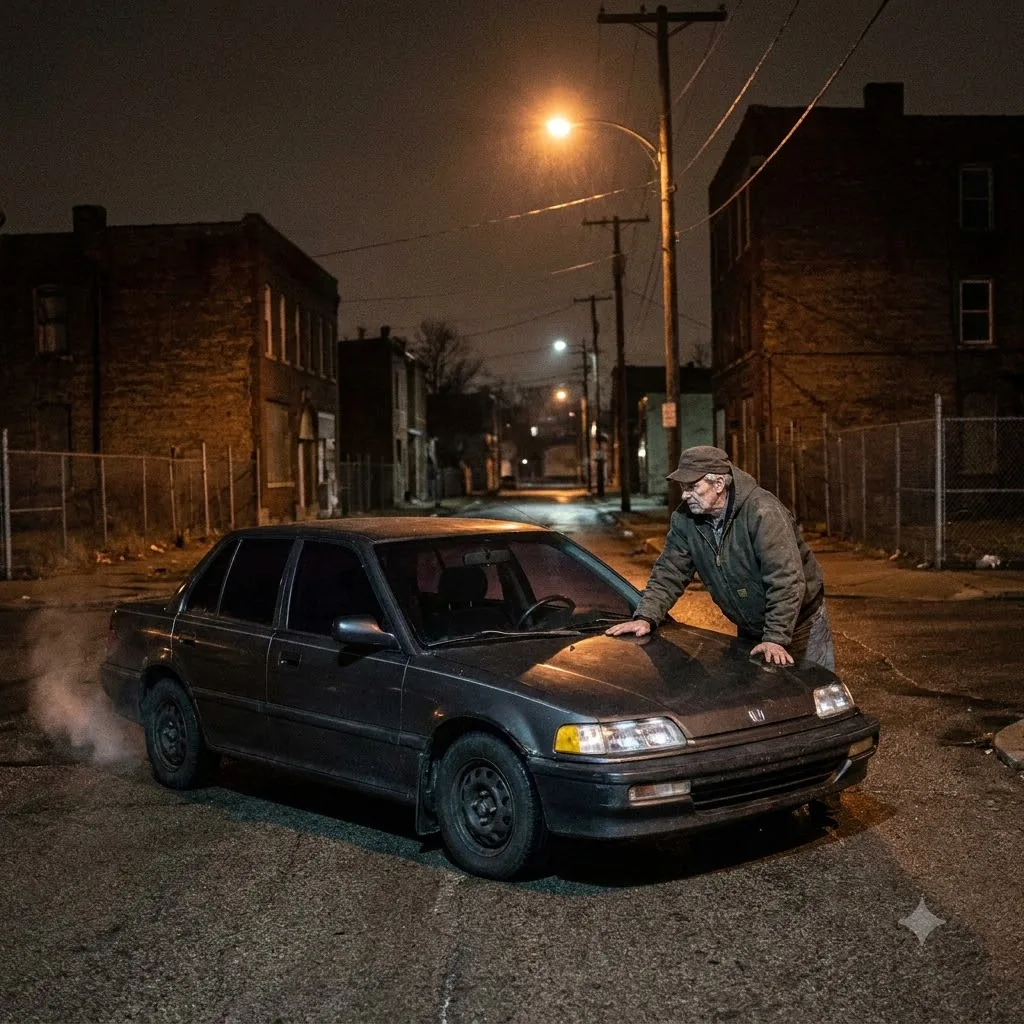
The metallic clack of the pump-action shotgun echoing through the broken window bypassed Bex’s conscious thought entirely. Survival instinct, honed over two decades on the concrete, took over in a violent, unthinking flash. He released his crushing grip on Leo’s wrist, twisting his torso with explosive force as his heavy fist slammed into the gearshift.
The transmission ground in a horrific, high-pitched protest as Bex forced the lever down into reverse. Before the bald enforcer could raise the barrel to eye level, Bex threw his entire weight backward onto the accelerator.
The Civic’s bald tires shrieked, spinning uselessly for a fraction of a second on the broken glass before violently biting into the asphalt. The burner car rocketed backward just as the shotgun roared. The concussive blast was deafening in the confined space, a thunderous explosion that blew out the passenger-side headlight and peppered the rusted hood with heavy buckshot.
Sparks showered the cracked windshield as the Civic’s rear quarter-panel slammed brutally into the brick wall of the narrow alleyway. Bex didn’t ease off the gas. He kept his heavy boot pinned to the floorboards, ignoring the sickening screech of tearing metal and shattering taillights as the car scraped along the masonry. He drove backward blindly into the darkness, his neck strained as he relied entirely on the side mirrors and muscle memory to navigate the chute of debris.
The alley finally widened out into a deserted cross street. Bex whipped the steering wheel hard with his left hand, throwing the front end of the Civic around in a violent, swaying reverse-180. He slammed the shifter back into drive, flooring the accelerator. The overtaxed engine screamed, spewing a thick cloud of dark exhaust as they tore down a dilapidated service road. He immediately reached out and killed the headlights, plunging the cabin into total darkness. Bex navigated the labyrinth of the Heights by memory alone, taking sharp, erratic turns through gutted neighborhoods to lose any potential pursuit.
He didn’t slow down until they were miles from Miller Avenue, crossing the rusted, weed-choked railroad tracks that marked the edge of the abandoned industrial sector. Bex pulled the battered Civic behind the crumbling brick husk of a forgotten textile mill, the tires crunching loudly over frozen gravel and shattered cinder blocks.
He threw the car in park and killed the engine. The sudden silence that rushed into the cabin was absolute and heavy, broken only by the ticking of the overheating radiator and the ragged, wet sound of Leo’s hyperventilation. The interior smelled fiercely of burnt transmission fluid, raw ozone, and the distinct, acrid tang of discharged gunpowder.
Bex sat frozen in the driver’s seat for a long time, his large hands gripping the steering wheel so tightly his knuckles burned. His heart hammered a brutal, exhausting rhythm against his ribs. He turned his head slowly toward the passenger seat.
Leo was curled into a tight, trembling ball on the cracked vinyl, his knees pulled up to his chest, his face buried deep in his dirt-smudged hoodie. The rigid, untouchable corner boy persona that the teenager had been desperately projecting all week was entirely gone. In the pale moonlight filtering through the shattered window, he was just a terrified, grieving sixteen-year-old orphan who had nearly gotten himself executed in the street.
Bex leaned down into the passenger footwell, his thick fingers searching the floorboards until they wrapped around the cold iron of the dropped crowbar. He picked it up and tossed it into the back seat with a heavy, hollow clatter.
“Sit up,” Bex ordered. His voice lacked its usual gravelly, commanding authority. It just sounded remarkably tired.
Leo didn’t move, his shoulders heaving with muffled sobs. Bex reached over, grasping the boy by the shoulder and firmly hauling him upright against the seat. Without asking, Bex patted down the teenager’s jacket pockets. He found a cheap, heavy switchblade tucked into the lining. He pulled it out and tossed it backward into the dark to join the crowbar. Leo offered zero resistance, his eyes vacant and glassy as the tears tracked through the grime on his cheeks.
Bex leaned back against his own headrest, staring out through the spider-webbed windshield at the skeletal remains of the factory against the night sky. For twenty years, Bex had believed in the rigid rules of the block. He believed that holding territory, controlling the corners, and enforcing strict borders kept a fragile order in a violent world.
But looking at the weeping, broken child beside him, the illusion finally shattered.
The borders meant absolutely nothing anymore. The Eastside enforcers didn’t need to cross Miller Avenue with armored SUVs and shotguns to destroy Bex’s crew. They just had to push cheap, lethal fentanyl across the invisible line. They were bypassing the street soldiers entirely, dropping chemical warfare directly into the living rooms of the neighborhood. The violence wasn’t territorial anymore; it was an insidious infection, silently killing mothers while the lookouts diligently watched the wrong borders for the wrong threats.
Bex felt the biting winter wind cut through the shattered passenger window, chilling the sweat on his neck and sinking deep into his bones. He was an aging soldier standing guard over a neighborhood that was already dead, rotting quietly from the inside out, carrying the crushing realization that there was no war left to fight that could actually save it.