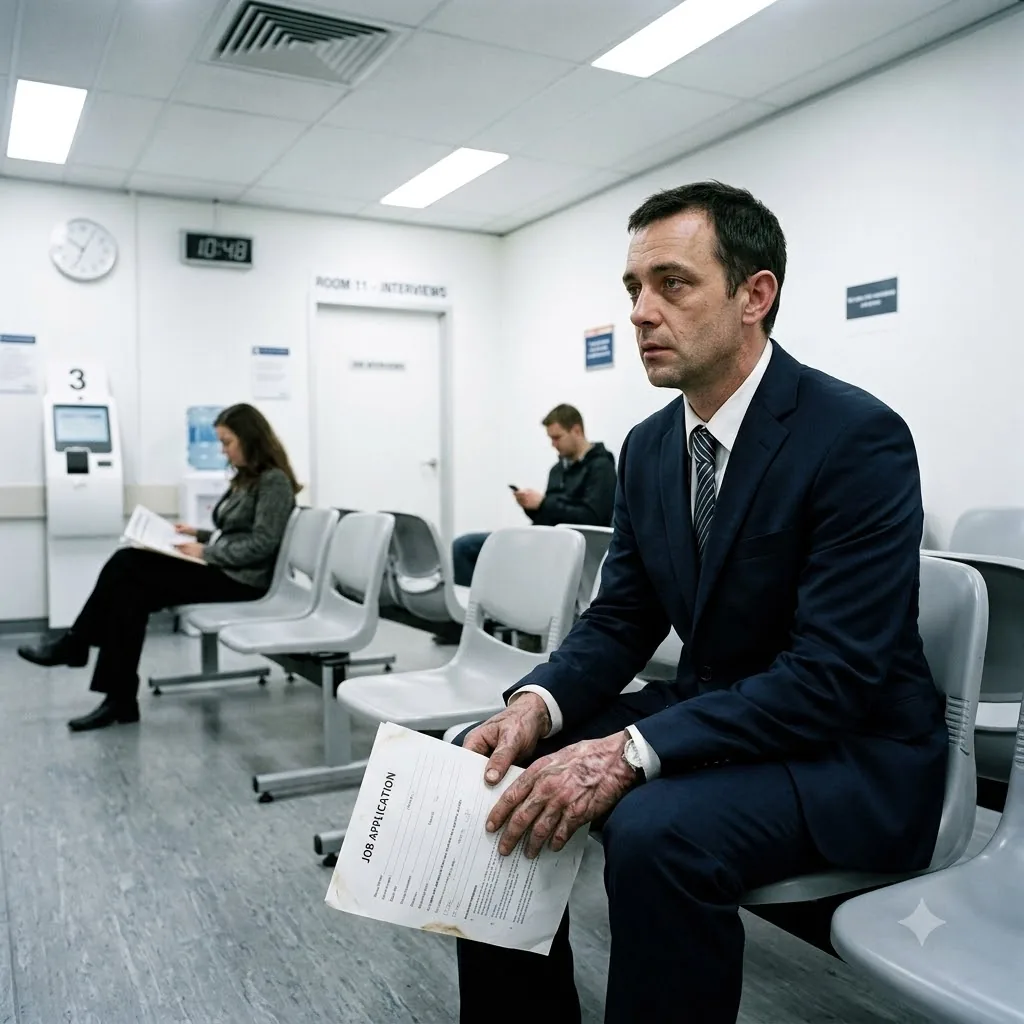
Story code: ST-001627
Part 2: The Liability
The outstretched hand hung in the sterile air between them. Mateo held it there for two agonizing seconds before the reality of Henderson’s backward step fully registered. The regional director wasn’t just adjusting his stance; he was retreating.
Mateo slowly lowered his arm. The heavy, ridged skin on his knuckles pulled tight, a dull ache radiating up to his forearm. The buzzing of the fluorescent overhead light suddenly seemed deafening, filling the heavy silence in the lobby.
“Mr. Henderson?” Mateo asked, keeping his voice carefully modulated. The camp commanders had drilled into him the absolute necessity of a calm, submissive tone when speaking to free personnel. He thought he had left that tone behind when he received his absolute discharge papers, but it clawed its way back up his throat instantly.
Henderson did not close the distance. He held the manila folder like a shield against his crisp white shirt. The red ink from the stamp seemed to glow through the thin paper. “There has been an administrative error,” Henderson said. His voice was no longer the smooth, welcoming tone of a manager greeting a prospective hire. It was clipped, defensive, and entirely hollow. “Your file was forwarded to my desk by the preliminary screening committee. It appears they missed a critical flag in the automated system.”
Mateo’s chest tightened. He reached into his cheap polyester jacket and felt the crisp edges of the heavy bond paper resting in his inner breast pocket. “I have the conditional approval letter, sir. Signed by the committee board. They reviewed my field hours.”
“A conditional approval is just that, Mr. Vargas. Conditional.” Henderson tapped a manicured finger against the outside of the closed folder. “Conditioned upon a final background check, which evidently just cleared our system this morning. The Department of Forestry and Fire Protection has incredibly strict guidelines regarding liability and public trust.”
“I was a swamper, and then a sawyer for Camp 14,” Mateo said, forcing himself to maintain eye contact, refusing to look down at his scarred hands. “I have over four thousand hours on the active fire line. I was deployed to the Mendocino Complex. The CZU Lightning Complex. The state trusted me with a chainsaw and civilian lives for four years.”
“That was under the jurisdiction of the Department of Corrections,” Henderson countered swiftly, stepping back until his shoulder blades nearly touched the heavy frosted glass of his office door. “The inmate handcrew program is a valuable rehabilitation tool, yes. But municipal and state civilian roles operate under completely different insurance umbrellas. We cannot knowingly hire individuals with felony convictions for positions involving heavy machinery, emergency vehicles, and direct access to civilian property.”
“The new state pathway program-”
“Is a guideline, not a mandate,” Henderson interrupted, his jaw tight. He looked down at Mateo’s hands again. This time, there was no mistaking the sheer revulsion in his eyes. He wasn’t looking at a man who had sacrificed his own flesh to save others; he was looking at a walking workers’ compensation claim. “And quite frankly, looking at your medical history… the state has already assumed enough liability with your injuries. Hiring someone with significant physical impairments on top of a criminal record is a risk this regional office will not take.”
Mateo felt the blood rushing in his ears. The insult hit harder than the rejection. *Impairments.* He had held the line at a fifty-degree incline for thirty-six hours straight while the wind shifted and rained burning embers down on his neck, all to protect a subdivision of people who would lock their doors if they saw him walking down their street. His hands were ugly, yes. They cramped when it was cold. But they were stronger than anything Henderson had ever built in his life.
“I can pass the physical,” Mateo said, his voice dropping an octave, losing the carefully rehearsed submissiveness. “I can run the pack test right now. Forty-five pounds, three miles, under forty-five minutes. Put me on a Pulaski or a saw. Let me show you.”
“That won’t be necessary,” Henderson said, his grip tightening on the folder.
“You’re voiding my conditional offer without even letting me interview?” Mateo stepped forward. It was a half-step, a completely natural motion of someone trying to plead their case, but in the tight confines of the beige lobby, it shifted the entire atmosphere.
Across the room, the receptionist’s typing stopped abruptly. The sudden absence of the clicking keyboard was louder than a shout. Mateo glanced over and saw her hand hovering over the telephone receiver, her eyes wide, staring at him as if he were a live wire thrashing on the carpet.
He froze. He recognized that look. It was the look civilians gave men in orange jumpsuits working on the side of the highway. It was blind, unreasoning fear.
“Mr. Vargas, I am going to ask you to step back,” Henderson said, his voice rising in volume, clearly performing for the receptionist’s benefit. “Your application is denied. The interview is canceled.”
“I bought this suit,” Mateo whispered, the absurdity of the situation momentarily overpowering his anger. He looked down at the cheap fabric, the fraying threads on the sleeve. “I spent my last sixty dollars on a bus ticket to get to Sacramento because the state of California told me I had a job.”
“The state of California owes you nothing,” Henderson said coldly. “You served your time. Your debt to society is paid, but that does not entitle you to a career in this department.”
Mateo reached into his jacket. The receptionist gasped, actually picking up the phone receiver, her finger poised over the keypad. Mateo ignored her, slowly pulling out the folded conditional offer letter. He unfolded it with trembling, scarred fingers, the thick paper crinkling in the tense silence. He held it out toward Henderson. The golden state seal caught the harsh fluorescent light.
“It says right here,” Mateo said, his voice shaking with a dangerous mix of grief and rising adrenaline. “Fire Equipment Operator I. Approved.”
Henderson didn’t even look at the paper. He reached into his shirt pocket, produced a silver pen, and uncapped it with his thumb. Without taking a step forward, he leaned over, grabbed the top edge of Mateo’s letter, and slashed a thick, aggressive line of black ink diagonally across the text, right over the embossed bear.
“Now it says void,” Henderson said, letting go of the paper. “If you do not leave the premises in the next ten seconds, I will have security escort you out in handcuffs. And I assure you, causing a disturbance in a state building will be immediately reported to your parole officer.”
Mateo stared at the defaced letter in his hand, the black ink bleeding into the fibers, feeling the phantom heat of a wildfire suddenly rushing back to consume the only lifeline he had left.