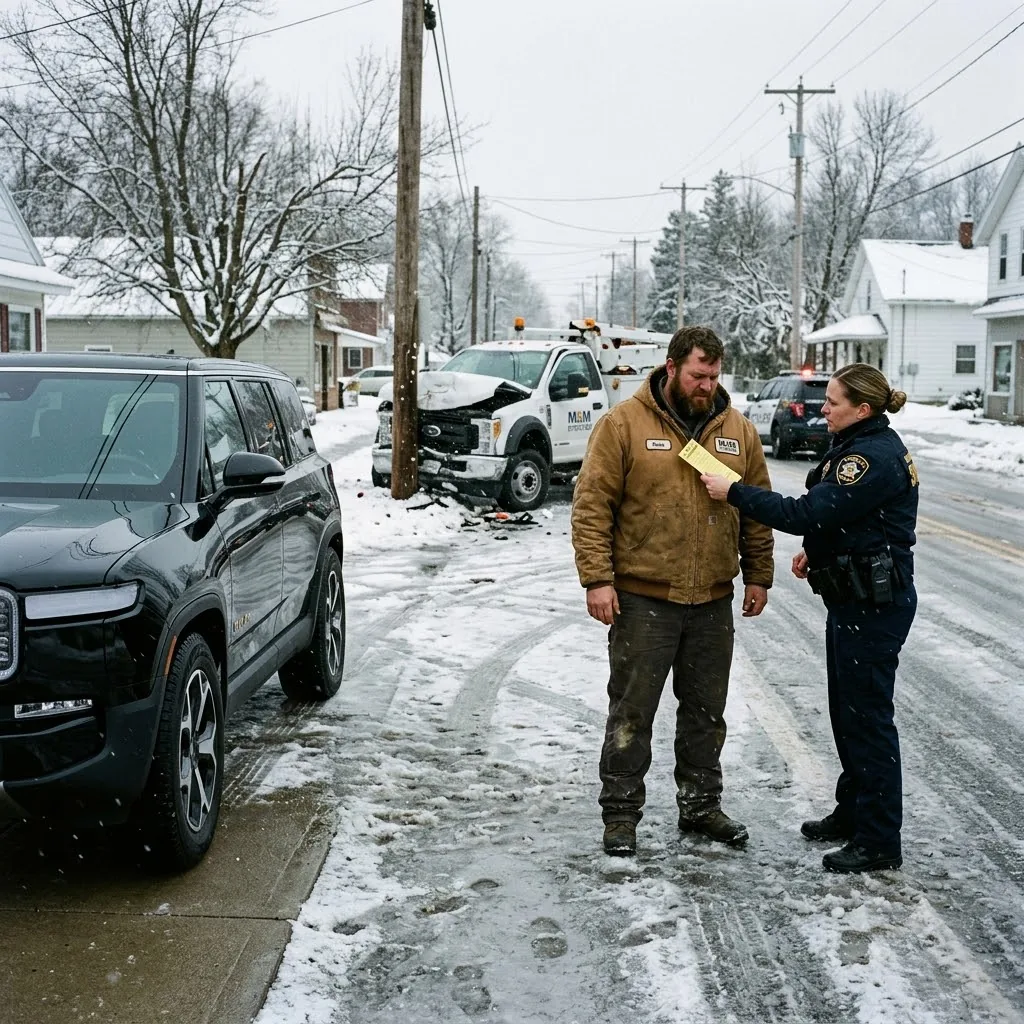
Story code: ST-001121
Part 2: The Impound
“Stand down, Frank.”
Miller’s voice was barely a whisper over the low hum of the SUV’s engine, but it carried the dead weight of absolute authority. The deputy’s thumb remained wedged under the stiff leather retention strap of his holster. He didn’t draw the weapon, but he didn’t need to. The implication hung in the sweltering July air, as thick and suffocating as the smell of evaporating antifreeze.
Frank froze. He looked at Miller’s hand, then up into the deputy’s eyes. There was no adrenaline in Miller’s stare, no heat of the moment. It was a cold, procedural emptiness. Miller was fully prepared to put Frank face-down in the dirt and slap him with an assault on an officer charge, a felony that would strip Frank of his commercial license permanently.
Behind Miller, the slate-gray SUV’s tinted window glided upward with a soft electronic hum, sealing the pale hand and the sharp scent of citrus cologne back inside its climate-controlled vault. The heavy tires crunched over the scattered shards of Frank’s fiberglass canopy. The luxury vehicle didn’t even reverse to maneuver around the wreckage; it simply powered forward, its suspension absorbing the ditch’s uneven shoulder with effortless grace, before merging smoothly back onto the asphalt and accelerating toward the county line.
Frank stood perfectly still until the SUV disappeared around the bend, leaving only a fading dust trail and the metallic ticking of his ruined truck’s engine. He looked down at his right hand. The yellow parking citation was crumpled into a damp, sweat-stained ball.
“You’re letting him go,” Frank said, his voice grating against his dry throat. “He destroyed my rig, Miller. He nearly killed me.”
“I issued a citation for the road hazard you created,” Miller replied evenly, finally snapping his holster strap closed. “The accident is a civil matter between your insurance companies. I suggest you contact yours.”
Before Frank could point out that Miller hadn’t even taken the SUV’s license plate down, a heavy diesel engine rumbled down the straightaway. It was a municipal flatbed tow truck, its yellow lights strobing against the mid-morning sun. The timing was impossible. Miller hadn’t used his radio since the crash. The wrecker had been dispatched before the collision even occurred, or the precise moment the SUV’s driver had picked up a phone inside his soundproof cabin.
The wrecker backed up to Frank’s crushed Ford. The driver, a guy named Pete whom Frank bought coffee for every Tuesday at the local diner, hopped out of the cab. Pete kept his eyes glued to the asphalt. He didn’t look at Frank’s bleeding head. He didn’t offer a hand. He just grabbed the heavy steel winch cable and began dragging it toward the truck’s bent front axle.
“Pete,” Frank said, stepping toward him. “Take it to my yard on Elm Street. I need to salvage the toolboxes before the rain hits tonight.”
Pete flinched, refusing to make eye contact. He hooked the J-chain onto the Ford’s undercarriage. “Can’t do it, Frank. Dispatch order. Vehicle is being impounded at the municipal lot on Route 9 as evidence of a code violation.”
“Impound?” Frank’s chest tightened, a sharp pain radiating from his bruised ribs. “I own that truck outright. Half my gear is spilled in the ditch. You can’t just take my tools.”
“It’s a hazard cleanup,” Miller interjected, stepping between Frank and the tow truck. “Town ordinance 44-B. When an illegally parked commercial vehicle causes an obstruction, it is impounded until the fines and cleanup fees are settled.”
Frank stared at the deputy. “Cleanup fees? What cleanup fees?”
“Towing, impound storage, and environmental remediation for the coolant leak,” Miller recited, tapping his pen against his ticket book. “Standard rate is twelve hundred dollars, plus a hundred a day for storage. Payable at the clerk’s office on Monday.”
It was Friday. Frank did the math. By the time the clerk’s office opened, he would owe nearly fifteen hundred dollars-money he didn’t have, because his upcoming invoices were locked inside the truck, and the truck was his only means of earning more.
Desperation clawed at Frank’s throat. He lunged past Miller, aiming for the burst steel toolbox hanging precariously off the side of the flatbed. He needed his digital multimeter and his hydraulic crimper-two thousand dollars’ worth of specialized gear that he could carry in a duffel bag. If he had those, he could at least sub-contract out of his sedan next week.
Miller’s heavy hand clamped onto Frank’s shoulder, hauling him backward with brutal force. Frank stumbled, his boots slipping on the slick coolant, and went down hard on his bad ribs. The breath left his lungs in a ragged wheeze.
“Interfering with a municipal impound,” Miller said, looking down at him. “That’s a warning, Frank. Try it again, and you’re leaving in the back of my cruiser.”
Frank lay in the dirt, gasping for air, the taste of copper flooding his mouth. He watched helplessly as the winch screamed, dragging his crippled livelihood up the steel incline of the flatbed. The ruined toolboxes shifted, and a shower of heavy copper fittings, drill bits, and specialized connectors cascaded onto the dirt shoulder. Pete didn’t stop to pick them up. He secured the chains, climbed back into the cab, and drove away, leaving Frank’s scattered tools to be buried in the dust.
Miller walked to his cruiser, slid behind the wheel, and rolled up the window. He didn’t offer Frank a ride back to town. He pulled out, tires crunching over a stray ratchet, and headed in the opposite direction.
Frank was alone on the shoulder of the rural highway. The midday sun beat down on his shoulders like a physical weight. The ringing in his ears had returned, a high, desperate whine. He slowly pushed himself up to a sitting position, clutching his ribs. He pulled his phone from his pocket. The screen was cracked from the impact, but it still worked.
He opened his insurance app and dialed the claims department. After twenty minutes on hold, listening to cheerful elevator music while his blood dried into an itchy crust on his temple, an agent finally answered.
Frank explained the situation, reading the citation number off the crumpled yellow slip. The agent typed for a long time. When she spoke, her voice was painfully sympathetic.
“Mr. Russo, according to the digital police report just filed by Deputy Miller, you are listed as the at-fault party for creating a road hazard. Furthermore, the other vehicle is listed as ‘Unknown and Fled Scene’.”
“He didn’t flee!” Frank shouted, wincing at the pain in his chest. “Miller talked to him! He let him go so he could make a tee time at the private club!”
“I’m sorry, sir,” the agent said. “But without the other driver’s information, and with a police report placing you at fault, we cannot waive your commercial deductible or cover the impound fees. You’ll need to pay out of pocket and sue the other driver in civil court, assuming you can identify them.”
Frank hung up. He let the phone drop into the dirt. He was bankrupt. The municipal government had closed ranks around a man whose name Frank didn’t even know, stripping Frank of his truck, his tools, and his recourse in less than an hour.
Frank looked at the severed utility line he had been hired to fix. The work order was for the town’s secondary power grid. He looked down at the dirt. Half-buried in the dust was a heavy, solid copper lug nut-one of the few things that hadn’t been swept away by the tow truck. Frank picked it up. Its weight felt grounding in his hand.
The man in the SUV had complained about a stiff steering alignment. He had demanded a car wash. He was headed to the Silver Pines Country Club, just across the county line.
Frank couldn’t fight the police, the impound lot, or the insurance company. But he knew how to fix things. And he knew how to break them. He slipped the heavy copper lug into his pocket and began the five-mile walk down the highway.