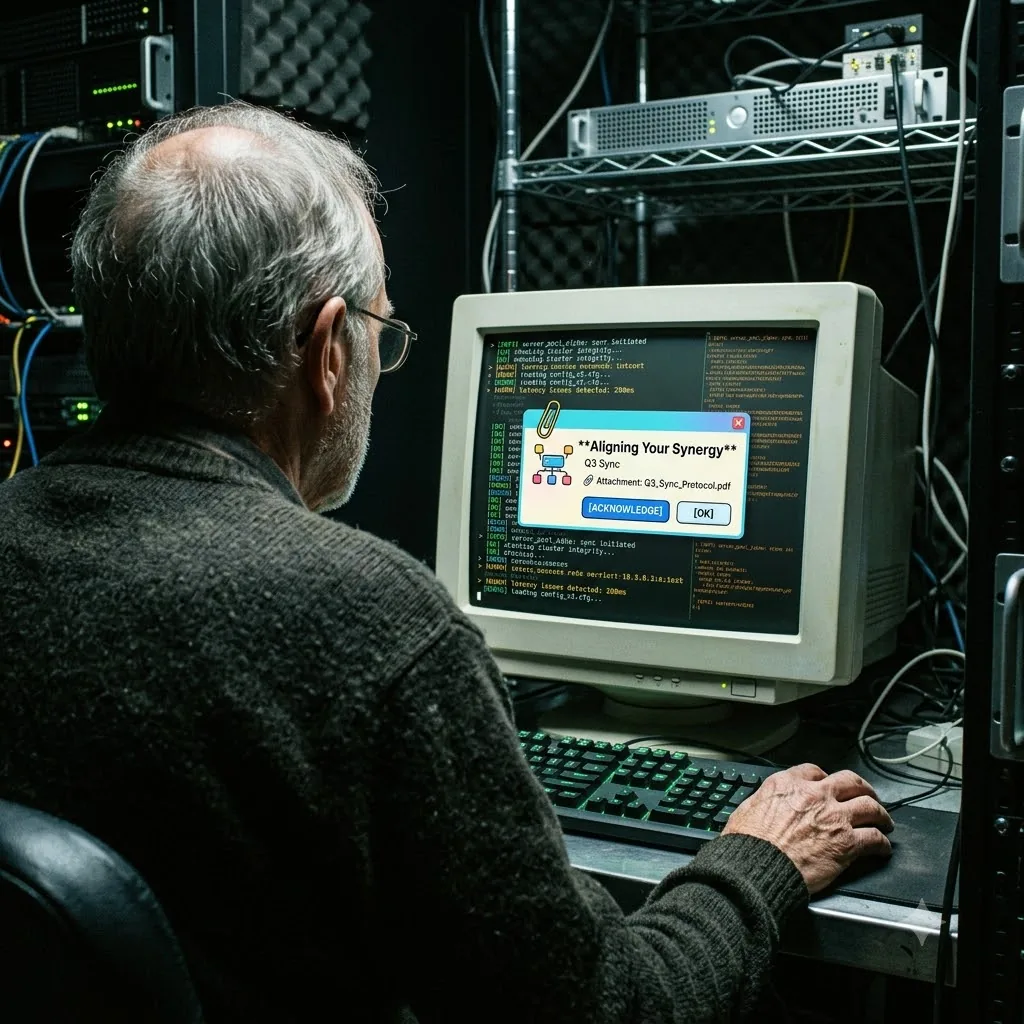
Story code: ST-000957
Part 3: The Accommodation
“Fifty seconds,” Maya’s voice was a ragged, metallic whisper through the cell phone speaker. “I already have the gross negligence template open on my screen, Arthur. I am typing your name.”
Arthur stared at the catastrophic red alerts flashing across his server monitoring dashboard. The company was hemorrhaging thousands of dollars with every breath he took. He looked back at the massive PDF of the Global Empathy and Inclusion Framework still open on his primary monitor. His tired eyes scanned the dense corporate text, desperately searching for anything that could shield him from a termination for cause.
His gaze locked onto a bulleted list on page forty-five, buried deep within the cognitive diversity section.
“I’ll be in Conference Room 3B in two minutes,” Arthur rasped. “Bring your laptop.”
He ended the call before she could scream at him. Adrenaline spiked through his chest, a cold and terrifying surge that made his fingers numb. He didn’t have time to second-guess himself. He hit print on page forty-five, snatching a yellow highlighter from his cluttered pen cup as the ancient laser printer in the corner of his office whirred to life.
He turned back to his workstation. His hands flew across the mechanical keyboard, punching in the manual failover command sequence for the payment gateway. It was fourteen lines of dense, unforgiving bash scripting. If he made a single syntax error, the database would corrupt permanently. He finished the string, but he did not press the enter key. He left the white cursor blinking silently at the very end of the execution command.
He disconnected his heavy, sticker-covered laptop from the docking station, grabbed the warm, freshly printed sheet of paper from the printer tray, and walked out the door.
The walk to the third floor felt like a death march. Arthur’s knees ached with every step up the concrete stairwell. His heart hammered wildly against his ribs, driven by the suffocating fear of his wife’s upcoming hospital bills. He was betting her entire medical safety net on a desperate interpretation of a corporate vanity project.
He pushed through the heavy glass doors of the Human Resources wing. The lighting here was soft, indirect, and aggressively soothing. It was a stark contrast to the utilitarian fluorescent glare of his basement server room.
He found Conference Room 3B at the end of the hall. Maya was already inside.
She was pacing behind the polished oak table, her laptop open and glowing in the dim room. She looked absolutely feral. Her meticulously cultivated corporate cheerfulness had completely evaporated, leaving behind a flushed, cornered, and deeply panicked mid-level manager fighting for her own survival.
“Sit down and sign the severance,” Maya snapped the second he stepped through the glass door. She spun her laptop around so he could see the screen. An email to the Legal department was already drafted, the subject line screaming *URGENT: Termination for Cause – Sabotage.* “You are bleeding ten thousand dollars a minute. You deliberately unplugged your desk phone. I have the network logs showing you haven’t entered a single command into the gateway console in fifteen minutes. It is textbook gross negligence, Arthur. I am hitting send.”
Arthur didn’t look at her screen. He set his thick laptop down on the center of the oak table and opened the lid. The terminal window was still there, the cursor blinking patiently at the end of his unexecuted script.
Without a word, he placed the freshly printed sheet of paper onto the table. He pressed two fingers against the center of the page and slid it across the smooth wood until it bumped gently against the edge of Maya’s laptop.
Maya glared down at the paper, her finger hovering millimeters above her trackpad. “What is this?”
“That is page forty-five of the Global Empathy and Inclusion Framework,” Arthur said. He kept his voice deliberately flat, forcing his trembling hands under the table so she couldn’t see them shake. “Specifically, the section detailing mandatory corporate support for an ‘age-correlative neurodivergent working style.'”
Maya’s eyes darted down to the thick block of bright yellow highlighting. She scoffed, a harsh, brittle sound. “You aren’t neurodivergent, Arthur. You don’t have a medical file on record with HR. You can’t just invent a disability to avoid being fired for destroying the payment gateway.”
“The mandate explicitly states that formal medical diagnoses represent an ‘inequitable barrier to care,'” Arthur recited, having frantically memorized the absurd phrasing on his walk up the stairs. “It dictates that self-identification is entirely sufficient to trigger immediate workplace accommodations. It also outlines the common manifestations of this specific working style.”
Maya didn’t move. The threat of legal action hovered heavily in the sterile, air-conditioned air of the conference room.
“Those manifestations include an absolute inability to task-switch during periods of high cognitive load,” Arthur continued, his voice steadying as he leaned forward. “And a strict, recognized requirement to eliminate auditory sensory triggers-like a ringing VoIP phone-in order to maintain hyper-focus.”
“You’re lying,” Maya whispered, the color rapidly draining from her face. “You’re holding the servers hostage.”
“I wasn’t ignoring the servers, Maya,” Arthur said, tapping the edge of his open laptop. “I was experiencing extreme sensory overload due to a catastrophic database failure. To protect my neurodivergent working style, I had to unplug my phone. I had to ignore all peripheral communications. I required absolute, uninterrupted silence to architect the failover script safely.”
He reached over and tapped the Enter key.
The terminal on his screen exploded with cascading green text as the manual failover sequence finally initialized. Within seconds, a high-pitched ping from his background monitoring software confirmed that the secondary cluster was taking the load. The financial bleeding stopped. The enterprise network stabilized.
“There,” Arthur said, staring directly into Maya’s eyes. “The payment gateway is secure. No data was lost. I wasn’t negligent, and I wasn’t sabotaging the company. I was just working exactly as our Chief People Officer’s highest-profile internal policy dictates I am allowed to work.”
Maya stared at the scrolling green text on his laptop, then slowly looked down at the highlighted piece of paper. Her breathing grew shallow and erratic.
“If you file that gross negligence termination now,” Arthur said, his voice dropping into a quiet, unyielding rhythm, “you aren’t just firing an employee for a system outage. You are directly penalizing a senior engineer for exhibiting documented symptoms of an age-correlative neurodivergent working style, during a crisis, immediately after he formally requested an accommodation through the Ethics portal.”
Arthur watched the terrifying calculus unfold behind Maya’s wide eyes. She had desperately needed him to sign the severance agreement to bypass the mandatory ninety-day transition audit for older employees. When that had failed, she had tried to use the server crash to fire him for cause, bypassing the inclusion framework entirely.
But Arthur had just formally classified his supposed sabotage as a protected psychological symptom under the exact same framework she was trying to circumvent. If she sent that termination email to the Legal department now, the automated Ethics system would instantly flag it as blatant retaliation against a protected class. The outside compliance auditors wouldn’t just block his firing; they would tear Maya, and the director who gave her the illegal orders, to absolute pieces.
Maya slowly lowered her shaking hands away from her laptop keyboard. The aggressively cheerful rocket ship emoji on her original calendar invite mocked them both from the corner of her screen. She looked at the highlighted paper, then up at Arthur, her jaw tight enough to crack her own teeth.