Story code: ST-000957
Part 4: The Ninety-Day Clock
The silence in Conference Room 3B stretched until it felt brittle enough to shatter. The aggressively soft HR ambient lighting cast long, pale shadows across the polished oak table, illuminating the microscopic dust motes hovering between Arthur and Maya.
Maya’s finger remained frozen millimeters above her trackpad. Arthur watched the muscles in her neck jump. He didn’t need to read her mind to know exactly what was playing out behind her wide, terrified eyes. She had laid out her own stakes less than ten minutes ago on the phone: she had a mortgage, two kids, and a director who was perfectly willing to sacrifice her to cover his own tracks. If she fired Arthur now, the automated Ethics system would flag it as retaliation against a formally requested medical accommodation. The compliance auditors would descend on the Western Region office like vultures. Maya would be fired for exposing the company to a massive, highly publicized discrimination lawsuit.
But if she didn’t fire him, she missed her Q3 headcount reduction quota. Her director, having given the illegal order verbally to leave no paper trail, would simply terminate her for failing to execute the synergistic shift.
She was legally and professionally paralyzed. Arthur had built the cage out of her own corporate jargon, and she had walked right in and locked the door.
Slowly, with a hand that trembled so violently she could barely control the mouse, Maya dragged her cursor across the screen. Arthur watched the reflection of her monitor in the conference room window. He saw the drafted email to the Legal department-the one accusing him of gross negligence and sabotage-turn blue as she highlighted the text.
She pressed the backspace key.
The screen blinked white, wiping away the accusation. Maya closed her laptop with a soft, defeated click. She didn’t look up at him. She just sat there, staring blankly at the smooth surface of the oak table, her meticulously cultivated corporate cheerfulness completely dead and gone. She looked small. Her shoulders slumped forward, defeated by the very system she had tried to wield as a weapon. She looked exactly like a person who had just realized they were going to lose their livelihood before the end of the fiscal quarter.
Arthur felt no triumph. There was no rush of victory, no vindictive thrill at outsmarting the administration. As he reached out and retrieved his highlighted copy of the Global Empathy and Inclusion Framework, a sour, metallic taste flooded the back of his mouth. He felt deeply, fundamentally sickened. He had spent eleven years maintaining the company’s fragile digital infrastructure, working weekends and holidays, only to find himself weaponizing a toxic vanity project just to keep his wife alive.
“Close the severance ticket in the system, Maya,” Arthur said. His voice was entirely devoid of emotion. It sounded like an automated system prompt. “And approve the ninety-day transition audit request.”
Maya didn’t answer. She just gave a single, hollow nod.
Arthur closed his heavy, sticker-covered laptop, tucked it under his arm, and walked out of the conference room.
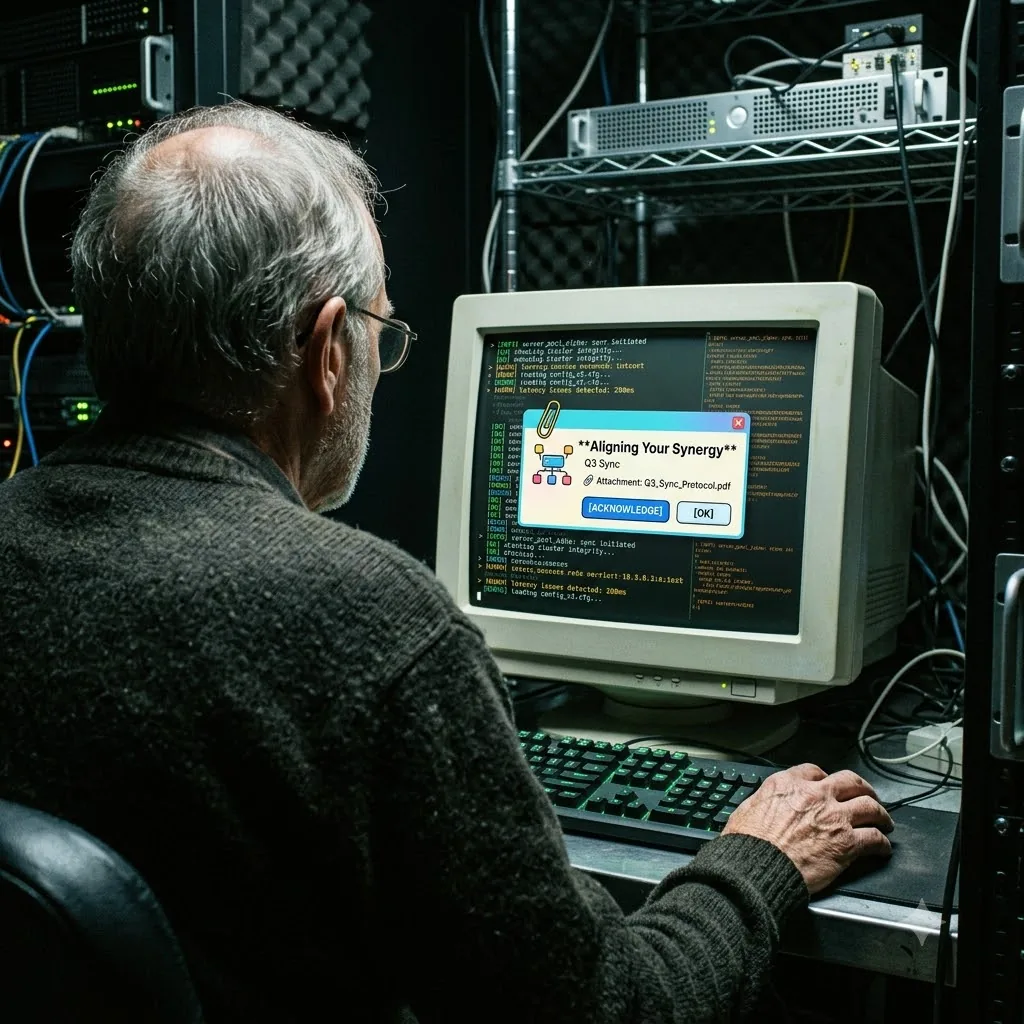
The walk back down to the basement server room was agonizing. The massive spike of adrenaline that had carried him up the stairs was evaporating rapidly, leaving behind a cold, crushing exhaustion. His knees popped in the quiet stairwell. His chest ached with every shallow breath. By the time he pushed through the heavy fire door into his subterranean office, his shirt was clinging to his back with cold sweat.
He set his laptop on the desk and reconnected it to the docking station. The dual monitors flared to life. The cascading red errors were gone, replaced by the steady, rhythmic green pulses of the secondary backup cluster handling the live payment gateway. The manual failover was holding. The company’s revenue stream was secure, oblivious to the fact that it had almost been sacrificed to a middle-management layoff quota.
Arthur ignored the server dashboards. He opened a new browser tab and navigated directly to the third-party employee benefits portal. He typed in his credentials, his fingers stiff and clumsy on the mechanical keys.
The screen loaded. Arthur stared at the top right corner of the interface.
*Status: Active. Plan Tier: Legacy Comprehensive.*
He let out a long, ragged breath, resting his forehead against the cool edge of his keyboard. The insurance was safe. Thursday morning’s immunotherapy infusion was funded. They would not lose their savings this week.
But as the deafening roar of the server cooling fans washed over him, Arthur knew the reality of his situation. The failover cluster was only a temporary patch; he still had to rebuild the primary database before the weekend load hit. More importantly, the ninety-day Cognitive Transition and Mentorship Audit was just a stay of execution. It was a ticking clock. The company would spend the next three months meticulously documenting every keystroke he made, building an impenetrable, legally airtight case to terminate him without triggering the inclusion framework.
They would come for him again. They would be smarter next time.
Arthur sat up slowly in the dim, flickering light of his office. He minimized the benefits portal, pulled up a blank command terminal, and began typing the tedious, exhausting code required to clear the corrupted memory logs. He had survived the Q3 sync, but as he worked alone in the cold, windowless room, he understood that the transition had already begun.