Story code: ST-001529
Part 2: Thirty Cents on the Dollar
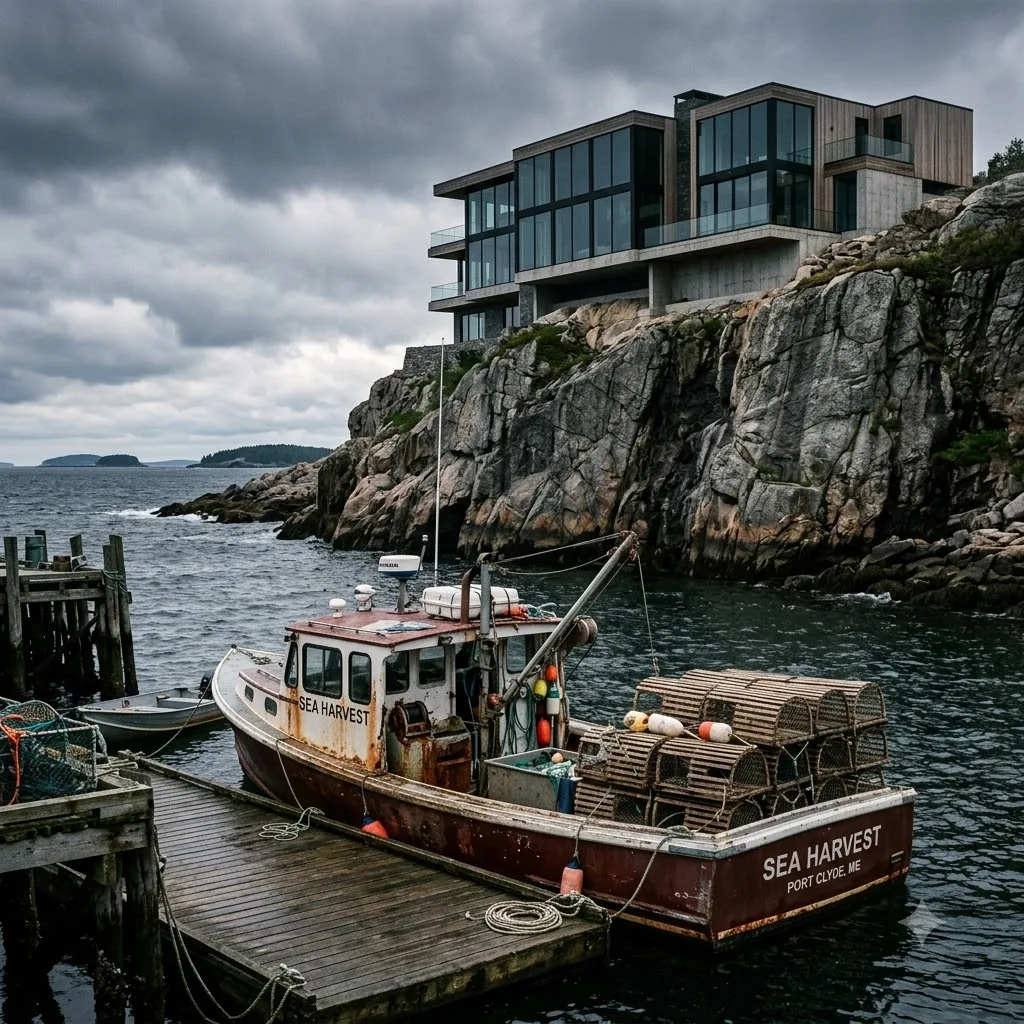
The heavy footsteps belonged to a man who wore his wealth like a second skin. He descended the floating glass stairs with a slow, deliberate cadence, the thick soles of his leather loafers sinking into the absolute silence of the house. He was older than the suit, broad-shouldered and deeply tanned, dressed in a lightweight linen shirt that likely cost more than Tommy’s monthly fuel budget.
“Davis,” the older man said, his voice a low, gravelly baritone that commanded the room without raising an octave. “I thought we upgraded the gate security specifically to prevent the local wildlife from wandering into the foyer.”
The suit-Davis-stiffened. “He slipped past the landscaping crews, Mr. Blackwood. I was just about to have him escorted off the property.”
“I’m not leaving until somebody unlocks that ramp,” Tommy said. He didn’t move his hand from the crumpled injunction on the glass table. His rubber boots left dark, wet rings of seawater on the pristine marble floor. The cold air conditioning was already biting through his damp canvas jacket, chilling the sweat on his back, but he kept his posture rigid.
Blackwood reached the bottom of the stairs and walked slowly over to the table. He didn’t look at Tommy’s face. He looked at the salt-stained boots, the frayed, wet cuffs of Tommy’s jeans, and finally, the grimy, calloused hand pinning the legal document to the glass.
“You’re bleeding saltwater onto imported Calacatta marble,” Blackwood noted softly. “Do you have any idea how porous this stone is, son?”
“Do you have any idea how many families rely on that dock to eat?” Tommy shot back.
Blackwood finally met Tommy’s eyes. There was no anger in them, only a vast, chilling indifference that made Tommy’s stomach tighten. “The harbor is currently undergoing a comprehensive ecological review. The injunction is a necessary pause. The bay is dying, Mr…?”
“Tommy. And the bay isn’t dying from lobster traps. The water was eighty degrees at the bottom this morning. There’s no kelp, no baitfish, absolutely nothing. You don’t give a damn about the ecology.”
Blackwood’s expression didn’t flicker. He casually reached out and pulled the injunction from beneath Tommy’s hand. Tommy tensed, but let the paper slide. Blackwood smoothed the creases with his thumb. “The ocean is changing. The committee is merely ensuring that commercial vessels don’t exacerbate the stress on the fragile marine habitat. It’s a conservation effort. I would think someone whose entire livelihood depends on the sea would appreciate that.”
“It’s a textbook land grab,” Tommy said, his hands balling into fists at his sides. “You shut down the commercial slip, the fisherman’s co-op defaults on the municipal lease. The town auctions the harbor frontage. You’ve been buying up the residential lots on this cliff all year.”
Davis took a step forward, producing a sleek smartphone from his jacket pocket. “You’re actively trespassing. If I dial the sheriff, you’ll be arrested, and your truck will be towed. I suggest you lower your voice, turn around, and leave.”
Tommy ignored the lawyer, keeping his eyes locked entirely on Blackwood. “I’ve got an eighty-thousand-dollar note on my boat. I can’t dock to unload, and I can’t dock to refuel. You’re starving us out.”
“I am offering you a transition,” Blackwood corrected. He gestured to Davis, who hesitated before reaching into a slim leather briefcase resting on a nearby credenza. Davis pulled out a crisp manila folder and slid it across the glass table toward Tommy.
“What’s this?” Tommy asked, not touching it.
“A buyout,” Blackwood said, turning to face the massive glass wall overlooking the bay. “Your co-op is finished. Even if you pool your money to fight the injunction, the legal fees will bleed you dry before the first frost. That folder contains an offer for your commercial slip lease and the title to your vessel. Thirty cents on the dollar. It’s enough to clear your bank note and leave you with just enough cash to move down the coast. Or inland.”
Tommy stared at the folder. The sheer arrogance of it made his chest tight, squeezing the air from his lungs. Thirty cents on the dollar meant losing his grandfather’s boat, his livelihood, and walking away with nothing but a cleared debt. It was a calculated, bloodless execution of his entire life.
“And if I tell you to go to hell?” Tommy asked, his voice dropping to a harsh whisper.
“Then the injunction holds,” Blackwood said to the glass, watching the distant, empty horizon. “Your boat runs out of gas. You default on the loan next week. The bank seizes the vessel, and you walk away with absolutely nothing but a ruined credit score and a trespassing charge.”
The silence in the room stretched out, broken only by the faint, rhythmic hum of the central air conditioning. Tommy looked at the back of Blackwood’s linen shirt. He looked at the vast, empty ocean beyond the glass-an ocean Blackwood never touched.
“You have until nine o’clock tomorrow morning to sign,” Davis said, tapping the folder. “After that, the offer is permanently withdrawn, and we file a personal grievance against your commercial license for operating an unsafe vessel in a restricted conservation zone.”
Tommy slowly reached out and picked up the folder. It felt impossibly light for something designed to end his life on the water. He didn’t open it. He just gripped it tight enough to dent the cardboard edge.
“I know what you’re doing,” Tommy said.
Blackwood didn’t turn around. “You really don’t, son. Davis, show him out.”
Tommy turned on his heel, his wet boots squeaking violently against the marble as he marched toward the heavy oak door. He was vibrating with a cocktail of rage and exhaustion, dreading the oppressive heat waiting outside. As he passed the sprawling kitchen island, his peripheral vision caught something distinctly out of place.
Spread out over the polished quartz counter were several massive, glossy architectural schematics. They weren’t blueprints for a house or a harbor development. Tommy slowed his pace by a fraction of a second, his eyes tracing the thick blue and red lines radiating from the cliffside down into the ocean depth chart.
It was a topographical map of the bay, overlaid with heavy industrial piping routes. Right where his eighty empty traps were currently rotting, directly beneath the unnaturally warm eighty-degree water he had just left, the schematic showed a massive cluster of red directional arrows pushing outward from the seabed. The title block in the corner bore the logo of an unknown energy conglomerate, stamped with a single, bold line of text: *THERMAL COOLING DISCHARGE – ACTIVE.*
“Keep walking,” Davis snapped from close behind him.
Tommy pushed through the oak door into the suffocating coastal heat, the manila folder burning in his hand. The PAC wasn’t protecting the bay. They were boiling it.