Story code: ST-001529
Part 4: Disposable
Tommy watched the tremor in Blackwood’s hand. The ice cubes clinked against the crystal, the only sound in a house built specifically to keep the world out. Tommy didn’t feel victorious looking at the shattered expression on the older man’s face. He just felt an overwhelming, suffocating exhaustion. He reached out, not to comfort the millionaire, but to slide the manila folder across the mahogany desk, pushing it right up against the silver sorting tray of rejected mail.
“I’m not signing it,” Tommy said. His voice was flat, stripped entirely of the anger that had carried him up the cliff. “And I’m not going to fight the injunction, either. I’m not organizing a steering committee, and I’m not going to arbitration. You can keep your money, and you can keep your empty house. I’m not going to be your hostage.”
Blackwood didn’t answer. He just stared at the folder, his jaw slack, looking every bit his age and then some. The commanding, gravelly baritone that had dominated the room minutes earlier was completely gone. Davis stood frozen near the door, his phone forgotten in his hand, unsure of how to protect his boss from his own pathetic reality.
Tommy turned around and walked out of the cavernous study. He didn’t look back. His heavy boots squeaked across the marble floor of the grand foyer, leaving a trail of dried salt and mud that no one would bother to clean until the maid service arrived. He pushed through the massive oak front door, stepping out of the aggressive, ozone-scented air conditioning and back into the suffocating coastal humidity.
The heat was immediate, wrapping around him like a wet, heavy blanket. He walked down the perfectly leveled slate steps to his rusted pickup truck, the engine ticking as it cooled in the afternoon sun. He climbed into the cab, the vinyl seat burning through his damp jeans. He didn’t look up at the seamless glass walls of the mansion as he turned the key. He threw the truck into reverse, crunching over the pristine white crushed shell of the driveway, and drove back toward the sea.
The coastal highway was empty. Tommy drove with the windows down, the hot wind roaring through the cab, offering no relief. He didn’t head toward his small apartment in town. He drove straight back to the commercial slip.
The harbor was exactly as he had left it. Dead calm. Eerily quiet. Deputy Miller was gone, leaving only the heavy galvanized chain and the new brass padlock gleaming in the harsh afternoon sunlight. Tommy parked his truck at the edge of the gravel lot and walked down to the water’s edge, stopping just short of the wooden pilings.
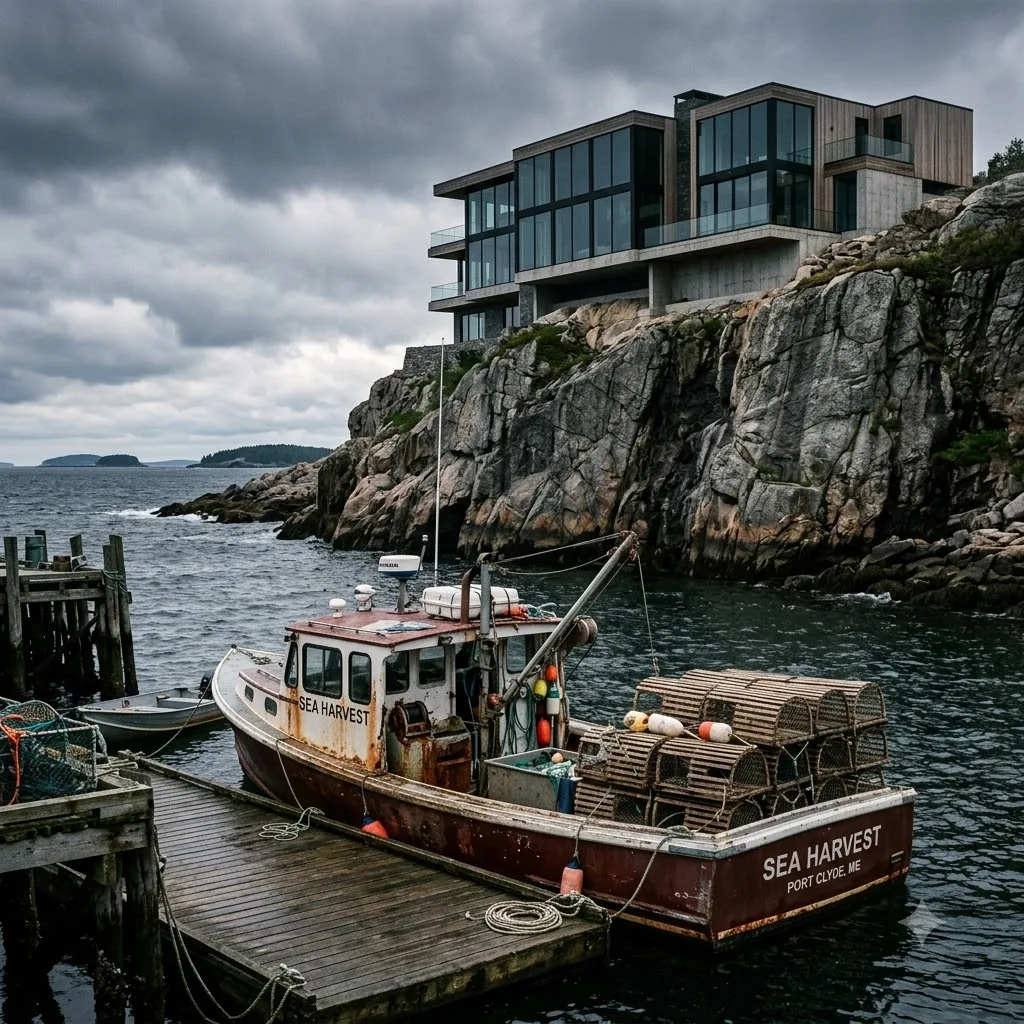
His boat, the *Mary Alice*, bobbed gently against the rubber bumpers. The graveyard of eighty barren wire cages sat stacked on the aft deck, baking in the heat. There was a thin layer of brown, dead kelp clinging to the wire mesh, crisping into dust. The fuel gauge on the console was still resting dead on the red line. The eighty-thousand-dollar bank note felt like a physical weight pressing down on his chest. Without dock access to unload or refuel, the bank would repossess her by the end of the month. He had lost her.
Tommy knelt on the edge of the sun-bleached planks and reached down, plunging his bare hand into the bay.
The water was completely wrong. It didn’t bite at his skin with the crisp, bracing chill of the North Atlantic. It was tepid. Eighty degrees of stagnant, lifeless warmth, heated from the bottom up by a massive industrial discharge pipe that the town would never be allowed to investigate. The baitfish were gone. The lobsters were gone. The delicate, fragile ecosystem that had fed his father and his grandfather had been boiled away in a matter of months.
He pulled his hand out of the water, watching the warm drops run down his calloused fingers and splash back into the dying bay.
The sheer, terrifying scale of his own insignificance settled deep into his bones. His entire life-the freezing early mornings, the calloused hands, the endless ledger calculations, the legacy of his grandfather’s boat-was completely disposable. It was nothing more than collateral damage. Blackwood hadn’t destroyed the bay to make a profit. He hadn’t chained the harbor out of corporate malice. He had purchased absolute ruin simply because he was lonely.
An entire coastal ecosystem, a generations-old working-class community, all quietly suffocated just so a wealthy man in a glass house could force someone, anyone, to sit across a table and talk to him.
Tommy stood up, wiping his wet hand on his jeans. He looked back up the sheer granite face of the bluff. The glass mansion sat anchored to the cliff edge, staring down at the water like a blind, unblinking eye. Tommy turned his back on it, walking slowly toward his truck, leaving his boat tied to a dock he could no longer use, floating on an ocean that no longer breathed.