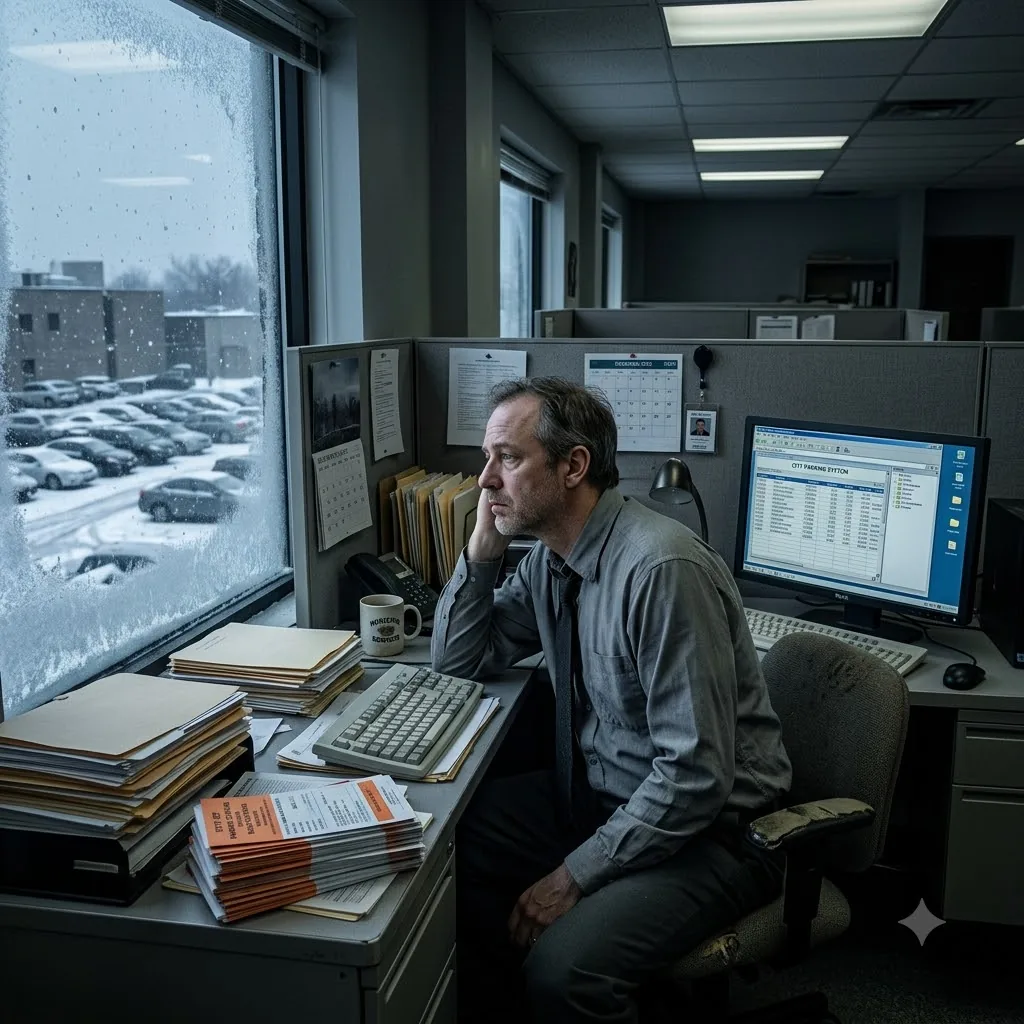
Story code: ST-000825
Part 2: The Architecture of Apathy
The heavy steel of the fire door clicked shut behind him, the magnetic lock engaging with a solid, echoing thud. Elias stepped onto the concrete landing. The twelve-degree air possessed a sudden, physical weight. It stripped the residual heat from his clothes in seconds. He was wearing a thin cotton button-down shirt, poly-blend slacks, and a pair of leather dress shoes. The wind sheared across the open expanse of the parking lot, raising the hair on his arms and tightening his chest into a shallow, involuntary gasp.
He did not turn back to check the door handle. He knew the building’s security protocols. The perimeter exits locked externally at four forty-five in the afternoon to channel all departing staff through the main lobby turnstiles.
Elias walked down the short flight of concrete steps and out into the lot. The wind whipped dry, granular snow across the asphalt, stinging his exposed skin. He bypassed the cleared lanes and headed straight for the back fence, where the monolithic mound of dirty ice sat isolated against the retaining wall.
The municipal plows had been thorough. They had pushed four feet of compressed slush and road salt around the perimeter of the 2008 Ford sedan, effectively building a frozen moat around its chassis. Elias reached the berm. He stepped onto the hardened slush. The crust gave way, plunging his leg up to the knee in freezing wetness. Ice crystals immediately packed into his dress shoe. He pulled his leg free, scrambled over the ridge, and slid down the inward slope until he was standing pressed against the driver’s side door.
The vehicle was encased in a thick shell of hoarfrost. Under the windshield wiper, trapped in a solid block of ice, sat a stack of neon-orange municipal envelopes. Five citations in total.
Elias pressed his bare palm against the driver’s side window. The friction burned his skin. He scrubbed away a layer of rime, clearing a patch of glass just large enough to see inside.
Arthur Pendelton sat in the driver’s seat.
He was wearing a faded canvas field jacket, zipped to the chin. His head rested against the steering wheel, his arms folded tight across his chest. His skin was the color of old ash. On the passenger seat beside him rested a manila folder, neatly organized, displaying the agency’s mandatory recertification forms.
The key was in the ignition, turned to the ‘ON’ position. The dashboard was dead. The fuel gauge needle rested entirely below the empty line.
Elias understood the timeline with terrible clarity. Pendelton had driven to the agency lot late Monday night, terrified of missing his final Tuesday morning appointment. The severe cold front had moved in, dumping four inches of snow and dropping the temperature to zero. Unwilling or unable to leave the lot, Pendelton had run the engine to use the heater. Sometime on Wednesday, the fuel tank had run dry. The battery had died shortly after.
Elias looked at the stack of neon-orange tickets trapped under the wiper blade.
The ticketing officer had walked up to this vehicle every night at three in the morning. The officer had wiped away enough snow to photograph the license plate, completely ignoring the dark silhouette of the man freezing to death inches away behind the glass. The plow driver had maneuvered around the vehicle, burying it in an impenetrable wall of slush to maintain the required width of the fire lanes. And Elias had sat in a climate-controlled room, reviewing the data, preparing to click a button that would legally erase the man’s existence.
The system had not failed. It had functioned flawlessly. Every department had executed its isolated protocol, actively collaborating to enforce the veteran’s slow execution by sheer, compartmentalized apathy.
Elias grabbed the driver’s side door handle. He pulled. It was frozen solid.
He hammered the heel of his hand against the door seam, shattering the crust of ice bridging the metal gap. The impact bruised his palm. He grabbed the handle with both hands, braced his soaked foot against the side panel, and threw his entire body weight backward.
The metal shrieked. The door broke free with a loud crack, swinging open and raining sheets of ice into the cabin.
The air inside the car was colder than the air outside. It smelled of stale breath, freezing vinyl, and unwashed clothes. Elias leaned in and grabbed Pendelton’s shoulder. The canvas jacket was stiff.
“Mr. Pendelton,” Elias said. His own teeth were chattering.
The man did not move. Elias pressed two numb fingers against the side of Pendelton’s neck. Beneath the freezing skin, a faint, erratic pulse fluttered. Pendelton drew a breath, a shallow, wet rattle that barely moved his chest.
Elias reached instinctively for his pocket to call emergency services. His hand met flat, empty fabric. His smartphone was sitting on his desk on the third floor, right next to his insulated coffee mug.
Elias backed out of the car. He looked toward the monolithic concrete facade of the agency building. The windows were tinted black. No one was looking out. The parking lot was entirely empty.
He scrambled back over the plow berm and ran toward the emergency stairwell. His soaked shoe slapped heavily against the asphalt. He reached the heavy steel door and grabbed the handle, throwing his weight into it. It did not budge. The magnetic lock held fast.
He slammed his fist against the steel. The sound was swallowed instantly by the wind.
Elias lifted his wrist. His analog watch read four fifty-two.
The third-floor processing pool operated on an automated batch cycle. At exactly five o’clock on Friday afternoon, the system would run a sweep of the queue. Any file left open with a pending violation would be automatically finalized. If Arthur Pendelton’s file closed, his active status would be permanently revoked. His federal health insurance, his housing stipend, and his emergency medical coverage would be instantly wiped from the mainframe.
If Elias broke a window to call an ambulance now, Pendelton would be admitted to the hospital as an uninsured civilian. The resulting out-of-pocket medical debt for a severe hypothermia protocol would guarantee the man died in poverty, if he survived the night at all.
Elias stood in the freezing wind, his clothes stiffening into armor as the wet fabric turned to ice. He was locked outside. The man in the car had less than an hour to live. The digital axe would fall in exactly eight minutes.