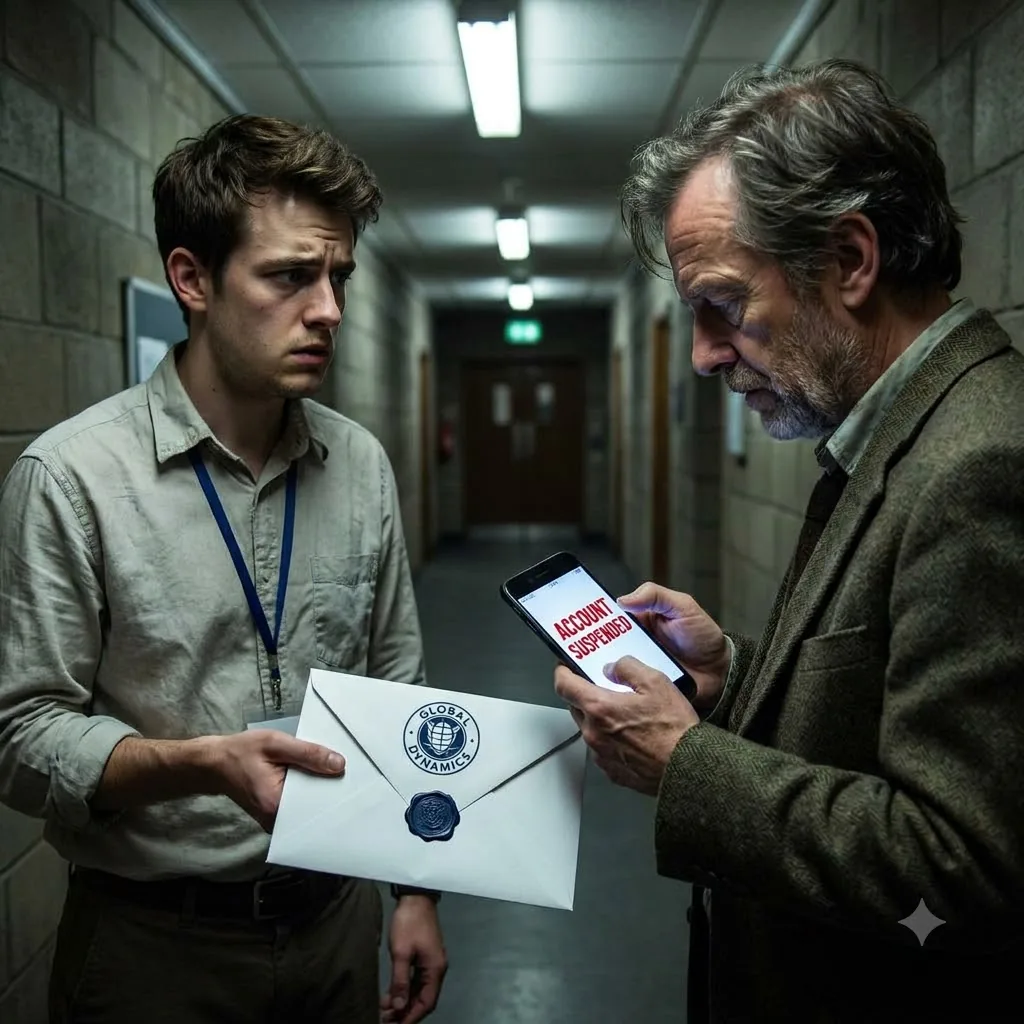
Story code: ST-000384
Part 2: The Payload
Tariq’s eyes skimmed the bold, capitalized text of the second paragraph. He read the sentence twice, convinced his panicked brain was misinterpreting the English language.
‘At 16:12 on Tuesday, October 14th, surveillance assets documented your unauthorized physical manipulation of the Tier-1 encrypted data conduit within the secondary network hub. This action constitutes a direct, deliberate act of cyber-infrastructure sabotage, an intentional bypass of the university’s central firewall designed to compromise classified institutional data.’
Tariq’s breath caught in his throat. The “secondary network hub”? He frantically dug through his memory of Tuesday afternoon. He had been sitting in the small, cramped faculty lounge on the second floor, trying to print a batch of syllabus addendums. The antiquated laser printer had flashed a blinking yellow “offline” error. Tariq had simply reached behind the machine, traced the standard gray ethernet cable to where it had fallen out of the wall port, and pushed the plastic connector back in until it clicked.
That was it. He had plugged in a loose cord so he could print thirty sheets of paper.
He stared back at the letter, his hands shaking so violently the heavy cardstock audibly rustled. The Office of Communications had twisted a thirty-second tech-support shortcut into an act of digital terrorism.
The third paragraph was even worse. ‘As a result of this malicious hardware interface, the institution has suffered a cascading network failure across three separate colleges. Pursuant to the Emergency Threat Protocol, your employment is terminated, effective immediately. You are hereby barred from all university property. If you do not vacate the premises within five minutes of receiving this formal notice, Campus Security will physically detain you for transfer to municipal authorities under felony trespassing and computer fraud statutes.’
Five minutes.
Tariq’s head snapped up. Down the long linoleum corridor, the elevator doors slid open with a soft, melodic chime. Two campus security guards stepped out. They were not the usual student volunteers in polo shirts; these were full-time officers in high-visibility tactical vests, heavy utility belts, and radios clipped to their shoulders. They did not look toward the busy classrooms. Their eyes immediately locked onto Tariq standing by the locked department door.
Panic, cold and sharp, flooded Tariq’s veins. He instinctively patted down his corduroy jacket. His car keys were not in his pockets. He had left his heavy keyring-along with his winter coat, his briefcase, and his wallet with his driver’s license-sitting on his desk, safely locked inside the very office he could no longer access.
One of the guards raised a hand, pointing a thick finger directly at him. “Hey! Professor Vance! Stay right there!”
Tariq didn’t stay. Survival instinct overpowered his usual academic restraint. He turned on his heel and walked briskly in the opposite direction, pushing through the heavy fire doors that led to the western stairwell. The moment the heavy metal door swung shut behind him, cutting off the noise of the hallway, he broke into a desperate run down the concrete steps.
His boots slapped loudly against the stairs as he descended toward the ground floor. He pulled out his phone, his thumb trembling as he scrolled past his disabled university email and dialed Aris Thorne, the Dean of Humanities. Aris had been his mentor for seven years. Aris would know how to stop this absolute madness.
The line rang three times before connecting. “Tariq,” Aris whispered. His voice was taut, strained, and accompanied by the hollow echo of a closed office.
“Aris, thank God,” Tariq said, taking the stairs two at a time. “I’m locked out. An intern just handed me a termination letter from Communications claiming I sabotaged the network. They’re saying I manipulated a data conduit! Aris, it was the loose ethernet cable in the faculty lounge! I plugged the printer back in on Tuesday! That’s all it was!”
“Tariq, I cannot be on this call,” Aris said, his tone devoid of its usual warmth. “IT is auditing all faculty communications. The Provost’s office just placed a gag order on the entire department.”
“What are you talking about? You know me! Tell them to check the lounge cameras!”
“They did check the cameras,” Aris hissed back, panic leaking into his voice. “The Provost is claiming the physical tampering injected a localized malware payload that corrupted the main grading server. Tariq, they are saying someone paid you to breach the mainframe. Legal is involved. The FBI field office has been notified. You need to get off campus. Now.”
“The FBI?” Tariq stopped on the second-floor landing, his knees suddenly weak. “Aris, I don’t even know how to code! How could plugging in a printer take down the network?”
“It doesn’t matter what you actually did,” Aris said, his voice dropping to a frantic whisper. “It matters what the system logs say you did. And the logs say the breach originated from your exact location, at your exact timestamp. Do not contact me again.”
The line went dead.
Tariq stared at the phone screen. The university wasn’t just firing him; they were building an airtight criminal case, actively rewriting reality to turn a mundane, helpful gesture into a federal crime. He shoved the phone back into his pocket and sprinted the rest of the way to the ground floor, bursting out the emergency exit into the biting chill of the October morning.
Without his coat, the cold wind cut right through his thin shirt and jacket. He stood in the concrete alleyway between the Humanities building and the Science center, his breath pluming in the air. He couldn’t drive away. His car was trapped behind the automated gates of the faculty parking structure, which required the very badge that had just been deactivated.
He needed to get to the off-campus bus stop, three blocks away, before the guards found him. He pulled his collar up and merged into a stream of undergrads walking toward the campus quad. He kept his head down, trying to match their casual, sluggish pace, though every nerve in his body screamed at him to run.
Halfway across the quad, a sharp, dissonant tone echoed from the towering loudspeakers mounted on the library roof. It was the two-second warning siren, the one usually reserved for active shooter drills or severe weather.
Immediately, a synchronized chorus of chimes and vibrations erupted from the pockets and backpacks of every single student walking around him. Tariq’s own phone buzzed aggressively against his thigh.
A girl walking two feet to his left pulled out her phone, reading the screen aloud to her friend. “Campus Alert from University Police. Active security threat in the Humanities quadrant…”
Tariq pulled out his own phone. The emergency text blast glared at him in stark black letters.
CAMPUS ALERT: Law enforcement responding to active cyber-security threat. Suspect identified as former faculty Tariq Vance. Do not approach. Suspect is considered desperate and potentially dangerous. If seen, call 911 immediately.
Attached right below the text was his official faculty portrait.
Tariq froze. The girl next to him glanced up from her screen, her eyes sweeping the crowd before locking directly onto his face. She looked down at her phone, then back up at him, her eyes widening in sudden, raw terror.