Story code: ST-000669
Part 4: The Drowning
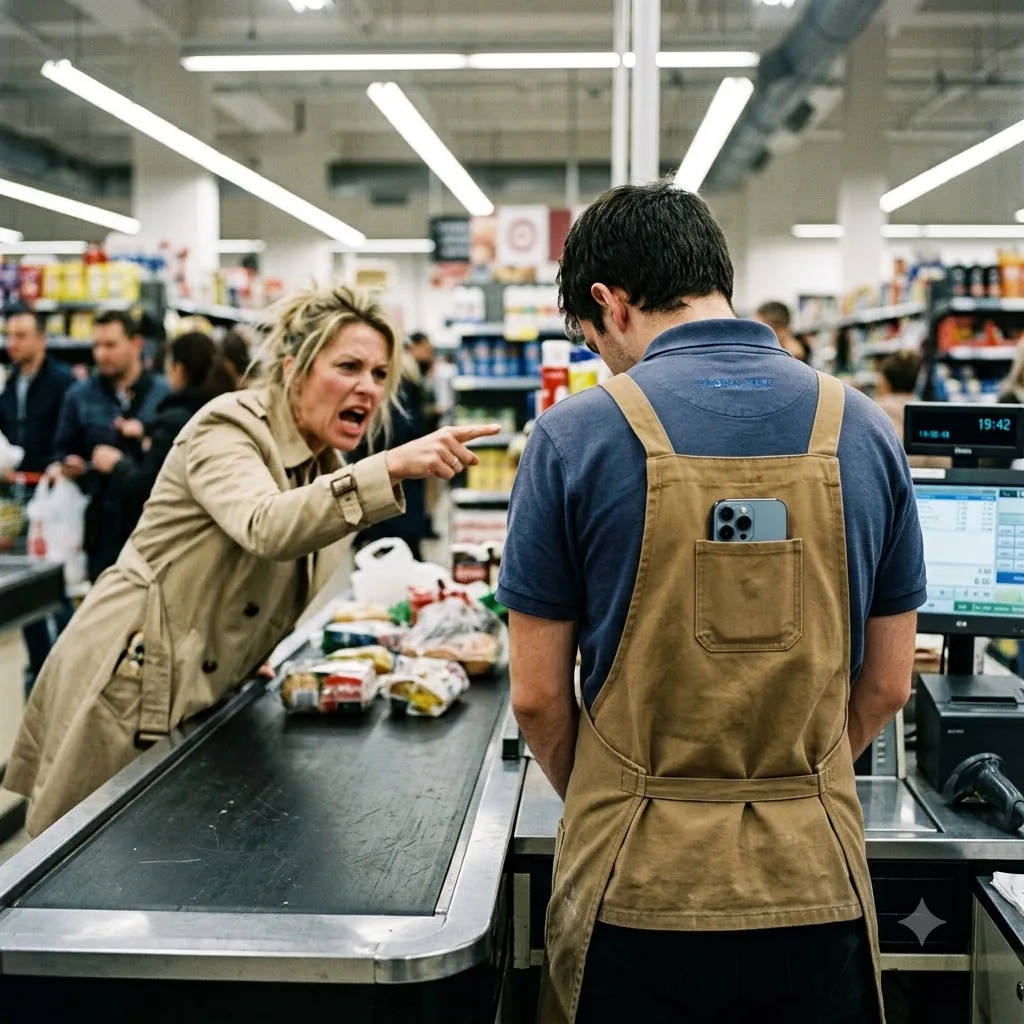
The harsh fluorescent lights of the grocery store buzz relentlessly overhead, indifferent to the absolute silence that has fallen over register four. Mateo watches Eleanor’s hands tremble against her chest. She clutches the pink oncology bills like a shield, her expensive, torn silk blouse doing nothing to hide the hollowed-out exhaustion in her frame. The lead officer steps closer, her eyes scanning the handwritten red ink on the pharmacy bag.
The officer reaches for her radio, the aggressive bark of her voice softening to a low murmur. She is assessing the situation not as an assault, but as a crisis.
Then, a synthetic camera shutter sound echoes through the frozen checkout lane.
A teenager in a heavy winter coat, standing just behind the older man in the wool jacket, leans over the empty bagging area. His smartphone is thrust forward, the camera lens zoomed in directly on Eleanor’s scattered medical debt and the cheap, peeling Prada wallet.
“Yo, this is crazy,” the teenager mutters, adjusting his angle to get Mateo and the crying woman in the same frame. “Fake influencer caught lackin’.”
Something in Eleanor shatters completely.
The terrified, frozen caregiver vanishes. A raw, primal scream tears from her throat-a sound of pure, unadulterated anguish that makes Mateo flinch behind the plexiglass. She lunges across the rubber conveyor belt, scrambling over the spilled bulk soup cans, her manicured nails hooking into the teenager’s winter coat. She doesn’t punch or scratch; she just desperately tries to rip the phone from his hands, sobbing hysterically about her husband, about the medication, about the fifty dollars.
The teenager shouts in panic, stumbling backward and knocking over a wire rack of magazines.
“Hey! Back off!” the lead officer barks.
The police reaction is instantaneous and procedural. The tall officer grabs Eleanor by the shoulders of her oversized camel-hair trench coat, spinning her away from the teenager. Eleanor fights back with the chaotic, uncoordinated strength of someone who has absolutely nothing left to lose. She thrashes against the officer’s grip, her heel slipping on a stray chapstick cylinder from the shattered mint display.
“I need the money!” Eleanor screams, her voice cracking as the second officer moves in to assist. “He needs it tonight! Please!”
Mateo’s hands remain flat on the stainless steel counter. He cannot look away. He watches the officers force Eleanor’s wrists behind her back. The sharp, metallic ratcheting of handcuffs cuts through her sobs. The heavy metal clicks shut, sealing her fate.
The older man in the wool jacket, who had been so eager to testify against Mateo, silently backs away down aisle four. He doesn’t say a word. The crowd of onlookers disperses slightly, their morbid curiosity satisfied, their phones still glowing in their hands.
Mateo watches the officers march Eleanor out through the automatic sliding doors. The red and blue police lights wash over her tear-streaked face one last time before she is shoved into the back of the cruiser. Her peeling, fake leather wallet and the pink hospital bills remain abandoned on his scanner glass. The pharmacy bag, with its desperate handwritten plea for fifty dollars, is crumpled under a dented can of beans.
Three days later, the overhead lights in Mateo’s apartment do not hum. The silence of his small kitchen is heavy and absolute.
He sits at the scratched laminate table, staring at his glowing phone screen. The teenager’s video from the grocery store had hit the internet by midnight. By the next morning, it had been stitched with the jogging woman’s initial footage, creating a viral mosaic of the entire breakdown.
Someone in the comments had identified Mateo and linked his digital payment handle. “Give the cashier a tip,” the top comment read. “Dealt with a Karen and stayed stone-cold.”
Mateo opens his banking app. The screen loads, displaying a checking account balance of four thousand, two hundred and twelve dollars. The heavy, folded parchment paper of his eviction notice sits in the center of the table, stamped with a bright red ‘VOID’ from the property manager’s office. His rent is paid for the next three months. The looming threat of the sheriff’s lockbox is entirely gone. He is safe.
He locks his phone and sets it face down on the table.
He feels entirely sick.
Mateo closes his eyes, but the darkness offers no relief. He doesn’t see his paid bills. He sees the desperate, jagged red ink on the pharmacy receipt. He sees the cheap cardboard backing of Eleanor’s fake designer wallet. He remembers the cold, clammy terror he felt when he found his own eviction notice, and he knows with absolute certainty that Eleanor felt the exact same terror when she looked at her husband’s empty pill bottles.
They were exactly the same. Two desperate people standing on opposite sides of a plexiglass barrier, both drowning in a system that demanded they fight each other for scraps. Mateo had played his hand perfectly. He had kept his job. He had kept his apartment. He had survived.
He pulls his canvas work apron from the back of his chair, his fingers brushing against the heavy seam of the front pocket where his phone had recorded everything. The coarse fabric feels like lead. He saved himself, but the agonizing realization settles deep in his chest, wrapping around his ribs like a vise. He had survived only by pushing another drowning person under the water, leaving her to sink into the dark so he could finally take a breath.