Story code: ST-000086
Part 1: The Escalation Matrix
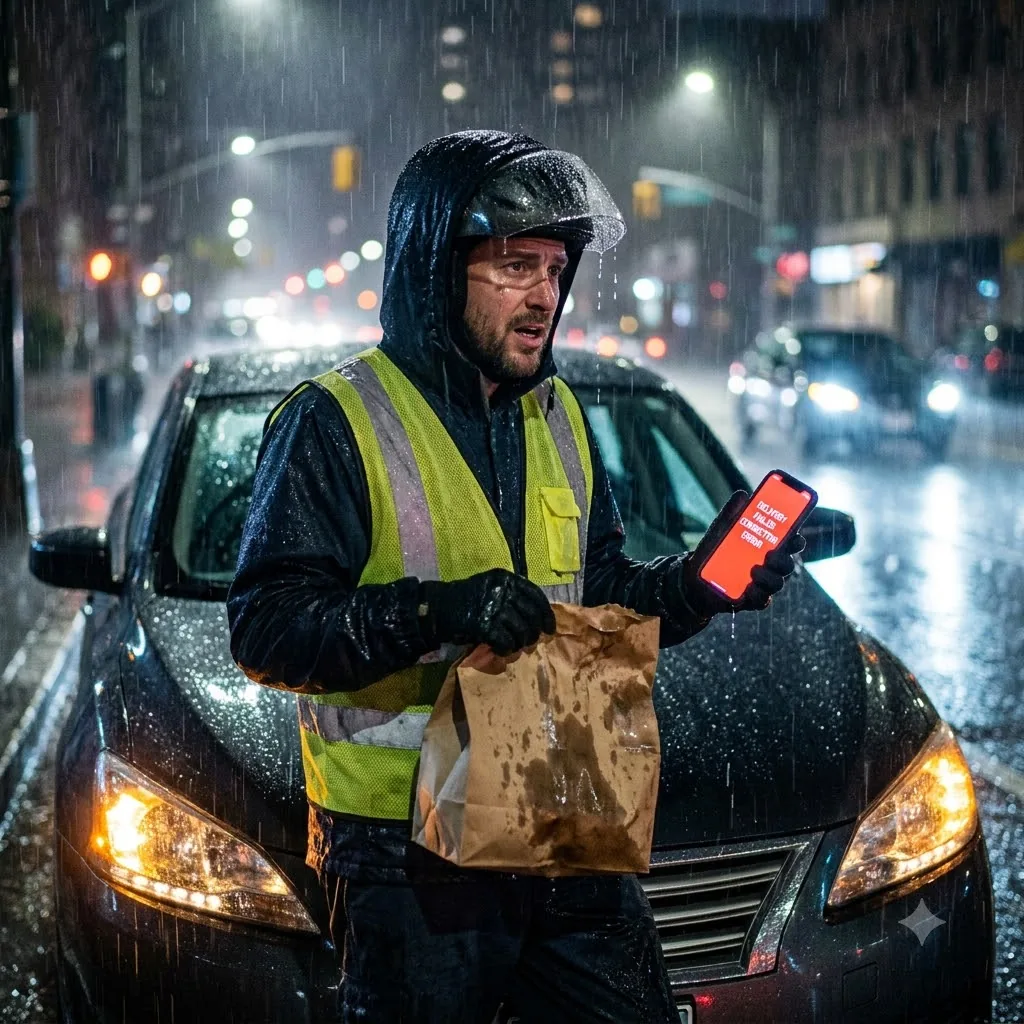
Water sheets off the brim of Kevin’s cap and soaks into the paper bag of expensive sushi he clutches against his chest. He taps the cracked screen of his phone, ignoring the rain pooling on the glass, but the bright red banner at the top of the delivery app refuses to budge. *Account Deactivated.* Beneath the banner, a tiny notification explains the AI identity verification failed his mid-route selfie check. He wipes his thumb across the lens and tries to force close the app, but the red banner returns the moment the screen refreshes.
The customer’s porch is only three blocks away, yet he has no address anymore. The app wiped the destination coordinates the second the automated flag tripped, replacing the map with a blank gray void.
Kevin holds the phone to his ear and dials the driver support hotline, shielding the device under the soaked collar of his jacket. The automated voice prompts him to enter his driver ID. He punches the numbers with an icy, shaking thumb. A robotic voice informs him his account is disabled and offers to hang up. He presses zero repeatedly until the system clicks over to the offshore routing queue. The hold music is a tinny, distorted piano loop that barely cuts through the sound of the storm drains rushing with floodwater.
A click breaks the loop. A woman with a thick headset echo introduces herself as Priya.
Kevin explains the situation immediately. He tells her he is standing on a flooded sidewalk on Elm Street with a bag of raw fish and no delivery address. He states clearly that the random selfie prompt caught him in the dark with a rain-smeared lens, causing the facial recognition software to fail. He insists she reset the prompt so he can complete the order.
Priya pauses for exactly two seconds. The delay is just long enough for Kevin to realize she is scrolling to the correct response module. She reads a highly standardized apology regarding his inconvenience and informs him that deactivated drivers cannot complete active orders.
He shifts the soggy paper bag to his other arm, feeling the bottom threatening to tear. He tells her he understands the policy but needs to override the automated selfie fail because it was a glitch. He demands to speak to someone in the local dispatch office.
Priya reads another paragraph. She expresses deep sympathy for his frustration and assures him that driver security is their highest priority. She then states that the appeal process requires a submission through the online web portal, which currently has a processing time of three to five business days.
Kevin grips the phone tighter. He points out the absurdity of holding perishable seafood in a thunderstorm for five business days. He insists she transfer him to a supervisor right this second.
The typing on Priya’s end is loud and rhythmic. She apologizes again in the exact same tone as before. She explains that supervisors do not take direct appeals for biometric security lockouts under any circumstances.
Kevin refuses to disconnect. He talks over her next scripted apology, aggressively listing his stats. He tells her he has four thousand completed deliveries and a perfect customer rating. He insists there is a manual override for false positives on the facial recognition software, telling her to look at his spotless record.
The typing stops. A heavy sigh filters through the line, sounding distinctively unscripted. Priya drops the cheerful customer-service cadence. She tells him she is strictly forbidden to do this, but there is an internal escalation matrix for immediate human review. She explains that she can bypass the web portal if his algorithmic risk profile allows for a tier-one dispatcher override.
Kevin exhales, a cold drop of water falling from his nose. He tells her to pull up the profile and send it up the chain.
He hears the rapid clack of a mechanical keyboard on her end. She narrates her actions in a hushed, rushed tone, explaining that she is opening the biometric log and accessing the internal flag database. She tells him it will only take a second to clear the selfie mismatch error and check the background flags on his account.
The keyboard clicking stops abruptly.
Kevin waits for her to speak, but the line remains completely silent. He can hear the faint hum of the call center in the background and the sharp, sudden intake of Priya’s breath.
He prompts her, telling her to read the screen.
Priya begins to speak, her voice trembling and barely above a whisper. She tells him she is looking at his escalation matrix right now, and the primary override code is…
She stops.
Kevin shifts the heavy bag again and tells her to finish her sentence.
He hears her exhale a shaky breath directly into the microphone. The call center background noise persists, proving the call is still active. She does not hang up, but she refuses to say another word.
Water sheets off the brim of Kevin’s cap and soaks into the paper bag of expensive sushi he clutches against his chest. He taps the cracked screen of his phone, ignoring the rain pooling on the glass, but the bright red banner at the top of the delivery app refuses to budge. *Account Deactivated.* Beneath the banner, a tiny notification explains the AI identity verification failed his mid-route selfie check. He wipes his thumb across the lens and tries to force close the app, but the red banner returns the moment the screen refreshes.
The customer’s porch is only three blocks away, yet he has no address anymore. The app wiped the destination coordinates the second the automated flag tripped, replacing the map with a blank gray void.
Kevin holds the phone to his ear and dials the driver support hotline, shielding the device under the soaked collar of his jacket. The automated voice prompts him to enter his driver ID. He punches the numbers with an icy, shaking thumb. A robotic voice informs him his account is disabled and offers to hang up. He presses zero repeatedly until the system clicks over to the offshore routing queue. The hold music is a tinny, distorted piano loop that barely cuts through the sound of the storm drains rushing with floodwater.
A click breaks the loop. A woman with a thick headset echo introduces herself as Priya.
Kevin explains the situation immediately. He tells her he is standing on a flooded sidewalk on Elm Street with a bag of raw fish and no delivery address. He states clearly that the random selfie prompt caught him in the dark with a rain-smeared lens, causing the facial recognition software to fail. He insists she reset the prompt so he can complete the order.
Priya pauses for exactly two seconds. The delay is just long enough for Kevin to realize she is scrolling to the correct response module. She reads a highly standardized apology regarding his inconvenience and informs him that deactivated drivers cannot complete active orders.
He shifts the soggy paper bag to his other arm, feeling the bottom threatening to tear. He tells her he understands the policy but needs to override the automated selfie fail because it was a glitch. He demands to speak to someone in the local dispatch office.
Priya reads another paragraph. She expresses deep sympathy for his frustration and assures him that driver security is their highest priority. She then states that the appeal process requires a submission through the online web portal, which currently has a processing time of three to five business days.
Kevin grips the phone tighter. He points out the absurdity of holding perishable seafood in a thunderstorm for five business days. He insists she transfer him to a supervisor right this second.
The typing on Priya’s end is loud and rhythmic. She apologizes again in the exact same tone as before. She explains that supervisors do not take direct appeals for biometric security lockouts under any circumstances.
Kevin refuses to disconnect. He talks over her next scripted apology, aggressively listing his stats. He tells her he has four thousand completed deliveries and a perfect customer rating. He insists there is a manual override for false positives on the facial recognition software, telling her to look at his spotless record.
The typing stops. A heavy sigh filters through the line, sounding distinctively unscripted. Priya drops the cheerful customer-service cadence. She tells him she is strictly forbidden to do this, but there is an internal escalation matrix for immediate human review. She explains that she can bypass the web portal if his algorithmic risk profile allows for a tier-one dispatcher override.
Kevin exhales, a cold drop of water falling from his nose. He tells her to pull up the profile and send it up the chain.
He hears the rapid clack of a mechanical keyboard on her end. She narrates her actions in a hushed, rushed tone, explaining that she is opening the biometric log and accessing the internal flag database. She tells him it will only take a second to clear the selfie mismatch error and check the background flags on his account.
The keyboard clicking stops abruptly.
Kevin waits for her to speak, but the line remains completely silent. He can hear the faint hum of the call center in the background and the sharp, sudden intake of Priya’s breath.
He prompts her, telling her to read the screen.
Priya begins to speak, her voice trembling and barely above a whisper. She tells him she is looking at his escalation matrix right now, and the primary override code is…
She stops.
Kevin shifts the heavy bag again and tells her to finish her sentence.
He hears her exhale a shaky breath directly into the microphone. The call center background noise persists, proving the call is still active. She does not hang up, but she refuses to say another word.