Story code: ST-000086
Part 2: The 8-Delta Protocol
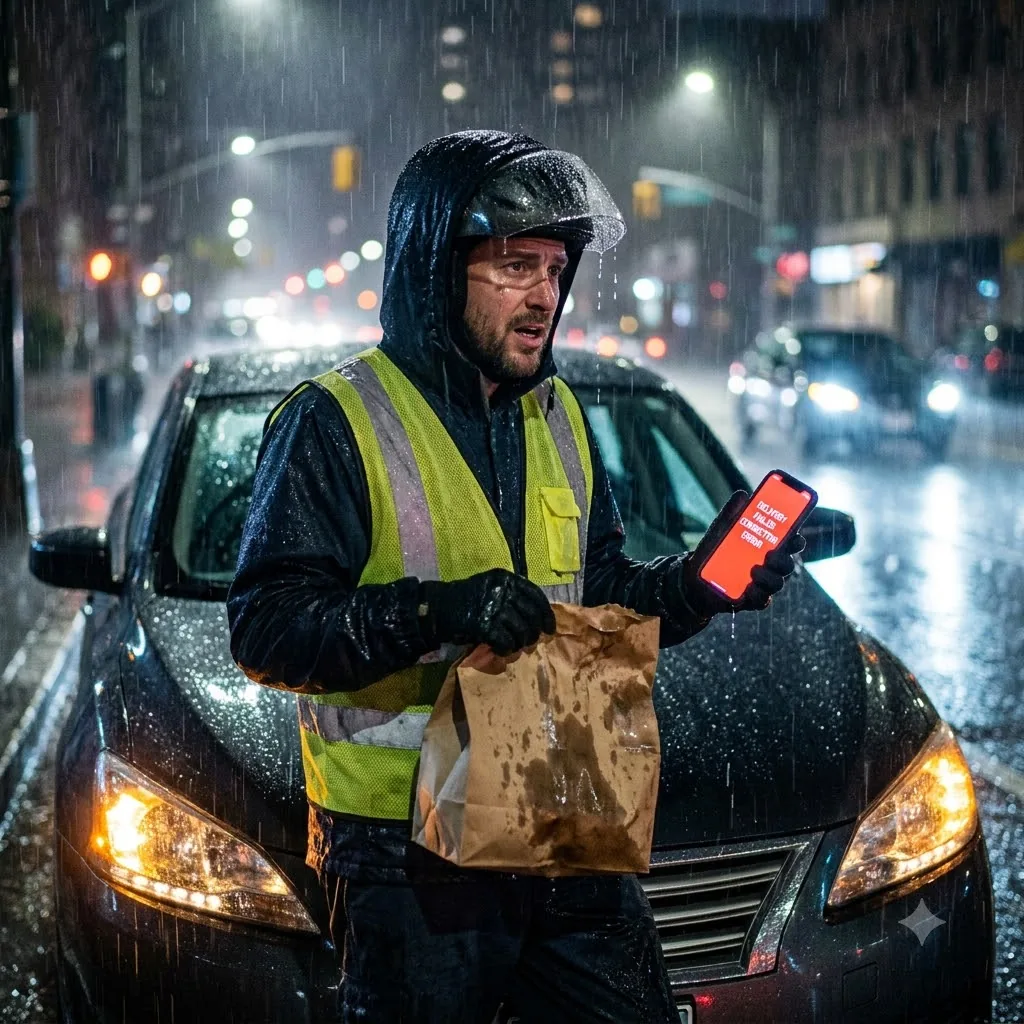
Kevin stands perfectly still, letting the rain batter the shoulders of his jacket. The silence stretching over the line is heavy, broken only by the distant, chaotic hum of the offshore call center. He presses the phone tighter against his ear, his fingers numb and slick with rainwater.
“Priya,” Kevin says, keeping his voice dangerously even. “Read the screen.”
Another shaky breath rattles the tiny phone speaker. “I cannot, sir,” Priya whispers. Her standard customer-service cadence is completely gone, replaced by genuine, unscripted panic. “The system… the system is flashing red. I am locked out of your account interface.”
Kevin shifts the heavy, damp paper bag of expensive sushi against his chest. The bottom is beginning to feel perilously soft. “What do you mean you’re locked out? You just said you were looking at the internal escalation matrix.”
“I am looking at an active security trigger,” she breathes, her voice dropping so low Kevin strains to hear her over the rushing storm drains. “It is Algorithmic Policy 8-Delta. The Predictive Impersonation Protocol.”
Kevin frowns, wiping a stream of cold water from his eyelid. “Impersonation? It’s me. I’ve done four thousand deliveries on this account.”
“The algorithm does not review delivery history,” Priya says, speaking quickly, as if racing a clock. “Policy 8-Delta flagged your selfie failure as a deliberate biometric spoofing attempt. The AI analyzed the shadows, the blur, and the lighting variance. It determined you are utilizing an algorithmic masking technique to bypass facial recognition. The system has officially classified you as an unauthorized user renting a stolen account.”
“That’s insane,” Kevin barks, his voice echoing off the brick walls of the empty street. “It’s raining. The camera lens was wet. Look at the photo!”
“I cannot look at anything, Kevin,” she says, her voice trembling. “Once an 8-Delta code triggers, my terminal freezes. There is a countdown banner on my screen right now. If I do not disconnect this call and report you to the fraud department, the Quality Assurance AI will flag me for a compliance violation. I will lose my job.”
Kevin realizes the automated corporate wall is utterly impenetrable from the bottom. The AI has completely stripped away his identity, turning him into a digital ghost, and now it is threatening the only human who can see him. He looks down the flooded street, shivering as the cold begins to seep through his saturated clothes. He cannot lose this job. Not today.
“Priya,” Kevin says, lowering his voice. “I am standing in a thunderstorm with eighty dollars of raw fish. I am not a hacker. I need to get through this wall. How do I bypass the offshore queue and reach a local dispatcher?”
“You cannot. The system erased your routing privileges.”
“There has to be a backdoor,” Kevin insists, gripping the phone until his knuckles turn white. “Tell me how to reach a Tier Two supervisor in the local dispatch office. Right now.”
“I have to disconnect, sir,” she whimpers.
“If you hang up, I’ll call back,” Kevin threatens, feeling a sudden surge of desperate adrenaline. “I will keep calling. I will clog your queue and report your employee ID for failing to assist a driver in a storm. Tell me how to bypass the AI wall.”
A sharp, digital chime echoes through the phone-an automated warning on Priya’s end.
“Dial back,” she whispers in a frantic rush. “Press nine during the language selection. Enter override PIN zero-four-five-one.”
“What does that do?”
“It is the driver-in-danger hotline,” she breathes. “It forces a direct, unmediated line to the regional safety desk. They have physical override power. Do not tell them I gave you the code.”
The line clicks dead. The automated voice returns, cheerily informing Kevin that his representative has disconnected.
Kevin lowers the phone. As he does, the damp paper bag finally gives way. The bottom rips open, and a plastic container of edamame slips through the gap, splashing directly into the flooded gutter at his feet. He curses, frantically clutching the remaining plastic containers of sushi against his ribs, trapping the wet phone between his cheek and collarbone.
He redials the driver support number. The robotic voice begins to list the language options. Kevin immediately presses nine.
The system pauses. A synthetic prompt asks for the four-digit emergency authorization. He punches zero, four, five, one with a trembling thumb.
The tinny piano hold music vanishes. A single, harsh ring sounds, immediately followed by a crisp, authoritative American voice.
“Tier Two Safety Desk. Are you injured, or is your vehicle compromised?”
Kevin exhales a cloud of white mist into the freezing rain. “Neither. My name is Kevin. I’m a driver, and I need an immediate biometric override.”
The heavy silence on the line is vastly different from Priya’s terrified hesitation. This silence is cold, analytical, and distinctly hostile.
“You utilized a Code Red panic line for a suspended account?” the dispatcher asks, his voice dropping an octave into pure corporate ice.
“I am trapped behind a Policy 8-Delta error,” Kevin says quickly, talking over the rain. “The AI failed my selfie because of the storm and flagged me for impersonation. I need you to manually ping my phone camera or look at the feed. You have the physical override power to clear the 8-Delta. I am standing on Elm Street with a destroyed bag of sushi, and I just want to finish my job.”
The rapid clacking of a mechanical keyboard echoes through the line. The dispatcher does not sound sympathetic. “How did you obtain a Tier Two driver-assault hotline PIN?”
“That doesn’t matter,” Kevin says, shifting the remaining sushi containers under his arm. “Look at my camera feed. Verify my face.”
“I am not verifying anything,” the dispatcher snaps. “Policy 8-Delta is an automated fraud lock. The algorithm has legally classified your device as compromised and currently in the possession of an unauthorized identity thief.”
“I am not a thief! It’s me!”
“By abusing the assault hotline from a flagged device,” the dispatcher continues, raising his voice over Kevin’s protests, “the system has automatically upgraded this incident from a digital hold to a physical security breach.”
Kevin freezes, the icy rainwater dripping down his neck suddenly feeling like a dead weight. “What?”
“We are required by corporate policy to secure the compromised hardware,” the dispatcher states flatly. “I have locked your phone’s GPS coordinates. Local authorities have already been dispatched to your exact location on Elm Street to recover the stolen device and detain the impersonator. Remain exactly where you are.”
Kevin stares down the dark, flooded street. Through the relentless hammering of the rain, he can hear the faint, rising wail of police sirens approaching from the west.