Story code: ST-000997
Part 2: The Weight of the Standstill
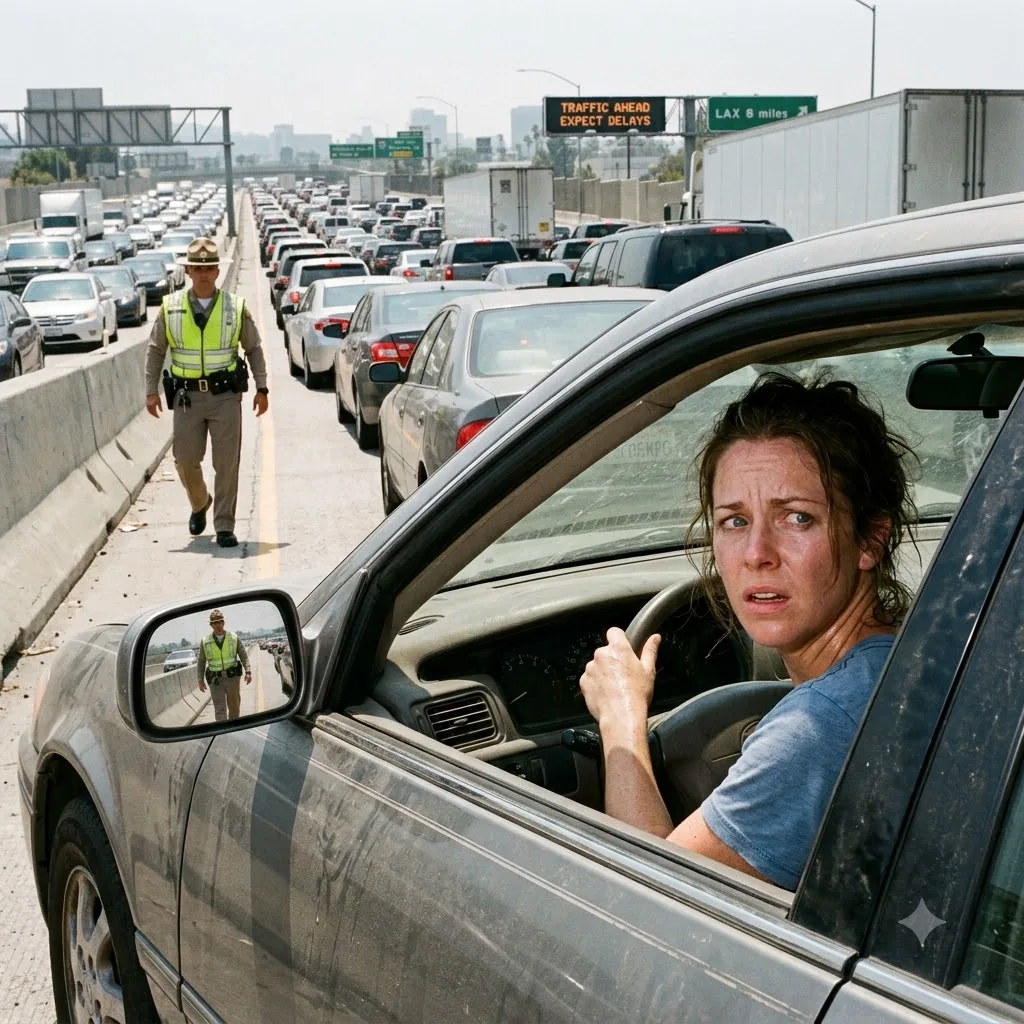
The sharp rap on the glass echoed in Maria’s skull, vibrating through her teeth. She stared at the mirrored sunglasses of the state trooper, her breath hitching as another wave of fiery pressure rolled through her lower abdomen. She fumbled for the window switch, her fingers slick with cold sweat. The glass slid down, admitting a blast of highway air that smelled of melting tar, scorched rubber, and exhaust.
“Engine off, ma’am,” the trooper said. His voice was a flat, authoritative drawl that left no room for negotiation or delay. “Step out of the vehicle.”
Maria blinked, her vision swimming with dark, erratic spots. “I… I’m just waiting for the traffic to clear. My AC is broken.”
The trooper leaned down, bracing a thick forearm against the baking roof of her sedan. His gaze swept over the cramped, messy interior, lingering on her white-knuckled grip on the parking brake and the sweat soaking through her faded warehouse t-shirt. “I said engine off. You’re burning gas going nowhere, and frankly, you look like you’re about to pass out behind the wheel. I need to see your license and insurance. Now.”
“I’m fine,” Maria lied, her voice a thin, unconvincing rasp. She couldn’t afford an ambulance. She definitely couldn’t afford a hospital visit, not with the termination text from Gary still burning into her retinas from the cup holder. No job meant no health insurance, effective immediately. If this man pulled her out and saw how bad it was, they would call the paramedics. The debt would bury her. She reached for the ignition, twisting the key. The engine sputtered and died, plunging the cabin into an eerie silence, broken only by the distant chanting and the chaotic hum of the gridlock. The immediate loss of the blowing air vents, however weak they had been, was suffocating. The Texas sun beat down on the metal roof, instantly transforming the small sedan into a suffocating oven. Sweat dripped from Maria’s hairline, stinging her eyes.
She reached into her purse on the passenger seat, every twist of her torso sending a jagged spike of agony through her pelvis. It felt like tearing, deep and structural. She gasped, biting down on her tongue so hard she tasted copper, and retrieved her wallet. Her hands shook violently as she handed over her driver’s license.
The trooper snatched the plastic card, his frown deepening beneath the mirrored lenses. “Are you under the influence of any narcotics, ma’am? You’re sweating through your clothes and you can barely hold your hands steady.”
“No,” Maria gasped, forcing her eyes wide to appear alert. “It’s just a stomach bug. And the heat. Please, I just need to sit here until the road opens.”
“Sit tight,” he commanded, stepping back from the door but keeping his heavy body angled toward her as he keyed his shoulder mic. He was running her plates, assessing her as a potential threat or a liability.
Maria slumped back against the headrest, closing her eyes as the pain peaked and then, mercifully, receded into a dull, agonizing throb. She turned her head toward the blockade. Up ahead, the situation was deteriorating rapidly. More troopers had arrived, carrying plastic jugs of chemical solvent to dissolve the industrial glue binding the protesters to the asphalt. The protesters were locking arms, bracing for the inevitable arrests.
The young man with the megaphone was only four car lengths away now. He had stopped chanting. His megaphone hung loosely at his side, and he was craning his neck, looking past the line of enraged drivers directly at Maria’s car. From this distance, without the glare of the sun on her windshield, she knew he could see her clearly. She could see him. The righteous, detached defiance that had masked his face just ten minutes ago was cracking. He watched the trooper hovering near Maria’s bumper, then watched Maria clutching her stomach, her face pressed against the glass, stripped of all color and drenched in sweat.
A heavy, suffocating realization seemed to settle over the activist’s shoulders as he watched her suffer. He tugged uselessly at his glued hand, a sudden frantic energy in his movements that tore the skin around his knuckles. He shouted something toward the trooper, but the words were lost in the wail of another approaching siren and the angry honking of a semi-truck in the next lane. He was trapped just as surely as she was, bound to the road by his own convictions, forced to witness the collateral damage of his blockade unfold in the stifling heat.
Maria squeezed her eyes shut. A sudden, terrifying rush of warmth spread beneath her, soaking into the fabric of her worn driver’s seat. Panic, cold and absolute, eclipsed the physical torment. It wasn’t just a cramp. Something was fundamentally wrong, failing inside her, and the evidence was now seeping into the upholstery. The faint, metallic scent of blood cut through the stale air of the cabin, a terrifying confirmation of her worst fears. She pressed her thighs together, her breathing turning into rapid, shallow pants. She couldn’t hide it. If she stood up, the trooper would see the stain. The whole highway would see.
The heavy tread of boots signaled the trooper’s return to her window. He didn’t hand her license back.
“Alright, Ms. Torres,” he said, his tone shifting from suspicious to rigidly procedural. “I’m calling EMS. You’re exhibiting signs of severe medical distress or intoxication, and I’m not clearing you to operate a motor vehicle on this interstate.”
“No!” Maria lunged toward the window, the sudden movement causing her to cry out in genuine, unrestrained agony. “No ambulance. Please. I don’t have insurance. I just lost my job. I can drive, I swear, I just need a minute to rest.”
“Ma’am, unlock the door,” the trooper ordered, his hand dropping from his duty belt to the heavy handle of her car door. He pulled, but the lock held. “Unlock this door right now, or I will break the window. You are a danger to yourself.”
Up ahead, the activist yelled again, his voice cracking, entirely devoid of its earlier political polish. “Hey! Hey, she needs help! Let her through! We’ll move!” But his hand remained fused to the pavement, pinning him to the asphalt.
The trooper ignored him, drawing a heavy metal baton from his belt and tapping it sharply against Maria’s glass. “Last warning, Ms. Torres. Open the door.”
Maria looked at the steel baton, then down at the dark, horrifying stain spreading across her lap, her mind racing for an escape from a cage that was rapidly closing in on all sides.