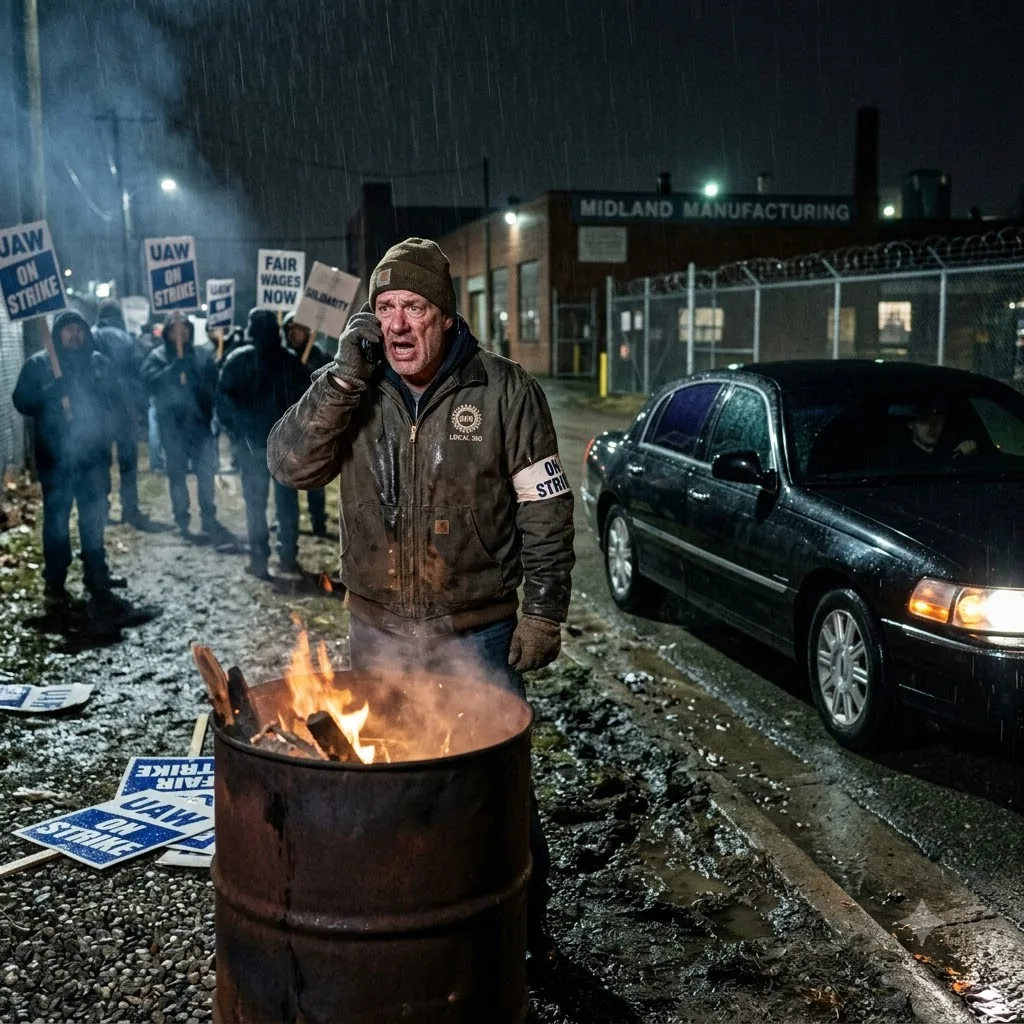
Story code: ST-001123
Part 3: The Thursday Clause
The wind howled through the chain-link fence, biting into Frank’s cheeks like a swarm of wasps, but he barely felt the sting. He stood frozen in the alleyway, staring at the idling black SUV. The tinted windows reflected the harsh, pulsing blue lights of the police cruisers massing on the main avenue.
He looked back over his shoulder toward the loading docks. The rhythmic chanting of the union men echoed off the brick factory walls, a desperate, defiant sound rising above the wail of sirens. He could see Jimmy’s massive silhouette standing on top of a rusted pallet jack, passing out heavy steel chains to the shivering workers. Those men were preparing to bleed. They were bracing to have their heads split open by riot batons because they trusted Frank. Because Frank had looked them in the eye and promised that if they held the line, the corporate liquidators would break.
Frank thought of his wife’s face, pale and exhausted against the hospital pillows. He thought of the sterile, flat voice of the billing representative reciting the astronomical out-of-pocket costs of a hospice bed. *Eighty thousand dollars.*
His stomach violently twisted. He had no choice. A man could only carry so much weight before his knees gave out entirely.
Frank turned his back on the loading docks. He stepped up to the SUV and rapped his bruised knuckles against the rear passenger glass.
The locks disengaged with a heavy, expensive thunk. Frank pulled the door open and climbed inside.
The heat in the cabin was a physical force, suffocating and thick, entirely masking the scent of tear gas with the rich aroma of cedar cologne and fresh espresso. Marcus Vance sat in the front passenger seat, staring straight ahead through the windshield. Sitting in the back, directly next to Frank, was a second man. He was younger, wearing a tailored charcoal suit with a silk tie perfectly knotted at his throat. An open leather briefcase rested on the seat between them.
“Frank,” Vance said, his voice smooth and detached, echoing off the plush leather interior. “This is Julian. He oversees risk mitigation and benefits for the holding company.”
Julian did not offer a handshake. His eyes flicked briefly to the soot and dried blood stained on the canvas sleeve of Frank’s coat, then returned to the glowing screen of his tablet. “We have a very narrow window, Frank,” Julian said, his voice a flawless imitation of the flat, mechanical tone Frank had just listened to on the phone. “The tactical unit breaches the secondary barricade in eight minutes.”
Julian reached into the briefcase. He withdrew a thick, perfectly bound manila folder and slid it across the pristine leather seat until it touched Frank’s frozen thigh. He placed a heavy silver Montblanc pen deliberately on top of it.
“This is a strike cessation and medical exemption agreement,” Julian explained, tapping the cover of the folder with a manicured fingernail. “It is fully funded and pre-approved by the board. The language restores your wife’s specific platinum-tier oncology coverage, effective the moment you sign the bottom line. You will then step out of this vehicle, pick up your megaphone, and order the picket line to disperse. Once the docks are clear of your men, the wire transfer for Monday’s chemotherapy session clears automatically.”
Frank stared at the folder. His fingers were stiff and completely numb, throbbing with the ghost-aches of thirty years on the assembly line. He pulled off his right glove with his teeth and picked up the heavy pen. It felt slick and foreign in his calloused grip.
He flipped open the heavy cardstock cover.
The interior pages were printed on thick, watermarked legal paper. Frank scanned the dense blocks of text. The bureaucracy was weaponized into neat, bulleted lists. He saw his wife’s full legal name. He saw her patient identification number. He saw the exact, highly classified name of the experimental chemotherapy suite Dr. Evans had prescribed.
Frank swallowed hard, the suffocating heat of the SUV making him dizzy. He lowered the pen toward the signature line on the final page.
As the silver tip hovered millimeters from the paper, Frank’s eyes caught a block of text at the bottom margin of the page. It was a standardized bureaucratic footer, listing the reference codes for the insurance adjustment.
*Rejection Code Voided: 884-J.*
Frank stopped breathing. He stared at the alphanumeric string. *884-J.* It was the exact rejection code the billing representative from Memorial Hospital had read to him over the phone just twenty minutes ago.
Frank’s eyes tracked slightly to the right, landing on the document’s version control stamp.
*Drafted: Thursday, 14:00 EST.*
*Final Revision: Thursday, 16:30 EST.*
Frank blinked, his mind struggling to process the crisp black ink through the lingering sting of the tear gas. He knew factories. He knew logistics. He knew the speed of assembly. You did not produce a fully bound, sixty-page legal contract on heavy watermarked paper in the front seat of a car at midnight.
Julian checked his platinum wristwatch. “We need your signature, Frank. The riot squad is moving.”
Frank slowly lowered the pen. He kept his eyes locked on the footer of the document. “My wife’s oncologist filed the final medical appeal on Thursday morning,” Frank said, his voice barely a rasp. “The hospital billing department called me twenty minutes ago to tell me the claim was denied.”
“The gears of medical bureaucracy are slow,” Julian replied instantly, his tone perfectly calibrated to convey practiced sympathy. “Which is why this exemption is so vital. Sign the paper.”
Frank slid his thumb over the bound spine of the folder. It was secured with heavy industrial staples and a glued vinyl backing.
“You’ve been sitting in this idling car at the edge of the shipping yard for at least two hours,” Frank said, the dizziness fading, replaced by a sudden, terrifying clarity. “There is no printer in this vehicle.”
Julian froze. His manicured hand stopped halfway in its reach to tap the page again.
Frank looked at the date stamp. “This contract was finalized on Thursday afternoon. You had this entire agreement printed, bound, and sitting in your briefcase two days before the hospital even processed the denial.”
In the front seat, Marcus Vance’s posture suddenly stiffened. The quiet hum of the SUV’s heater seemed to vanish entirely.
Frank turned his head slowly, looking directly into Julian’s perfectly neutral, heavily calculated eyes. He saw the cold, mechanical reality hiding just behind the man’s irises.
“You are the parent company that underwrites the secondary insurance tier,” Frank whispered, the horrifying truth clicking into place with the heavy finality of a steel vault locking. “You didn’t capitalize on a random medical denial tonight. You didn’t intercept it.”
Frank held up the bound contract, his battered hands no longer shaking.
“You ordered it.”